Bag Packaging for Export: Carton Sizes, Loads and Labels
An export carton has to survive the voyage, be identifiable after five handling points, and carry the marks the destination requires. Size, board grade, units per carton, closure, marking and labelling are six decisions, and each one prevents a specific failure. MOQ 500 pcs per style.
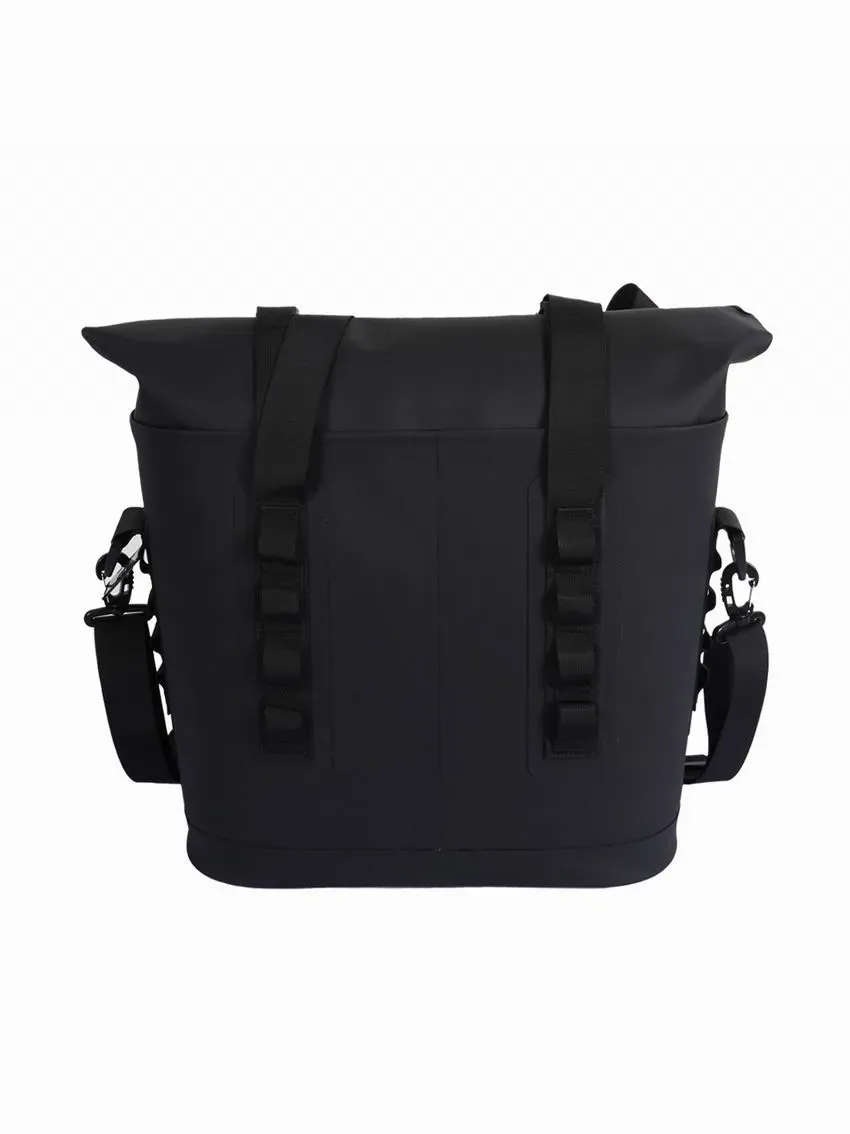
Six decisions make an export carton specification: the external dimensions, the board grade and construction, the units per carton, the internal protection, the marks and numbering, and the label content required by the destination. The standard carton on this programme is 60 x 40 x 40 cm, which is 0.096 cubic metres and stacks 9 x 5 x 5 in a 20-foot container. Get the six right and the container, the handling and the entry all go more smoothly.
What Has an Export Carton to Survive?
An export carton survives four things, in increasing order of difficulty. It survives stacking: a full container puts several tonnes on the bottom layer for weeks. It survives handling: clamp trucks, conveyor belts, chutes and manual handling at five or six points. It survives the environment: humidity in a container at sea, condensation, and the temperature swing between a Fujian afternoon and a northern European winter. And it survives time: a carton may sit in a consolidation warehouse for a week before it is loaded.
The second failure is humidity, and it is the one that produces a claim nobody can argue with because the damage is visible on every unit in the carton. Textile products packed at a relative humidity that is normal in Fujian in summer will stain or mildew in a container that crosses a cold climate. The countermeasure is drying before packing, a polybag, and a desiccant quantity calculated for the route and the season.
Most carton specifications are written for the first of those and fail on the second or the third. Board grade chosen for stacking compression does nothing about a conveyor chute, and no board grade survives a fortnight of condensation if the bag inside was packed damp. The specification has to be written against the whole journey rather than against the stack.
Which Carton Sizes Are Standard on This Programme?
The default is 60 x 40 x 40 cm, and it is a default for a reason: at 0.096 cubic metres it tiles a Series 1 container well, it is a size that two people can handle, and it is small enough that a single damaged carton is a small loss. ISO 3394 covers the dimensions of rigid rectangular packages and is the reference for the modular approach.
Variations are driven by the product. A long camera bag may need a 70 x 40 x 35 cm carton, a flat-packed drawstring bag may be better in a shallower 60 x 40 x 25 cm carton because the cargo is flat. The rule is to change the carton to fit the product only when the change improves the stacking arithmetic, and to test the new size before adopting it.
| Carton size | Volume | Used for | Stacking note |
|---|---|---|---|
| 60 x 40 x 40 cm | 0.096 cubic metres | The default for most soft bags | 9 x 5 x 5 in a 20-foot container |
| 60 x 40 x 25 cm | 0.060 cubic metres | Flat-packed drawstring bags | Higher carton count, lower units per carton |
| 70 x 40 x 35 cm | 0.098 cubic metres | Long camera and equipment bags | Check the length orientation carefully |
| 50 x 40 x 40 cm | 0.080 cubic metres | Small neoprene and wine sleeves | More cartons, more handling per unit |
| 60 x 40 x 60 cm | 0.144 cubic metres | Bulky team kit bags | Heavy when full; check manual handling limits |
How Do You Choose Board Grade and Construction?
Board grade is specified by two numbers that matter and one that does not. The flute profile — single wall, double wall, and the flute height — determines stacking strength and cushioning. The board grammage and the paper quality determine how it behaves in humidity. The burst strength figure that appears on many specifications is less useful than either, because a carton almost never fails by bursting.
One more construction detail is worth specifying explicitly: how the carton is closed at the top and bottom. A closure tape applied over a dusty or oily surface lifts, and a closure that is taped but not also strapped on a heavy carton opens at the seam under a clamp truck. Specify the surface preparation and the strapping as well as the tape.
Construction matters as much as grade. The closure — tape, glue or strapping — is where cartons open, and a closure that is adequate for a full container may be inadequate for a consolidation. Edge protection, corner posts and internal dividers each add cost and each prevent a specific failure. Specify the closure by method and width, not by brand.
What Goes Inside the Carton?
Three things: the polybag, the dunnage and the desiccant. The polybag protects against abrasion and against the humidity migration that causes mildew on textile products, and it is the least expensive single item in the whole specification relative to what it prevents. Where the destination or the buyer requires it, the polybag specification has to meet the restricted-substance requirements of the market.
There is a fourth item that belongs in the carton and is frequently argued about: the documentation. Whether a packing slip goes inside each carton, on the outside, or not at all depends on the destination. A retail distribution centre may require one inside; a fulfilment centre usually requires one outside in a pouch and none inside. Decide it in writing, because a carton opened at the destination to find out what it contains is a carton that has to be repacked.
Dunnage fills the void so the cartons in a stack do not collapse into each other, and its absence is the most common cause of crushed bottom layers. Desiccant is specified by the journey rather than by the cargo: a container crossing the equator and arriving in a cold climate generates condensation, and a carton of textile products is exactly what that condensation damages.
How Are Cartons Marked and Numbered?
Marks go on at least two adjacent faces, in a size that is legible after handling, and they carry the consignee, the destination, the carton number in the sequence and the gross and net weights. The carton numbering is the part with a system behind it: number sequentially from one, state the total on every carton as "1 of 214", and make the packing list match the numbering exactly.
The reason for the discipline is the entry. A carton count that does not match between the packing list, the invoice and the bill of lading is a query at the border, and a shortage discovered at destination cannot be located without a working numbering system. ISO 2206 covers the marking of complete filled transport packages and is the reference for the layout.
What Do the Handling Pictograms Mean?
ISO 780 defines the pictorial markings for the handling of goods, and the ones that matter on bag cargo are the umbrella for keep dry, the stack limit expressed as a number of layers, the upward arrows for this way up, and the fragile marking where the contents require it. They are not decoration: a stack limit that nobody printed is a stack limit nobody follows.
Two cautions. A pictogram is an instruction about handling and not a substitute for a carton strong enough to be handled badly — mark the carton and specify the board, do not choose between them. And a "keep dry" mark on a carton that will sit on an open quay in the monsoon is optimism rather than protection.
| Marking | What it instructs | When to use it | What it does not do |
|---|---|---|---|
| Keep dry | Store under cover | Every textile consignment | Does not waterproof the carton |
| Stack limit, n layers | Do not stack more than n high | Every carton, with the number filled in | Does not survive being ignored |
| This way up | Keep the carton upright | When contents are orientation-sensitive | Does not keep it upright |
| Fragile | Handle with care | Rarely appropriate for soft bags | Does not add strength |
| Centre of gravity | Where to lift | Heavy or awkward cartons | Does not reduce the weight |

What Goes on a Carton Label for a Fulfilment Centre?
The label stock deserves one clause of its own. A label printed on a face stock that cannot survive abrasion is a label that cannot be scanned at destination, and a carton that cannot be scanned at a fulfilment centre is a carton that has to be opened, identified and re-labelled by hand. Specify the label stock and the print method, not just the content.
A fulfilment centre has requirements that are stricter than a normal commercial address and they change, so the operator published specification is the authority. Three items are constant: a scannable label on a stated face with a stated orientation, a carton identifier that matches the advance shipment notice, and a weight and dimension declaration that matches what arrives.
The failure mode is a mismatch. A carton that arrives without a scannable label, or with a label on the wrong face, is a carton that cannot be booked in, and the cost is not the labelling — it is the appointment, the delay and the re-handling. Where the destination is a fulfilment centre, treat the label as part of the product specification rather than as part of the shipping.
How Is the Packing List Built?
From the cartons actually loaded, in carton number order, with the units per carton, the net and gross weight per carton and the dimensions. It should not be built from the order quantity, because the order quantity and the loaded quantity differ by the packing loss and by any short shipment, and the entry is filed against the loaded figure.
The fourth item is the one that produces disagreement at destination: whether the carton weight is declared per carton or as an average. Declare per carton. An average weight is fine for the total and useless for a shortage claim, because a claim is about specific cartons and an average cannot identify which ones were short.
The check that catches most errors is arithmetic: carton count times carton volume should equal the stated total volume, and carton count times units per carton should equal the stated total units. Where either does not reconcile, the packing list is wrong and the entry will be queried. That check takes two minutes and it is the least expensive quality control in the whole process.
Six clauses for a carton specification
- External dimensions in centimetres, with the resulting volume stated.
- Board construction: flute profile, wall, and the paper specification.
- Closure: method, width and how the seams are sealed.
- Internal protection: polybag specification, dunnage, desiccant quantity.
- Marking: faces, content, sequential numbering, and the ISO 780 pictograms used.
- Packing list discipline: built from the loaded cartons and reconciled arithmetically.
How Do You Test a Carton Specification?
Two frameworks are used. The ISTA test procedures give packaged-product performance tests that simulate the distribution environment, and ASTM D4169 gives a practice for performance testing of shipping containers and systems with a set of hazard elements to choose from. Both are performance tests rather than material tests, which is the point: they test the packed carton, not the board.
For a programme that does not want a full test programme, there is a simpler discipline that catches most failures: ship one carton on the actual route before the bulk shipment, then open it at destination and look at it. Corner crush, tape lift, condensation staining and label abrasion all show up on a single test carton, and the cost of the exercise is one carton and one delivery.
What Are the Most Common Packing Failures?
Five failures account for most of the damage claims on bag cargo. Crushed bottom corners from inadequate board or missing dunnage. Opened seams from a closure specified by brand rather than by method. Condensation staining from packing damp goods or omitting desiccant. Abraded or illegible labels from a label stock that cannot survive handling. And a carton count that does not reconcile across the documents.
The sixth failure is administrative and it costs more than the other five combined: a carton specification that was agreed verbally and never written down, so the second order ships in a different carton from the first and the packing plan no longer fits the container. Write the specification down, put it on the enquiry, and check the first carton of every order against it.
Each has an inexpensive countermeasure and each countermeasure costs less than the claim. The evidence discipline that makes a claim recoverable when it does happen is set out in How to handle damaged bag shipments, and the inspection that catches packing defects before the container is sealed runs at AQL 2.5 under ISO 2859-1.
Treat the carton specification as a controlled document rather than a drawing. Once a size, board grade, closure and dunnage arrangement has been tested and approved, record it against the style code and require it on every repeat order, because a silent change to any one of those four is invisible in the unit price and visible in the damage rate. A specification that is written down can also be re-quoted: if a thicker board raises the carton cost and lowers the claim rate, the trade-off is arithmetic rather than opinion.
Freight bands and transit windows in this cluster are planning ranges drawn from quoted lots, not published tariff rates. They move with bunker cost, vessel rotation, port congestion and the week you book; ask for a live quotation against your sailing before you commit the order to a calendar.
Ask for a carton specification with the quotation
Send us the style and the quantity and we will quote with the carton dimensions, board construction, units per carton, marking and label content all specified in writing.
Frequently Asked Questions
What is the standard export carton for bags?
60 x 40 x 40 cm, which is 0.096 cubic metres and stacks 9 x 5 x 5 in a 20-foot container. Other sizes are used where the product requires it.
How many bags go in one export carton?
It depends on the family: 30-40 for flat-packed drawstring bags, 20-25 for neoprene, 8-12 for insulated cooler bags, 12-16 for wine bags, 10-14 for team kit and 6-8 for camera bags.
Why does the carton need a polybag inside?
It protects against abrasion and against humidity migration, which is what causes mildew on textile products. It is the least expensive item in the specification relative to what it prevents.
What are the ISO 780 pictograms for?
They are handling instructions — keep dry, stack limit, this way up. They instruct handlers; they do not add strength to the carton.
How many faces should the shipping marks be on?
At least two adjacent faces, in a size legible after handling, so the carton can be identified whenever it is stacked.
Why is the packing list not the same as the order quantity?
Because it is built from the cartons actually loaded, and the loaded count differs from the order count by the packing loss and any short shipment.
What is the simplest way to test a carton specification?
Ship one carton on the actual route before the bulk shipment and open it at destination. Corner crush, tape lift, condensation and label abrasion all show up on one carton.
What is the difference between ISTA and ASTM D4169?
Both are performance tests on the packed carton rather than material tests on the board. ISTA simulates a distribution environment; ASTM D4169 lets you choose hazard elements.
Does a fulfilment centre need different labelling?
Yes. A scannable label on a stated face, a carton identifier matching the advance notice, and a weight and dimension declaration that matches what arrives. Treat it as part of the product specification.
How much desiccant does a container need?
It is specified by the journey rather than by the cargo: a container crossing the equator and arriving in a cold climate generates condensation. Ask for a quantity calculated for the route.
Can I change the carton size to fit more bags?
Only if the stacking arithmetic improves. Test the new size: a carton that holds more but tiles badly can reduce the total count.
Who checks the packing before the container is sealed?
Inspection at AQL 2.5 under ISO 2859-1 covers packing as well as product, and the carton count and marking are part of what it checks.
People Also Ask
What is the standard export carton size for bags?
60 x 40 x 40 cm, or 0.096 cubic metres, chosen because it stacks 9 x 5 x 5 in a 20-foot container.
How many bags fit in one carton?
By family: 30-40 flat-packed drawstring bags, 20-25 neoprene, 8-12 insulated cooler bags, 12-16 wine bags, 10-14 team kit, 6-8 camera bags with dividers.
What are ISO 780 pictograms?
Handling markings — keep dry, stack limit, this way up. They instruct handlers and do not add strength to the carton.
Why should marks be on two faces?
So the carton stays identifiable however it is stacked, including after several handling points.
How do I test a carton specification without a full trial run?
Ship one carton on the real route before the bulk shipment, then open it at destination and inspect it.
Sources and further reading
Every figure on this page is either our own programme data or attributed below. Open the originals before you write them into a specification.
- ISTA test procedures — packaged-product performance testingInternational Safe Transit Association
- ISO 780 — Packaging: pictorial marking for the handling of goodsInternational Organization for Standardization
- ISO 2859-1:1999 — Sampling procedures for inspection by attributesInternational Organization for Standardization