Custom Hockey Team Bags: Wet Gear Storage and Ventilation
Hockey kit arrives wet. Shin guards, socks and gloves go into the bag damp every single session, and a bag that only contains that damp instead of venting it will smell within a fortnight. Ventilation is the specification, not the pocket.
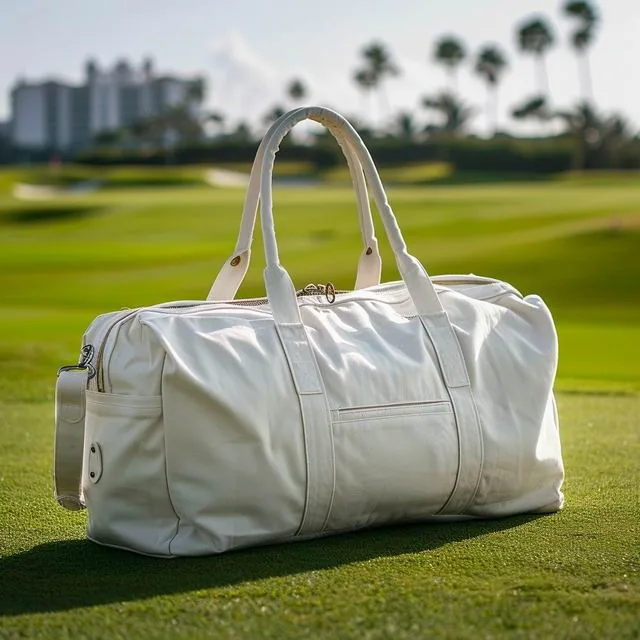
Two questions decide a hockey bag: how much damp kit goes in, and where the air goes. Answer the first with a separated wet zone large enough for shin guards and socks, and the second with a stated vent area at both ends of that zone. Everything else follows.
Why Is Hockey the Hardest Wet-Gear Problem in the Cluster?
Most sports generate one damp item. Hockey generates four: shin guards, socks, gloves and often a base layer, all of them damp at the same time, and two of them — the guards and the gloves — are semi-rigid and do not pack flat. A bag that handles a damp football shirt will not handle a hockey kit.
The second problem is frequency. Hockey is played on a surface that is wet by design in some formats and damp by climate in most others, so the kit is damp at nearly every session rather than occasionally. A ventilation arrangement that copes with an occasional wet item will not cope with a weekly one.
| Item | Damp every session | Rigid | Consequence for the bag |
|---|---|---|---|
| Shin guards | Yes | Semi-rigid | A long, ventilated pocket |
| Socks | Yes | No | With the guards, not with the dry kit |
| Gloves | Yes | Semi-rigid | Ventilated, not sealed |
| Base layer | Often | No | With the guards and socks |
| Stick | No | Rigid | External carry — it is 900 mm long |
| Dry kit and valuables | No | No | A genuinely dry zone, separated |
What Is the Difference Between a Wet Pocket and a Ventilated One?
A wet pocket contains damp. A ventilated pocket dries it. The difference is air, and air needs a path: an inlet low, an outlet high, and a route between them that is not blocked when the bag is closed and standing upright. A single grommet in the base of a sealed compartment is drainage, not ventilation — it removes liquid water and it does nothing for damp.
This is the single most common specification error in the category. Clubs ask for a wet pocket, receive a lined compartment with no air path, and report in November that the bag smells. The pocket was never the requirement; the air path was.
How Much Vent Area Does a Hockey Bag Need?
It is worth stating as a number rather than as a description, because "ventilated" is not a specification. A workable convention for a hockey wet zone is a vent area of at least two per cent of the compartment's surface, split between at least two positions at opposite ends of the compartment so that air can actually cross it.
| Vent arrangement | Air path | Dries damp kit | What it misses |
|---|---|---|---|
| Mesh panel, one side | Partial | Slowly | No cross-flow, so the far end stays damp |
| Mesh panel plus a drain grommet | Partial | Moderately | Drainage is not ventilation |
| Mesh at both ends of the zone | Yes | Yes | Nothing — this is the specification |
| Grommets at both ends | Weak | Slowly | Too little area to move enough air |
| Sealed compartment, no vents | None | No | Everything |
Where Should the Wet Zone Sit?
At the end of the bag, opening externally, with the dry zone at the other end. That arrangement does two things: it keeps damp away from the dry kit by distance as well as by a barrier, and it lets a player open the wet zone without exposing everything else to a cold touchline.
The position of the vents matters as much as their area. Vents at the bottom of a bag that stands upright are blocked by the ground; vents at the top are blocked by whatever is stacked on it. The workable arrangement is vents on the two vertical faces of the wet zone, protected by a binding so they do not snag.
Does the Stick Go Inside or Outside?
Outside, almost always. A field hockey stick is about 900 mm long, it is rigid, and it is wet at the handle end. Inside a bag it occupies the longest dimension and wets whatever it lies against; outside, on a pair of straps or in a shaped sleeve, it costs almost nothing and keeps the interior dry.
- External stick straps or a shaped sleeve on the side of the bag.
- A stick sleeve dimensioned to the stick length plus a margin, not to the bag.
- The sleeve positioned so the bag still stands upright with the stick in it.
- A drain at the bottom of the sleeve, because the handle end arrives wet.
- Nothing stored in the main compartment that depends on the stick being absent.
How Does Ice Hockey Change the Requirement?
Ice hockey generates a bigger wet problem and a bigger volume problem. The equipment is bulkier, it is damp with melted ice rather than rain, and the skates have blades that cut. That last point decides the specification: skate blades need their own compartment with a lining that will not be cut, and they need to be separated from everything soft.
The ventilation requirement is the same and the volume requirement is larger. An ice hockey bag tends to be a wheeled bag with a large ventilated main volume and a separate skate compartment, rather than a bag with a wet pocket at one end. The air path principle is identical — two vent positions, air crossing the load.
What Lining Suits a Wet Zone?
The lining has to do three things: resist water, survive being wiped, and stay attached to the shell it is laminated to. A coated woven lining does the first two and the coating adhesion is the thing to test, because a lining that delaminates in a wet compartment fails faster than one that simply absorbs water.
| Lining option | Water resistance | Wipeable | Coating adhesion risk | Best for |
|---|---|---|---|---|
| Coated woven polyester | High | Yes | Moderate — test it | A wet zone that drains |
| Laminated mesh | Moderate | Yes | Low | Vent panels and boot pockets |
| Unlined woven | Low | No | None | Nothing in this category |
| Coated nylon | High | Yes | Low | A wet zone in a cold climate |
| Neoprene panel | High | Yes | Low | Small wet zones and sleeve mouths |
How Does Colour Hold on a Bag That Lives Wet?
Damp and sunlight are the two exposures that move a club colour, and a hockey bag sees both. Light fastness is the standard answer and AATCC 16 is the method, but the result has to be reported at a stated exposure or the grade means nothing. A club should name the exposure on the tech pack.
The second exposure is laundering, because a hockey bag gets hosed out rather than wiped. A laundering result and a rubbing result are worth requesting alongside the light fastness grade, since a colour that shifts under a hose is a colour complaint reported as a cleaning complaint. The method is set out in Reorder colour consistency.
What Should the Tech Pack Say About Ventilation?
Three fields, and they are the ones that make the difference between a bag that dries and a bag that smells: the vent area, the vent positions and the barrier between the wet and dry zones. None of them is a feature name, and all three are measurable at inspection.
Tech pack fields for a hockey wet zone
- Vent area: a stated proportion of the compartment surface, not the word "ventilated".
- Vent positions: at least two, at opposite ends, on vertical faces, bound.
- Wet zone: internal dimensions, lining type and whether it drains.
- Barrier: what separates the wet zone from the dry zone, and of what.
- Stick carry: external straps or sleeve, dimensioned to the stick.
- Colour references for shell, lining, webbing, tape and thread.
How Is the Sample Judged?
With damp kit in it, and then left closed overnight. That is the whole test. Put wet shin guards, socks and gloves in the wet zone, close the bag, leave it in a cool room for twelve hours and open it. If the guards are still wet in the morning, the ventilation is not working and no amount of description on the tech pack will fix it.
The second check is the dry zone. After the same overnight test, the dry kit at the other end should be dry. If it is damp, the barrier is not doing its job, which is a different failure from a ventilation one and needs a different clause.
The third check is the stick. With the stick in its external carry, the bag should still stand upright and it should still close. A bag that falls over with the stick in it will be left lying down, and a bag left lying down has its vents against the ground — which defeats the ventilation that everything else in the specification was designed to deliver.
How Does the Season Calendar Drive the Order?
Hockey seasons differ by market — a winter season in some, a summer one on grass in others — but the production pressure is the same either way, because the kit is needed before the first fixture and the club decides late. Working backwards: bulk is 35-50 days from written sample approval and sampling is 6-10 working days from a signed-off tech pack.
A ventilation specification adds nothing to the calendar, which is worth saying because clubs assume it does. The vents are a pattern decision made before sampling, and the sampling window already accounts for them. What does add time is specifying ventilation after the first sample, which turns one sampling round into two. The calendar is set out in Why 35 to 50 days.
What Does the Inspection Criteria Need to Include?
Six checks: vent area and positions, wet zone dimensions, lining type, barrier presence, colour against the approved coupon set, and crest position measured from a seam. Classified as major defects, they are enforceable at the Ac/Re decision under AQL 2.5 and ISO 2859-1.
The vent check is the one that needs writing carefully, because "ventilated" is not measurable and "two mesh panels of at least 90 x 60 mm on opposite vertical faces" is. Write the second one. The arithmetic behind the decision is set out in AQL 1.5 versus 2.5.
What Does a Hockey Programme Cost to Run?
Ventilation costs nothing in unit terms — it is a pattern and trim decision, not a material one. The costs that matter are the usual four: quantity, colourway count, personalisation count and silhouette count. A hockey club that consolidates to one silhouette and one colourway will spend materially less per unit than one running three.
The saving worth naming is the reorder. Holding the reference, the coupon set, the dye-lot record and the shade band makes the second season a comparison, and it is what makes 300 pcs available on a repeat against the standard MOQ 500 pcs.
What Goes Into the Enquiry?
Six fields, and a hockey enquiry is complete. The vent specification is the one clubs leave out, and it is the one the whole bag depends on.
- How many items arrive damp, and what they are.
- Vent area and positions, stated as a requirement rather than as a preference.
- Whether the stick is carried externally, and its length.
- Whether the bag is for field hockey or ice hockey, because the volumes differ.
- Colour references for shell, lining, webbing, tape and thread.
- Quantity split and the date the kit has to be at the ground.
What Fails First on a Hockey Bag?
The wet zone lining, the vent binding and the strap root. The lining delaminates under constant damp; the vent binding lifts because it is the edge that gets grabbed; the strap root takes a bag that is always carried loaded because it always contains damp kit.
All three are one clause each: a coating adhesion result to ISO 2411, a bound rather than turned vent edge, and a reinforcement patch with a stitch type named to ASTM D6193. None of them adds weight, and all three are the difference between a bag that lasts a season and one that lasts five.
How Does a Hockey Club Handle Shared and Goalkeeping Kit?
Goalkeeping kit is in a category of its own. It is bulkier than a player's kit, it is heavier, and the pads are semi-rigid and damp at the same time. Putting it in a player bag is how player bags fail, and clubs that do it usually lose two or three bags a season to split seams.
The answer is one shared bag for the goalkeeping kit, wheeled, with the largest ventilated volume in the programme. It is unpersonalised beyond a crest and a role print, it is ordered in the same production slot, and it removes the single most destructive load a player bag is ever asked to carry.
What Does the Club Do About Drying Between Sessions?
A club with two sessions a week has a drying problem that no bag can solve on its own. Kit that goes into a bag on Tuesday and comes out on Thursday without being aired will smell regardless of how good the ventilation is, because the bag is a closed container for thirty-six hours.
The practical answer is a drying space rather than a better bag — a rack, a ventilated cupboard or simply a hook in a room with air movement. Clubs that have one report fewer smell complaints than clubs that bought a more expensive bag, which is worth saying plainly before a club spends money on the wrong thing.
How Is the Programme Kept Stable Across Seasons?
With the four artefacts: the reference, the coupon set, the dye-lot record and the shade band. Hockey clubs have an extra reason to keep them, because the wet zone lining is a substrate that drifts visually from the shell even when both are correct — a coated lining and a woven shell in one colour never read identically, and the coupon set is what makes that acceptable rather than surprising.
Where the artefacts exist the reorder is a comparison. Where they do not, the club re-develops, and the re-development lands in the same wet-climate season that produced the original complaint.
Specify the air path, not the pocket
Tell us what arrives damp and how much vent area you need, and we come back with a specified bag and a delivery date you can calculate.
Frequently Asked Questions
What is the difference between a wet pocket and a ventilated one?
A wet pocket contains damp; a ventilated one dries it. Ventilation needs an air path — an inlet, an outlet and a route between them.
How much vent area does a hockey bag need?
A workable convention is at least two per cent of the compartment surface, split across at least two positions at opposite ends.
Where should the vents go?
On the vertical faces of the wet zone, at opposite ends, bound so they do not snag. Vents in the base are blocked by the ground.
Should the stick go inside the bag?
Outside. A stick is about 900 mm, rigid, and wet at the handle end.
Does ice hockey change the specification?
Yes. The equipment is bulkier, it is damp with melted ice, and skate blades need their own cut-resistant compartment.
What is the minimum order?
MOQ 500 pcs per style and colourway, with 300 pcs open to discussion on a repeat.
How long does sampling take?
6-10 working days from a signed-off tech pack, extending to 12-15 working days for a complex build or a new club colour.
How long is bulk production?
35-50 days from written sample approval, inspected at AQL 2.5 under ISO 2859-1.
Which standards apply?
ISO 2411 for coating adhesion on the lining, AATCC 16 for light fastness, and ASTM D6193 for stitches and seams.
How is the sample tested for ventilation?
Put damp kit in the wet zone, close the bag, leave it twelve hours and open it. If the kit is still wet, the ventilation is not working.
Does ventilation add to the lead time?
No. It is a pattern decision made before sampling. Specifying it after the first sample is what adds time.
What fails first on a hockey bag?
The wet zone lining, then the vent binding, then the strap root.
People Also Ask
What makes a hockey bag different?
Four damp items per session, two of them semi-rigid. Containment alone will not do.
What is the difference between wet and ventilated?
A wet pocket contains damp; a ventilated one dries it with an air path.
How much vent area does a hockey bag need?
About two per cent of the compartment surface, across two positions at opposite ends.
Should a hockey stick go inside the bag?
No — outside, on straps or in a shaped sleeve with a drain.
How do you test a hockey bag sample?
Damp kit in, closed overnight, open in the morning. Still wet means it failed.
Sources and further reading
Every figure on this page is either our own programme data or attributed below. Open the originals before you write them into a specification.
- FIH — hockey rules of the game and equipment guidanceInternational Hockey Federation
- ISO 811 — Resistance to water penetration (hydrostatic pressure test)International Organization for Standardization
- ASTM D6193 — Standard Practice for Stitches and SeamsASTM International