Custom Martial Arts Bags: Gi Carriers with Ventilation
A gi is heavy, bulky and arrives damp with sweat. That combination is harder on a bag than mud is: it wicks rather than drips, it holds its own weight in water, and it will smell within days if the bag has no air path across it.
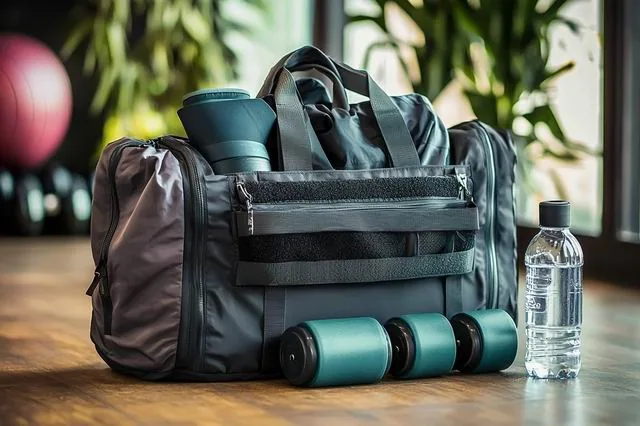
A martial arts bag is a ventilation problem carrying a heavy load. Specify an air path across the gi compartment, a stiff base board for the weight, and small pockets for the belt and the guard. The gi itself dictates the volume.
Why Is a Gi Harder to Carry Than Football Kit?
Three properties make it harder. It is dense — a gi weighs more per litre than any other item in this cluster. It holds water — a damp gi carries a substantial share of its own weight in sweat. And it wicks rather than drips, so a drain at the base of the compartment removes almost nothing.
That last point is the one clubs miss. A drained compartment works for boots and a shirt, where water runs out. It does not work for a gi, where the water is held in the weave and has to be evaporated. Evaporation needs air, and air needs a path.
| Property | Football kit | A gi | Consequence |
|---|---|---|---|
| Density | Moderate | High | The base and strap carry more |
| Water behaviour | Drips | Wicks and holds | Drainage is nearly useless |
| Drying route | Drain and air | Air, and a lot of it | Ventilation is the specification |
| Bulk | Moderate | High | The volume is set by the gi |
| Smell risk | Moderate | High | A closed compartment fails within days |
How Much Ventilation Does a Gi Compartment Need?
More than a boot pocket, and expressed as area rather than as a feature. A workable convention is mesh over at least twenty per cent of the gi compartment surface, across at least two faces, with the openings positioned so air can cross the folded gi rather than pass around it.
The second half of the requirement is what happens when the bag is closed. Vents on the outside of a bag that is stacked against a wall do nothing, and a club should think about where the bag actually sits between sessions — on a floor, on a hook, or in a locker.
| Arrangement | Air crosses the gi | Works closed | Verdict |
|---|---|---|---|
| Mesh on one face | No | Weakly | Not enough |
| Mesh on two opposite faces | Yes | Yes | The specification |
| Mesh plus a drain grommet | Partly | Yes | Better, drain adds little |
| Mesh lid panel only | No | No | Not enough — air does not reach the gi |
| Sealed compartment | No | No | Smells within days |
How Should the Gi Compartment Be Sized?
To the folded gi, which is a considerably larger object than most clubs expect. A folded adult gi is roughly 350 by 250 by 150 mm, and a club that also carries a belt, a mouthguard, a bottle and a change of clothes needs volume beyond that.
The practical rule is to measure the folded gi rather than to guess from the size, because gi weights vary — a heavyweight gi occupies noticeably more space than a lightweight one, and a club with both should specify to the heavier one.
Where Do the Belt and the Small Items Go?
In small, findable pockets rather than in a large organiser. A belt coils into a space about 150 mm across and it is the item most often left behind; a mouthguard is small, hard and easy to lose; a bottle needs a lined pocket or an external sleeve.
- Belt: a pocket of its own, around 160 x 120 mm, external wherever possible.
- Mouthguard: a small hard-sided or lined pocket, not a mesh one.
- Bottle: an external sleeve or a lined internal pocket with a sealed base.
- Phone and keys: a lined valuables pocket at the top.
- Nothing loose inside the gi compartment — that is where things get lost.
How Does the Bag Carry the Weight?
A martial arts bag is one of the heavier loads in the cluster once a damp gi is in it, and it is carried to and from a club rather than across a field. The specification answer is a stiff base board, a wide padded strap or a yoke, and corner protection.
The base board matters more here than in any other sport in the cluster, because the load is dense and concentrated. Without a board the bag sags into the gi and the load transfers into the side seams, which is where a martial arts bag fails.
Should a Martial Arts Bag Have Wheels?
Rarely. Most clubs train indoors, the walk is short, and a wheeled bag is heavier before anything goes in it. Where a club travels to competitions by train or coach, a wheeled variant may earn its place — and where it does, the wheel has to be specified as a system with axle, housing and base board together.
For the great majority of clubs, the better investment is the yoke and the board. Between them they solve the two problems a martial arts bag actually has, and they do not add the weight that wheels do.
How Does Colour Work on a Martial Arts Programme?
Martial arts clubs frequently run belt colours as a club identity, which presents a specific colour problem: the palette is small, saturated and traditional, and a club will know exactly what each colour should be. That makes the reference unusually important and the tolerance unusually tight.
The approval is the standard discipline, with one addition worth naming — the gi compartment lining. A coated, dark lining beside a saturated club colour on the shell is a visible combination, and it belongs on the coupon card as a deliberate decision. The method is set out in Reorder colour consistency.
| Substrate | Drift risk | Exposure | What to insist on |
|---|---|---|---|
| Shell fabric | Moderate | Sunlight and handling | A coupon and a lot number |
| Gi compartment lining | Low | Constant damp | A dark coated lining, ISO 2411 result |
| Embroidery thread | High | Sunlight | A coupon matched to the reference |
| Belt-pocket binding | Moderate | Abrasion from the belt | A bound rather than turned edge |
| Webbing | Moderate | Sunlight | A coupon in the same approval session |
What Should the Tech Pack Say?
Six fields, and a martial arts bag is specified. The vent area and the base board are the two clubs leave out, and they are the two the bag depends on.
Tech pack fields for a martial arts bag
- Gi compartment: internal dimensions to the folded gi, heavyweight where applicable.
- Vent: area as a proportion of the compartment surface, across at least two faces.
- Base: board thickness and material, plus corner protection.
- Carry: a yoke or a wide padded strap, with the root reinforced to ASTM D6193.
- Small pockets: belt, mouthguard and bottle, each with a stated purpose.
- Colour references for shell, lining, binding, webbing, tape and thread.
How Is the Sample Judged?
With a damp gi in it, closed overnight. That is the whole test and it is the one that matters. A heavyweight gi, damp, folded into the compartment, bag closed, twelve hours, then opened.
If the gi is still wet in the morning, the ventilation is not working and no number of mesh panels on the lid will fix it, because air has to cross the folded gi rather than pass over the top of it.
How Does the Club Calendar Drive the Order?
Martial arts clubs train year-round and their ordering peaks are usually tied to grading cycles and to a new intake, which gives more freedom in the production calendar than a winter sport has. That freedom is worth using to book a quieter slot.
Sampling runs 6-10 working days from a signed-off tech pack, extending to 12-15 working days where a mesh construction or a new club colour is involved. Bulk runs 35-50 days from written sample approval, inspected at AQL 2.5 under ISO 2859-1 and shipped FOB Xiamen on T/T 30/70. The calendar is set out in Why 35 to 50 days.
What Does the Inspection Criteria Need to Include?
Six checks: gi compartment dimensions, vent area and positions, base board presence, strap or yoke reinforcement and stitch type, lining type, and colour against the approved coupon set. Written into the major defect classification, they are enforceable at the Ac/Re decision.
The base board check is the one that predicts a return on this category, because a board is invisible from outside and its absence only shows up once the bag has sagged. The arithmetic is set out in AQL 1.5 versus 2.5.
What Does a Martial Arts Programme Cost to Run?
The four usual levers, with one category-specific point: mesh area costs money, because it is more material and more labour than a plain panel. A bag with mesh over a quarter of its surface costs more than one with a single panel, and the club should decide that deliberately.
The saving available is the reorder. Holding the reference, the coupon set, the dye-lot record and the shade band makes the next intake a comparison, and it is what makes 300 pcs available on a repeat against the standard MOQ 500 pcs.
What Goes Into the Enquiry?
Six fields, and a martial arts enquiry is complete. The gi weight is the one clubs forget, and it sets the volume.
- The gi weight the club uses — lightweight, middleweight or heavyweight — measured folded.
- Vent area and which faces it should sit on.
- Whether a yoke is wanted in place of a strap.
- What small items travel: belt, mouthguard, bottle, and whether each needs a pocket.
- Colour references for shell, lining, binding, webbing, tape and thread.
- Quantity split and the date the kit is needed.
What Fails First on a Martial Arts Bag?
The base, the vent binding and the gi compartment seam. The base fails because the load is dense and the board was not specified; the vent binding lifts because it is the edge that gets grabbed; the compartment seam opens because it carries the weight of a damp gi against a mesh panel.
All three are one clause each: a dimensioned board on the tech pack, a bound rather than turned vent edge, and a seam strength result on the assembled joint to ISO 13934-1.
Should One Bag Serve Training and Competition?
Usually not, for the same reason a swim bag and a land-training bag do not mix. Training kit is damp and bulky; competition kit is dry and needs to arrive pressed. One bag asked to do both ends up damp on the inside when it needs to be clean.
Where a club runs one bag, the compromise is a separated dry zone for the competition gi and a ventilated zone for the training one — which is a two-zone bag, and which costs more than either a pure training bag or a simple competition carrier.
How Does a Martial Arts Club Handle Sweat and Odour Long Term?
Sweat is harder on a bag than rain, because it carries salts and oils that a lining holds onto. Over a season a gi compartment that is never wiped out builds a residue that no amount of ventilation removes, and the bag smells even when it is dry.
The specification answer is a coated lining that can be wiped, plus a club instruction to wipe it. The instruction is the part that gets skipped, and it belongs on a label inside the compartment rather than in a handbook nobody reads.
How Is the Programme Kept Stable Across Seasons?
With the four artefacts: the reference, the coupon set, the dye-lot record and the shade band. Martial arts clubs are good at record-keeping by tradition, and the kit programme benefits from being filed the same way the grading records are.
Where the artefacts exist the reorder is a comparison. Where they do not, the club re-develops, and the re-development lands in the same damp-condition environment that produced the original complaint.
How Does a Club Handle Weapons and Protective Equipment?
Some disciplines carry weapons or rigid protective equipment, and both change the specification. A rigid item needs its own compartment with a barrier, because it will mark or cut anything soft it lies against, and it needs the compartment positioned so the bag still stands upright with it in place.
The practical approach is the same one a cricket club uses for a bat: a shaped external or end compartment, dimensioned to the longest item, with a bound mouth. Where several rigid items travel together, they are better in a separate carrier than in a bag that has to carry a gi as well.
How Does a Martial Arts Club Handle Grading and New Intakes?
Grading cycles produce a predictable surge in membership, and a club that orders to the current roll will be short immediately after a grading. The float is the answer, and it should be sized to the intake rather than to the roll.
The second point is that a new intake arrives with no gi and often buys a starter one that is heavier and bulkier than the club's usual. Specifying the compartment to the heavyweight gi is the clause that covers this.
What Is the Shortest Useful Advice for a Martial Arts Club?
Specify the air path before the pockets. A martial arts bag with beautiful organisation and no ventilation across the gi is a bag that smells, and a bag that smells stops being used.
The second piece of advice is to measure the folded gi. Clubs consistently under-estimate how much space it takes, and the compartment that is slightly too small is the one that gets forced and fails at the seam.
The third is to specify the base board. It is one line on a tech pack, it is invisible on a finished bag, and it is the clause that decides whether a martial arts bag lasts one season or five.
And the fourth is to ask for the fold-up test on the sample. A bag that cannot be folded and put away between sessions is a bag that lives on the floor of a club, and that is the condition in which it fails fastest.
Specify the air path across the gi
Tell us the gi weight, the vent area and the date the kit is needed, and we come back with a specified bag and a delivery date you can calculate.
Frequently Asked Questions
Why is a gi harder to carry than football kit?
It is dense, it holds a share of its own weight in water, and it wicks rather than drips — so a drain at the base removes almost nothing.
How much ventilation does a gi compartment need?
A workable convention is mesh over at least twenty per cent of the compartment surface, across at least two faces.
How big should a gi compartment be?
Dimensioned to the folded gi — roughly 350 x 250 x 150 mm for an adult heavyweight — plus volume for a belt, a mouthguard and a bottle.
Should a martial arts bag have wheels?
Rarely. Most clubs train indoors and the walk is short. A yoke and a stiff base board solve the real problems without the weight.
Why does the base board matter so much here?
The load is dense and concentrated. Without a board the bag sags into the gi and the load transfers into the side seams.
Does the gi compartment need to drain?
A drain adds little, because a gi wicks rather than drips. Ventilation is what dries it.
What is the minimum order?
MOQ 500 pcs per style and colourway, with 300 pcs open to discussion on a repeat.
How long does sampling take?
6-10 working days from a signed-off tech pack, extending to 12-15 working days where a mesh construction or a new club colour is involved.
How long is bulk production?
35-50 days from written sample approval, inspected at AQL 2.5 under ISO 2859-1.
How is the sample tested?
A damp heavyweight gi in the compartment, closed for twelve hours. Still wet in the morning means the ventilation is not working.
What fails first on a martial arts bag?
The base, then the vent binding, then the gi compartment seam.
Should one bag serve training and competition?
Usually not. Training kit is damp and bulky; competition kit needs to arrive clean.
People Also Ask
Why is a gi harder to carry than other kit?
It is dense and it wicks rather than drips, so a drain does almost nothing.
How much ventilation does a gi compartment need?
Mesh over at least twenty per cent of the surface, across two faces.
Should a martial arts bag have wheels?
Rarely — a yoke and a stiff base board solve the real problems.
How do you test a martial arts bag sample?
A damp gi inside, closed for twelve hours, opened in the morning.
What fails first on a martial arts bag?
The base, the vent binding and the gi compartment seam.
Sources and further reading
Every figure on this page is either our own programme data or attributed below. Open the originals before you write them into a specification.
- ASTM D6193 — Standard Practice for Stitches and SeamsASTM International
- ISO 12947 — Textiles: abrasion resistance by the Martindale methodInternational Organization for Standardization
- AATCC 16 — Colorfastness to LightAmerican Association of Textile Chemists and Colorists