Food Contact Compliance for Insulated Lunch Bags
Food contact is a property of a material layer rather than of a bag. An insulated lunch bag has a liner, a foam, an outer cloth and a print, and the obligation attaches to the layer intended to touch food. This page sets out how to scope that, what each jurisdiction asks for, and how to word the declaration.
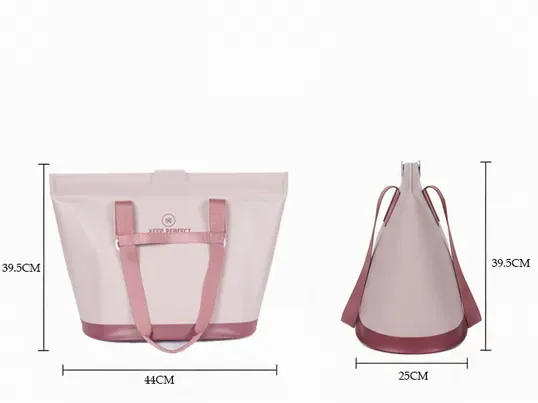
For an insulated lunch bag, food contact attaches to the layer intended to touch food, which in practice is the welded liner. The European Union framework regulation sets the general principle and specific measures apply per material group, including plastic. In the United States the relevant food contact provisions sit in the federal regulations. Evidence is a declaration per layer plus migration testing on the plastic one. Limits, lists and thresholds change when a regulation is amended. Confirm every figure against the current official text before you rely on it, and ask your importer of record to confirm the version that applies in the destination market. MOQ 500 pcs, bulk 35-50 days.
What Makes a Lunch Bag a Food-Contact Article?
Intention. A material becomes a food-contact material when it is intended to be brought into contact with food, or is already in contact with food and was intended for that purpose. An insulated lunch bag is plainly intended to carry food, so the layer that food actually rests on is in scope. The outer cloth, the shoulder strap and the packaging generally are not, because they were not intended for that purpose.
That intention test is why the answer is layer by layer rather than product by product. It is also why the same bag can be in scope for one layer and out of scope for five others, and why a single food-safe statement covering an assembly is not the structure the regulation uses. The evidence has to follow the layers.
What Does the European Union Framework Regulation Require?
The framework regulation sets the general principle for all food-contact materials: they must be manufactured so that, under normal or foreseeable conditions of use, they do not transfer constituents to food in quantities that could endanger human health, or bring about an unacceptable change in the composition of the food, or cause a deterioration in its organoleptic characteristics. It also sets traceability, labelling and documentation duties.
The general principle is deliberately broad, which is why the specific measures matter. Where a material group has its own measure — plastic has one — that measure sets out the substances permitted, the migration limits and the testing conditions. Confirm with your importer which measure applies to the polymer in your liner, because the answer determines what the migration test has to cover.
| Layer | Intended to touch food? | What applies | Evidence to hold |
|---|---|---|---|
| Welded inner liner | Yes | Framework regulation plus the measure for its material group | Declaration of compliance plus migration testing |
| Insulation foam | No — behind the liner | Framework regulation where a claim is made | Declaration from the foam maker |
| Outer shell cloth | No | General article rules | Chemical screening as for any article |
| Zipper tape and slider | Can be, where it is exposed inside | Depends on the design | Declaration, and migration where it is in the food zone |
| Print on the outer face | No | General article rules | Declaration plus screening against the brand list |
| Packaging polybag | No | Packaging rules | Declaration from the film maker |
What Does the Plastics Measure Add?
The measure for plastic food-contact materials sets out a list of substances permitted for use, migration limits, and the conditions under which migration is tested — including the simulants used, the temperatures and the contact times. It also sets the requirements for a declaration of compliance and the documentation that has to support it. Confirm the current text, and confirm with your importer which simulants and conditions apply to your intended use.
The conditions are the part buyers underestimate. Migration is tested under conditions that reflect the intended use — what the food is, how hot it is, and how long it stays in contact. A lunch bag intended for a cold sandwich and a bag intended for hot food are tested differently, and the conditions on the report have to match the use you actually claim. State the intended use at specification so the laboratory can set the conditions correctly.
Simulants, temperatures and contact times follow the use. A cold-use claim and a hot-use claim produce different test conditions and different reports.
What Is the Position in the United States?
Food-contact substances are regulated under the federal framework, with the relevant provisions and listings set out in the Code of Federal Regulations. The structure is different from the European one: rather than a single framework regulation plus material measures, the system works through listings of substances permitted for particular uses, with conditions attached, alongside a general safety requirement. Confirm the current position for your polymer with your importer or a specialist.
The practical advice for a programme selling into both markets is conservative and simple: build the European file first, because it is the more structured of the two, and then ask a specialist in the destination market to confirm which listings your materials rely on. Where a material is permitted in one jurisdiction and not the other, that is a specification decision rather than a documentation one, and it costs far less to make before the liner is booked.

What Is a Declaration of Compliance?
A written statement, normally issued by the material maker or the supplier placing the material on the market, confirming that the material meets the requirements that apply to it. It should identify the material, the measure it is declared against, the intended conditions of use, any restrictions, and the substances subject to a limit that were verified. It is the document that travels down the chain.
The declaration is only as good as the testing behind it. A declaration that names no measure, states no conditions of use and refers to no test should be treated as a marketing sentence rather than a compliance document. Ask for the migration report that supports it, and check that the report describes the same material and the same conditions.
Seven fields on a usable declaration of compliance
- Material identified, including polymer and construction.
- The measure or instrument it is declared against, with its version.
- Intended conditions of use: food types, temperature, contact time.
- Any restrictions or specifications attached to the use.
- Substances subject to a limit that were verified.
- The supporting migration report, referenced.
- The issuer, with a name, a role and a date.
How Is Migration Testing Scoped?
By material, by simulant and by conditions. The laboratory needs to know the polymer, the food types the bag is intended for, the maximum temperature and the longest contact time. Those four inputs determine which simulants are used and how long the test runs. Giving the laboratory the intended use in writing is the single most useful thing a buyer can do at this stage.
Two scopes are worth separating. Overall migration measures the total amount of substances that transfer, and it is the general check. Specific migration measures individual substances that are subject to a limit, and it is the check that catches a problem with a particular additive or monomer. Both appear in a properly built file, and they answer different questions.
| Test | What it measures | Why it is run | What a failure means |
|---|---|---|---|
| Overall migration | Total transfer into a simulant | The general check that the material is inert enough | The material is not suitable as specified |
| Specific migration | Transfer of individual substances with a limit | The check on additives, monomers and residues | A specific substance exceeds its limit |
| Screening for non-listed substances | Presence of substances outside the permitted list | The check that nothing unlisted is being used | The material relies on a substance that is not permitted |
| Organoleptic assessment | Change in the taste or odour of the food | The check the general principle also requires | The material taints the food |
| Traceability records | Identification of the material through the chain | The documentation duty in the framework | The chain cannot be demonstrated |
Which Parts of the Bag Need Testing and Which Need a Declaration?
Test the layer in the food zone; declare the rest. That is the rule of thumb, and it keeps the file proportionate. The welded liner is tested. The foam, the shell, the print and the packaging carry declarations from their makers. Where a component sits inside the food zone but is not the primary contact surface — an exposed zipper tape inside the compartment, for instance — it moves from declaration to testing.
The design decision that changes the scope is whether anything other than the liner is exposed to food. A liner that fully encloses the contents keeps the scope narrow. A design where food can touch a seam, a tape or a trim widens it. Settling that at the drawing stage costs less than discovering it when the test is scoped.
What Should the File Contain?
A per-layer list with each layer marked in or out of the food zone; a declaration of compliance for every layer; migration reports for the layers in the food zone, with the conditions stated; a traceability record linking the material to the lot; and a note of the intended use the testing was scoped against. Those five items answer every question a reviewer may ask.
Keep it per style. A liner used across several styles can share a report provided the material, the construction and the intended use are the same, and provided the file says which styles rely on which report. That single cross-reference is what lets one test cover a range rather than being repeated.
How Do You Handle a Welded Seam in the Food Zone?
A welded liner is only as good as its seams, and the seam is the place where a food-contact layer most often stops being continuous. Where a seam is heat-welded with no adhesive, the assessment is about whether the weld produces a continuous barrier and whether the weld conditions introduced anything that migrates. Where an adhesive is used, the adhesive becomes a material in the food zone with its own declaration.
The design decision, therefore, is whether to weld or to sew and seal. Welding keeps the material set small and the declaration simple. Sewing introduces thread and, where the seam must be liquid tight, a tape or a sealant, both of which need documentation. Neither is wrong, but the welded route produces a smaller file and fewer places for it to go wrong.
Where a seam tape or sealant is used, ask the maker for a declaration covering its intended use and the conditions it was assessed under, and check that those conditions match your own. A tape declared for ambient use on a product intended for hot food is a mismatch that will be found at review rather than at design.
What Should the Specification Say?
Name the liner material, the intended use and the evidence. A specification that names the polymer and the construction of the liner, states the food types and the maximum temperature it is intended for, requires a declaration of compliance per layer and migration reports for the food zone, and makes the balance payment conditional on them, produces the right file.
Add the intended-use sentence prominently and the change-control sentence after it. The first determines the test conditions and is the field most often left blank; the second requires notice before the liner material, the seam construction or the adhesive changes, with re-testing when it does. Together they keep the file true across reorders.
How Does This Fit the Rest of the Compliance Work?
Alongside it. An insulated lunch bag is also an article, so the chemicals regulation applies to all of its layers. Where it is sold in California the listing and warning question applies. Where it is marketed to children the children's product or toy question applies. Food contact is one more answer in the file rather than the whole file.
The efficient way to run it is one screening exercise scoped against the union of what every regime asks, plus the migration test which only the food-contact regime needs. That avoids two laboratories working on the same material, and it leaves each file able to answer its own question.
Sequence it as well. Declarations can be collected at material booking; migration testing runs on the liner and can be commissioned inside the 35-50 day window. Nothing in the food-contact file needs to delay a shipment if the intended use was stated at specification and the liner was booked against a material that already carries a declaration.
Where the liner has no existing declaration, the sequencing changes and the calendar has to absorb it. Ask at quotation whether the liner material already carries one for the intended use, because that single question decides whether the file is a collection exercise or a testing exercise, and the two have very different timelines.
Record the answer per style in the product file, with the material name, the polymer, the intended conditions and the report reference. A lunch bag range built on one liner across several styles needs one file with a cross-reference; a range with three liners needs three. Knowing which case applies is what keeps the work proportionate rather than repetitive.
What About the Layers That Are Not Meant to Touch Food?
The obligation attaches to the layer intended to touch food, and on a lined lunch bag that is the liner. The layers behind it are not automatically outside the question. A print applied to the inside face of the liner, an adhesive bead in a welded seam that sits within the food space, and a foam that can be reached through a seam gap are all capable of contributing, and a reviewer will ask about them. The practical rule is to declare every layer that sits inside the food space, not only the one that was designed for contact.
Then the testing follows the declaration. Where the liner is the only layer in the food space, one migration result on that liner supports the file. Where an adhesive or an internal print sits inside it, the file needs a statement that those inputs are suitable for the intended contact conditions, which are a temperature and a duration rather than a list of foods. Write the conditions into the specification with the liner, because a liner declared for cold contact does not answer hot-filled use.
Get the food zone marked before the liner is booked
Send the construction, the liner material and the intended use, and our production team will tell you which layers are in the food zone, what the declarations have to say, and how the migration test should be scoped. MOQ 500 pcs, sampling 6-10 working days, bulk 35-50 days from sample approval, FOB Xiamen.
Frequently Asked Questions
Is a whole insulated lunch bag a food-contact material?
No. The obligation attaches per material layer, based on which layer is intended to touch food. On a lunch bag that is normally the welded liner.
What does the EU framework regulation require?
That materials do not transfer constituents to food in quantities that could endanger health, change its composition unacceptably, or degrade its organoleptic characteristics, plus traceability and documentation duties.
What does the plastics measure add?
A list of permitted substances, migration limits, and the testing conditions including simulants, temperatures and contact times. Confirm the current text for your polymer.
What is the US position?
Food contact substances are regulated under the federal framework with relevant provisions and listings in the Code of Federal Regulations. Confirm the current position for your polymer with a specialist.
What are the intended conditions of use and why do they matter?
The food types, the maximum temperature and the longest contact time. They determine the simulants and the test conditions, so they have to be stated before the test is scoped.
What is the difference between overall and specific migration?
Overall migration measures total transfer into a simulant; specific migration measures individual substances that have a limit. Both belong in a properly built file.
What is a declaration of compliance?
A written statement from the material maker or supplier confirming the material meets the requirements that apply, identifying the measure, the conditions of use and any restrictions.
Which layers need testing and which need only a declaration?
Test the layers in the food zone; declare the rest. An exposed component inside the food zone moves from declaration to testing.
Can one liner report cover several styles?
Yes, where the material, construction and intended use are the same, and where the file records which styles rely on which report.
What should the specification state?
The liner polymer and construction, the intended conditions of use, the declarations required per layer, the migration reports for the food zone, and a change-control trigger.
Does food-contact compliance replace other requirements?
No. The bag is also an article under chemicals law, and other regimes apply depending on market and audience.
When should the work be sequenced?
Declarations at material booking, migration testing on the liner inside the production window, and nothing after the goods are packed if the intended use was stated at specification.
Does the foam or the outer cloth need food-contact evidence?
Only where it can be reached from the food space. Declare every layer inside the space, and the testing follows the declaration.
People Also Ask
What is food contact compliance for a lunch bag?
Evidence that each material layer intended to touch food meets the requirements that apply to it, per layer rather than per bag.
Which layer is in scope?
The one intended to touch food, normally the welded liner. The shell, foam and print carry declarations instead.
What is EU 1935/2004?
The framework regulation setting the general principle for food-contact materials, plus traceability and documentation duties.
What is a declaration of compliance?
A written statement from the material maker confirming the material meets the applicable requirements, naming the measure and the conditions of use.
What are intended conditions of use?
The food types, maximum temperature and longest contact time, which determine the migration test conditions.
Sources and further reading
Every figure on this page is either our own programme data or attributed below. Open the originals before you write them into a specification.
- Regulation (EC) No 1935/2004 — framework for food-contact materialsEUR-Lex
- Regulation (EU) No 10/2011 — plastic food-contact materialsEUR-Lex
- Food contact substances — inventory and 21 CFR partsU.S. Food and Drug Administration