How to Build a Bag BOM: Fabrics, Components and Trims
Build a bag BOM in four passes rather than one: fabric and lining first, then structure, then hardware, then trims and packing. Each pass has its own unit of measure and its own allowance driver, and mixing them up is how a BOM ends up unpriced.
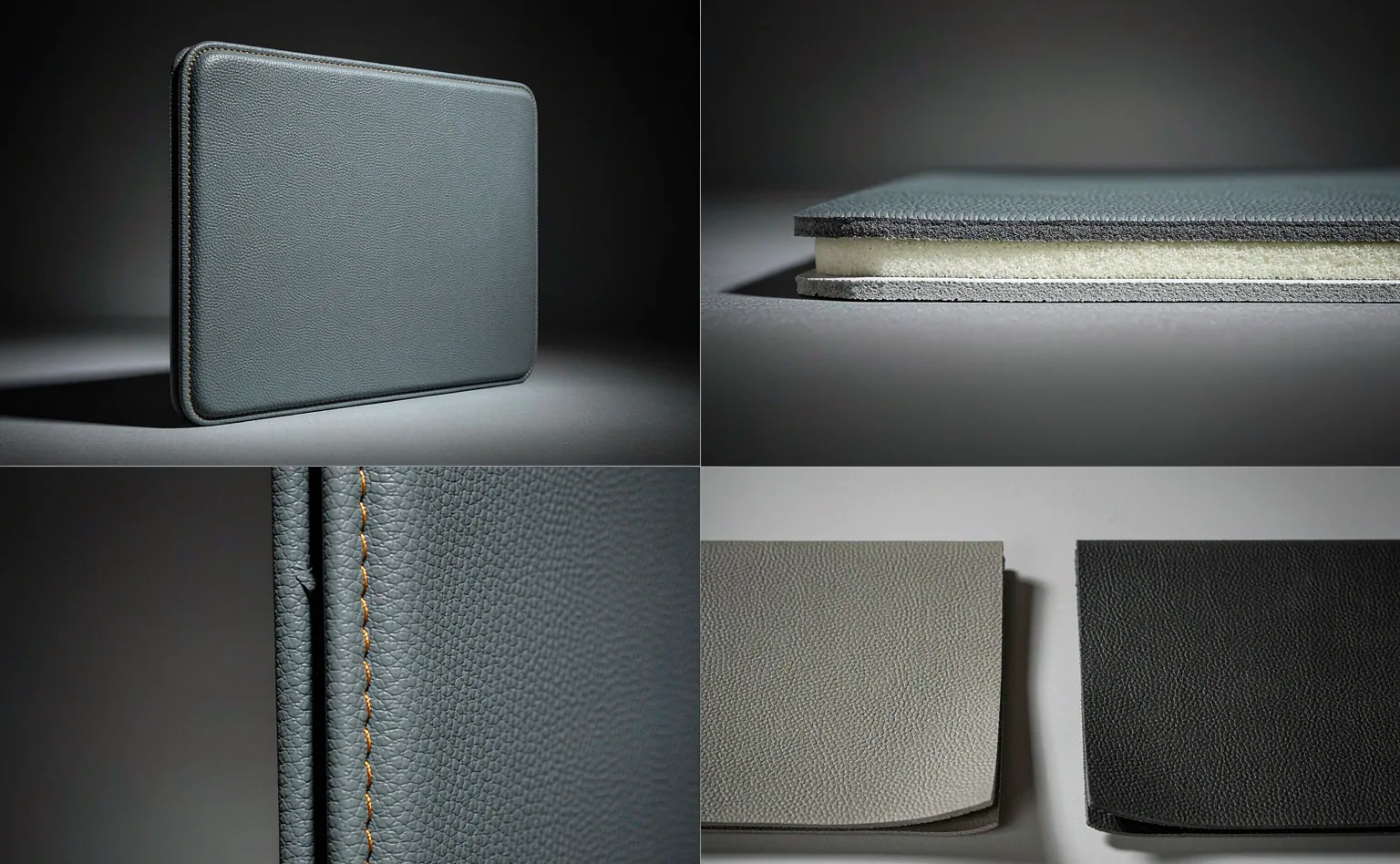
Build the BOM in four passes. Pass one is fabric and lining, in linear metres at a stated width, with a marker allowance. Pass two is structure: foam and interlining, in square metres, with a die-layout allowance. Pass three is hardware, counted in pieces with a defect allowance. Pass four is trims, thread and packing. On a 500 pcs order the four passes together decide the material commitment.
The reason for working in passes is that each class of item is bought in a different unit from a different kind of supplier and arrives on a different clock. Fabric comes in rolls by the metre from a mill. Foam comes in sheets or die-cut parts from a converter. Hardware comes in pack quantities from a component supplier. Writing them in one list makes the BOM hard to action and easy to get wrong.
There is also a sequencing argument. Fabric is usually the longest lead item and the largest cost line, so it gets resolved first, and the answers it produces — the width, the yield, the shade — constrain the passes that follow.
How Do You Build Pass One: Fabric and Lining?
Start from the panel list on the pack, not from the bag. Every panel has a cut size; the sum of the panel areas, divided by the marker efficiency and the fabric width, gives the linear metres per bag. Then add the cutting allowance and the defect allowance and multiply by the order quantity.
State the width explicitly. A consumption figure without a width is meaningless, because the same bag cut from 150 cm material and from 110 cm material uses different lengths. Where the marker has not been made yet, state the assumed efficiency and revise the line when it has.
How Do You Build Pass Two: Foam and Interlining?
As an area, with the sheet size stated. Foam is cut from sheet or die-cut to a profile, and the yield depends on how the profiles nest. State the area per bag, the sheet size, and the number of parts per sheet, rather than a single thickness figure that nobody can buy against.
Where the foam is laminated to the shell or the lining, the line changes character: it becomes a converted material bought by the metre rather than a sheet bought by the area. Say which it is, because the supplier, the lead time and the allowance are all different.
| Pass | Item class | Unit of measure | How the quantity comes out | Allowance driver |
|---|---|---|---|---|
| 1 | Shell and lining fabric | Linear metres at a stated width | Panel areas divided by marker efficiency and width | Marker loss plus a defect rate |
| 1 | Coated or laminated shell | Linear metres | As above, plus the conversion yield | Conversion loss on top of marker loss |
| 2 | Foam sheet | Square metres | Profile area per bag, nested on a stated sheet size | Die-layout yield |
| 2 | Die-cut foam parts | Pieces | One per position on the bag | Defect and loss rate |
| 2 | Interlining and stiffener | Linear metres or square metres | From the panel it is fused to | Marker loss on the same marker |
| 3 | Hardware | Pieces | One per position on the pack callout list | Defect and loss rate |
| 4 | Thread | Metres per bag | Stitch count multiplied by seam length | Included in the consumption figure |
| 4 | Webbing, binding, cord | Linear metres | Cut length plus turn-back per position | Cut-length loss |
| 4 | Print, transfer, label | Pieces | One per position | Application spoilage |
| 4 | Polybag and carton | Pieces | One per bag, and one carton per count | Handling loss |
How Do You Build Pass Three: Hardware?
Straight from the callout list. Every balloon on the drawing that points at a buckle, a ring, a slider, a snap, an eyelet or a stud becomes a row with a count per bag. Then multiply by the order quantity and add the defect allowance.
The two extra columns that matter on hardware are the pack quantity and the finish. Hardware is sold in pack quantities — a hundred, five hundred, a thousand — and an order for 1,040 pieces buys 1,500. And a plated finish carries a longer lead time than a moulded colour, which is the difference between a component that fits the bulk window and one that does not.
Four checks before the hardware pass is finished
- Every drawing callout has a BOM row, and every BOM row has a callout.
- Every row carries a pull or cycle figure copied from the pack.
- Every row states the pack quantity it is sold in, not just the count needed.
- Every plated finish is flagged for lead time against the bulk window.
How Do You Build Pass Four: Trims and Packing?
Trims are webbing, binding, cord, elastic, hook-and-loop, labels, print and transfers. Each is a cut length or a piece count, and each needs the turn-back included: a webbing handle is not 180 mm of webbing, it is 180 mm plus what is folded under at each anchor.
Packing is the pass most often left off the BOM entirely, and it is a real material cost. Polybags, cartons, tape, desiccant where the destination needs it, and the insert or hangtag where the programme has one. State the polybag gauge and whether it is perforated, because both are purchasing decisions with a cost attached.
Labels and printed matter belong in this pass as well, and they are the items most often forgotten until packing week. The care label, the fibre content label, the country-of-origin marking, the tracking label where the product is a children's product, and any barcode or hangtag each have a supplier, a minimum run and a lead time of their own.
Where a label carries a compliance claim, the certificate reference goes on the same line. A recycled-content claim needs a GRS transaction certificate number, and a restricted-substance claim needs the REACH statement reference, and neither can be produced at short notice once the goods are packed.
How Do You Handle a Component With No Second Source?
Flag it on the BOM as single-source and give it a lead-time buffer. A component bought from one supplier in one place is a single point of failure for the whole run, and the failure does not have to be dramatic: a mill running two weeks late on a single-source shell moves the entire bulk window.
Where a single-source component is also long-lead, the buffer has to be in the order plan rather than in the window. Ordering it earlier than the rest of the BOM costs storage and working capital, and it is still usually the right call against a 35-50 day bulk commitment that has already been promised to a customer.
How Do You Put Prices and Lead Times on the Lines?
Prices go on as a unit price with a break level and a currency, and lead times as working days from order to delivery at the production site. Both should be dated, because both move. A BOM with undated prices is a snapshot that will be quoted as if it were current several months later.
The lead-time column is the one that decides the order plan. Work out the longest line and count backwards from the date bulk is due to start. On a 35-50 day bulk window, a component with a four-week lead time has to be ordered before the sample is approved, which is a decision the buyer should make knowingly rather than discover.
| Item | Typical order trigger | What decides it | Consequence of ordering late |
|---|---|---|---|
| Dyed-to-match shell | Before sample approval | Dye-lot lead time and a shade approval step | Bulk starts late by the whole dye-lot window |
| Stock shell in a stock colour | After sample approval | Mill stock position | A shortfall mid-run |
| Tooled metal hardware | Before sample approval | Tooling time on top of production | A component that cannot be made in time |
| Stock moulded hardware | After sample approval | Supplier stock position | A substitution to a similar part |
| Printed labels and transfers | After artwork approval | Plate or film time | A bag with no branding |
| Cartons | Shortly before packing | Board and print lead time | A finished run with nothing to pack it in |
How Do You Handle a Component That Is Bought in Two Places?
As two lines with a split stated, not as one line with two suppliers. A programme that buys a stock buckle from one source and a branded puller from another has two different lead times, two different minimums and two different substitution rules, and collapsing them into one row hides all three.
Where a genuine second source exists for the same part, that is different: it is one line with an approved-substitute column naming the second source and the person who approves its use. The distinction is between a split buy, which is two commitments, and a fallback, which is one commitment with a contingency.
How Does the BOM Handle Colourways and Size Runs?
By multiplying rather than by adding rows. One BOM covering all colourways, with a column per colourway giving the quantity of that component in that colour, is easier to check than a separate BOM per colourway and far easier to change. Where a colourway uses a different material entirely, it becomes a separate style with its own BOM.
Size runs work the same way: one BOM, with the quantity per size taken from the grading sheet. The trap is personalisation, which is not a size issue and does not scale with the grading. A run of 500 pieces across three sizes and forty names is forty personalisation units, and that line has to be counted separately from the piece count.
| BOM dimension | How it is handled | What changes | Common error |
|---|---|---|---|
| Colourway | One BOM, one column per colourway | The component colour reference | Writing a separate BOM per colourway and letting them drift |
| Size run | One BOM, quantities from the grading sheet | Consumption per size | Applying one consumption figure across every size |
| Personalisation | A separate line counted in units, not pieces | The name and number data | Counting personalisation against the piece count |
| Market variant | A separate BOM where the compliance differs | Labels, documents and sometimes materials | Assuming one BOM serves every destination |
| Repeat run | The same BOM reissued against the current revision | Allowance figures checked against the last run | Reusing the old BOM without reissue |
What Does the BOM Say About Packaging Weight and Freight?
Enough to model the freight before the price is agreed. The packing lines give the polybag and carton specification; the packing section of the pack gives the pieces per carton; and the two together give the carton count and the carton weight. Those are the inputs a freight quotation needs.
Where they are missing, the freight is estimated on a guess about the carton, and the guess is usually optimistic because an unstuffed bag packs tighter than a stuffed one and nobody has said which applies. State the fold method and whether the bag is stuffed, and the freight per unit stops being a surprise.
How Do You Check the BOM Before It Is Issued?
Three arithmetic checks and one completeness check. The arithmetic: does every row have a quantity and a unit; does the sum of the material lines reconcile with the quoted material cost; do the allowance percentages produce a plausible order quantity. The completeness check: does every callout on the pack have a row.
One more check that is worth the five minutes: read the BOM as if the order quantity were ten times larger. Lines that are fine at 500 pieces and break at 5,000 — a component with a long lead time, a dye lot with a minimum, a part from a single source — are visible at that scale and invisible at this one, and they are the constraints the programme will hit if it grows.
Then one sanity check that catches most errors. Multiply the total material weight by the order quantity and compare it with an estimate of the finished bag weight. If the material weighs less than the finished bag, a line is missing. It is a crude test and it works.
How Does the Finished BOM Feed the Cost and the Calendar?
Both downstream documents inherit the BOM's errors and neither can correct them. A cost sheet built on a BOM that missed a trim produces a unit price that is wrong by the cost of that trim, and a plan built on a BOM that missed a lead time produces a date that is wrong by the length of it. Neither error is visible downstream, because both read as arithmetic that has already been checked.
The cost sheet applies prices to the BOM quantities, adds labour from the operation list, adds overhead and margin, and produces a unit price. The calendar takes the longest lead-time line and counts backwards. Both are only as good as the BOM underneath them.
From there the programme runs on the standard windows: sampling 6-10 working days from the signed pack, bulk 35-50 days from written sample approval, inspection at AQL 2.5 under ISO 2859-1, FOB Xiamen. The BOM is what makes those windows real rather than nominal, because it says what has to arrive before the first day of bulk. Model the result in the landed cost calculator.

Get a four-pass BOM built from your pack
Send the pack and the quantity. You get every line with a unit, an allowance, a lead time and an order trigger.
Frequently Asked Questions
Why build a BOM in passes rather than in one list?
Because each class is bought in a different unit from a different kind of supplier on a different clock. One list makes the BOM hard to action and easy to get wrong.
How do I calculate fabric consumption?
Sum the panel areas, divide by the marker efficiency and the fabric width, then add the cutting and defect allowances. State the width, or the figure means nothing.
How is foam quantified?
As an area per bag with the sheet size stated and the number of parts per sheet. Where the foam is laminated to a fabric it becomes a converted material bought by the metre.
What is a turn-back on webbing?
The length folded under at each anchor. A 180 mm handle is not 180 mm of webbing; it is 180 mm plus the turn-back at both ends.
Why does hardware need a pack quantity?
Because hardware is sold in pack quantities. An order for 1,040 pieces from a supplier selling in hundreds buys 1,100, and the surplus is real money.
Does a plated finish change the lead time?
Yes, and often enough to matter. A plated finish carries a longer lead time than a moulded colour, which can push a component outside the bulk window.
What packing items belong on the BOM?
Polybags with gauge and perforation stated, cartons, tape, desiccant where the destination needs it, and inserts or hangtags.
Should prices be dated on the BOM?
Yes. A BOM with undated prices gets quoted months later as if it were current.
What has to be ordered before sample approval?
Typically dyed-to-match shell and tooled metal hardware, because both carry a step that cannot be compressed once bulk is due to start.
How do I check a BOM for missing lines?
Match every drawing callout to a row, then sanity-check the total material weight against the finished bag weight. If the material weighs less, a line is missing.
How does the BOM affect the unit cost?
The cost sheet applies prices to BOM quantities and adds labour, overhead and margin. The BOM is the quantity side of that arithmetic.
How many pieces does the MOQ cover?
500 pcs per style and colourway, with 300 pcs open to discussion on a repeat. Component minimums are checked against that figure on the BOM.
What is the bulk window from sample approval?
35-50 days, with inspection at AQL 2.5 under ISO 2859-1, FOB Xiamen.
Where can I get a blank BOM?
The downloads library holds the four-pass BOM template with worked columns.
People Also Ask
How do you build a BOM for a bag?
In four passes: fabric and lining in linear metres, foam and interlining in square metres, hardware in pieces, then trims, thread and packing.
What unit is used for fabric on a BOM?
Linear metres at a stated width. Without the width the consumption figure is meaningless.
What unit is used for foam?
Square metres, with the sheet size and the number of parts per sheet stated, because yield depends on the die layout.
Why does hardware have a minimum purchase quantity?
Because it is sold in pack quantities, and dyed or tooled parts carry minimums that can exceed what one order consumes.
When should material be ordered for a bag run?
Stock items after sample approval; dyed-to-match shell and tooled hardware before it, because both carry a step that cannot be compressed.
Sources and further reading
Every figure on this page is either our own programme data or attributed below. Open the originals before you write them into a specification.
- ASTM D6193 — Standard Practice for Stitches and SeamsASTM International
- ASTM D751 — Standard Test Methods for Coated FabricsASTM International
- ISO 9001 — Quality management systemsInternational Organization for Standardization