How to Specify Bag Dimensions: Flat vs Taped Measurements
Flat measurement is taken with the bag laid empty, unfastened and smoothed on a table. Taped measurement follows the outside of the finished bag with a tape. The two differ by the seam allowance and by whether the bag is filled, and a dimension without a method is two numbers.

Flat means the bag is laid empty, unfastened and smoothed on a flat surface and measured with a rule. Taped means a tape is run around or across the finished bag following its panels. Flat is what a cutting pattern produces and what most inspection tables use; taped is what a customer measures at home and what a capacity claim uses. Write which one applies against every external dimension on the pack.
The two methods disagree, and the disagreement is not an error. A bag with a 300 mm flat width and a 40 mm gusset measures roughly 680 mm taped around the body, because the tape traverses the front, the gusset and the back. Both numbers are correct and neither is the bag.
What makes this a specification problem rather than a curiosity is that the two numbers get used for different things. Flat is the number the pattern is cut to and the number an inspector checks. Taped is the number a customer reads on a website and the number a carrier uses for a girth calculation. A pack that gives one and means the other produces a bag that fails inspection or disappoints a customer.
How Do You Take a Flat Measurement Correctly?
Lay the bag on a flat surface, empty, with every closure open and every strap laid out rather than coiled. Smooth the panels so the seams lie flat without stretching the cloth, then measure with a steel rule between the outermost points of the panel, excluding handles, straps and external pockets unless the pack says they are included.
State the exclusions. That is the part buyers omit, and it is the part that causes the argument: a width measured across the body and a width measured to the outside of a side pocket differ by the pocket depth. Write "excluding external pockets and straps" once on the drawing and the argument does not happen.
How Do You Take a Taped Measurement Correctly?
With a flexible tape following the surface of the finished bag, closed as it would be carried, and either empty or filled according to what the pack says. For a girth measurement the tape runs around the body and returns to its start; for a height it follows the panel over the top rather than across it.
Filled or empty has to be stated, and this is where most discrepancies come from. A soft bag filled with kit measures larger than the same bag empty, and the difference on a soft-sided cooler bag can be twenty millimetres or more across a panel. State which condition the figure refers to.
| Dimension | Flat method | Taped method | Typical difference | Which to specify where |
|---|---|---|---|---|
| Body width | Across the front panel, seam to seam | Across the front, following any curve | 5 to 15 mm on a curved panel | Flat for the pack, both for a listing |
| Body height | Base seam to top edge, laid flat | Up the front, over the top and down the back | Large — the taped figure doubles it | Flat for the pack |
| Depth or gusset | Measured flat, which is half the gusset | Across the opened gusset | The flat figure is half | State gusset width, not folded depth |
| Girth | Not applicable | Around the closed body | Not comparable | Taped only, for carriers and listings |
| Strap length | Laid flat end to end, unstretched | Not used | Not applicable | Flat, with the pad excluded or included as stated |
| Handle drop | From the top seam to the underside of the handle | Not used | Not applicable | Flat, on the assembled bag |
| Capacity | Not measured | Not measured | Calculated, not measured | State the method if a litre figure is claimed |
Why Is the Gusset the Dimension Most Often Wrong?
Because a gusset laid flat is half its width. A 100 mm gusset folded and measured flat reads as 50 mm per side, and a buyer who writes 50 mm on the drawing gets a bag with a 50 mm gusset. The specification should be written as the gusset width — the dimension of the strip before it is folded — and labelled as such.
The same trap catches internal dividers and pocket pleats. Any dimension that describes a folded or pleated piece of material has to be stated as the flat width of the piece rather than as its contribution to the finished bag, and the pack should say which is being given.
Six rules for writing dimensions on a pack
- State the method — flat or taped — against every external dimension.
- State whether the bag is empty or filled for any taped figure.
- State what is excluded: straps, handles, external pockets.
- State gusset and pleat dimensions as the flat width of the piece.
- Give every dimension a tolerance band rather than treating it as absolute.
- Dimension the bag the way it will be measured at inspection, and say so.
How Do You Write Dimensions for a Bag That Packs Flat?
Give the assembled dimension and the folded dimension, because they are two specifications and the second one decides the carton. A bag that folds flat for shipment needs a stated fold method and a stated folded size, and neither can be derived from the assembled drawing.
Where a bag is shipped assembled, the carton dimension follows from whether it is nested, stacked or laid side by side. State which. Two packing methods on the same bag produce different carton counts and therefore different freight per unit.
How Do Dimensions Get Checked at Inspection?
Against the method on the pack, on a flat table, with a steel rule, on the sample size drawn from ISO 2859-1 at General Inspection Level II with an AQL of 2.5. Where the pack gives two methods, the inspector will use the one that produces the tighter check unless the pack says which governs.
That is why the measurement method belongs in the inspection instructions as well as on the drawing. An inspector given a dimension with no method will pick one, and the one they pick is usually the flat measurement, which is right for internal dimensions and wrong for a girth figure.
How Do You Dimension a Bag With a Curved or Soft Panel?
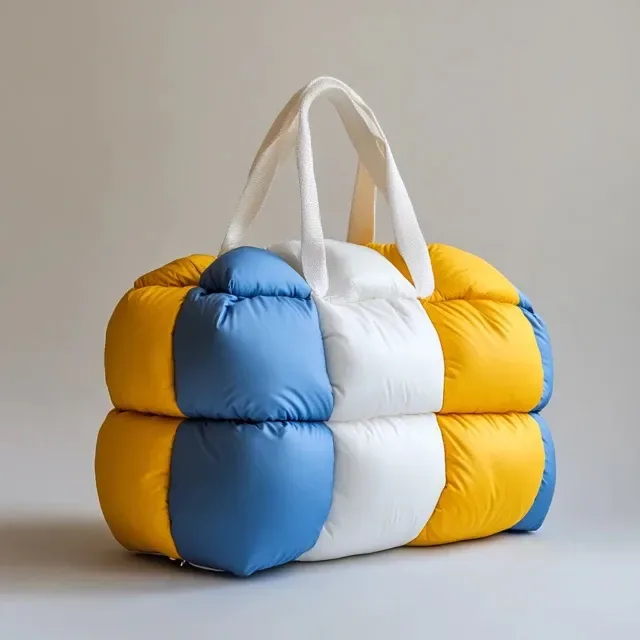
By giving the flat dimension of the pattern piece and a note that the finished bag will measure differently over a curve. A panel with a compound curve cannot be described by two straight measurements, and a pack that tries produces a pattern that is right on the drawing and wrong in the hand.
Where the curve matters commercially — a listing figure, a carrier girth — the taped measurement is the one to publish, measured on a finished sample rather than derived from the pattern. One physical measurement settles a question that no amount of drawing annotation will.
How Do Dimensions Feed a Capacity or Volume Claim?
Carefully, because a litre figure is a calculation rather than a measurement, and the calculation method changes the answer. Multiplying the three internal dimensions gives a rectangular volume that overstates a soft bag with rounded corners; filling the bag with a measured medium gives a figure that depends on how it was filled.
Where a capacity claim is made on a listing, the pack should state which method produced it and the listing should not present it as a measured figure. A cooler bag sold by the number of cans it holds is using a different and more honest claim, because cans are countable.
| Claim | How it is produced | What can go wrong | What to write instead |
|---|---|---|---|
| A litre capacity | Calculated from internal dimensions | Overstates a bag with rounded corners | An internal dimension set and a can or bottle count |
| A can count | Counted with the real cans | Depends on can size and orientation | The count with the can size stated |
| A laptop or device size | The internal clear dimension | Confuses the device size with the sleeve size | The internal clear dimension in millimetres |
| A girth for a carrier | Taped around the closed bag | Changes if the bag is filled | Girth empty and girth filled, both stated |
| A folded pack size | Measured folded as packed | Depends on the fold method | The fold method and the carton dimension |
| A weight | Weighed on a scale | Changes with the lining and the hardware | Empty weight with a tolerance band |
How Do You Dimension the Inside of a Bag?
As clear internal dimensions measured with the dividers or the lining installed, because that is the condition the bag will be used in. An internal dimension taken with the dividers out is a different number, and on a camera bag the difference is the difference between a kit that fits and one that does not.
State what the dimension is clear of: clear of the padding, or to the face of it. A compartment specified as 250 mm clear will hold a 250 mm item; the same compartment specified to the face of the foam will not, because the foam compresses and the item does not.
| Internal dimension | How it is measured | What it must be clear of | Typical error |
|---|---|---|---|
| Compartment length | Between the installed dividers | The divider padding | Measured with the dividers removed |
| Compartment height | Lining face to lining face | Any top padding | Measured to the shell rather than the lining |
| Boot or bottle pocket | Between the lining faces at the narrowest | The seam allowance | Measured across the opening rather than the body |
| Sleeve or device slot | Clear width and clear height | Any edge binding | Quoting the device size rather than the clear opening |
| Sealed cavity, cooler bag | Between the welded liner faces | The weld flange | Measured outside the liner |
| Opening width | Across the zip or the mouth | The tape or the binding | Measured to the outside of the tape |
What Does a Dimension Set Contain on a Finished Pack?
A table with one row per dimension, giving the value, the method, the condition, the exclusions and the tolerance. Five columns, and the table is short: most bags have between eight and fifteen external dimensions that matter.
The internal dimensions sit in a second table because they are checked differently — against the contents rather than against the outside. A camera bag carries an internal clear dimension for each compartment; a kit bag carries one for the boot pocket; a cooler bag carries one for the sealed cavity.
How Do Tolerance and Measurement Method Interact?
The tolerance band is only meaningful against a stated method, because the two methods sit at different points in the band's range. A flat width of 300 mm with a tolerance of plus or minus 10 mm and a taped width of 680 mm with the same tolerance are not the same specification at all.
This is why the two fields belong on the same row of the table rather than in different sections of the pack. A reader who has to cross-reference a dimension in section two against a tolerance in section eleven will get it wrong, and the error only appears at inspection.
How Do Dimensions Get Recorded on a Sample Approval?
As a measured table rather than as a copy of the drawing. The buyer measures the approved sample, records what it actually is, and that table becomes the reference the inspection reads. The drawing says what was specified; the sample record says what was approved; where they differ, the sample record governs.
This is the step most programmes skip and the one that prevents the most arguments. A bag approved at 308 mm against a drawing of 300 mm is correct, and without a recorded measurement the inspection will fail it against the drawing rather than passing it against the sample.
There is a final practical point about the listing figure. Where the same style is sold in two markets with different conventions, the pack should carry both numbers rather than a single one, because a conversion done at the listing stage is where most dimension errors reach a customer.
How Does This End at Bulk and Inspection?
With the dimension table on the pack and the same table in the inspection instructions, so the sample is measured the way it was specified. Sampling runs 6-10 working days and bulk runs 35-50 days from written sample approval, with inspection at AQL 2.5 under ISO 2859-1.
Where a buyer has stated both methods, the second benefit arrives at the listing stage: the customer reads a taped or filled figure that matches what they will measure at home, and the internal flat figure stays available for production. Both numbers are correct and the pack holds both.
What Is the Short Rule?
Never write a bare number. Every external dimension on a bag pack carries a method, and every taped figure carries a condition. Two words per dimension, and they remove the most common measurement argument in the trade.
Then hold the rule through the revision history. A dimension corrected during sampling has to carry its method into the new revision, because a corrected number with no method is the same ambiguity wearing a new revision letter.
Get the dimension method checked before the pattern is cut
Send the drawing and the pack. You get each dimension marked with the method, the condition and the tolerance it needs.
Frequently Asked Questions
What is a flat measurement on a bag?
The bag is laid empty, unfastened and smoothed on a flat surface and measured with a rule between panel edges, excluding straps and external pockets unless the pack says otherwise.
What is a taped measurement?
A flexible tape run around or across the finished bag following its panels, with the bag closed as it would be carried and either empty or filled as stated.
Why do the two methods give different numbers?
Because the tape traverses more surface. A 300 mm flat width with a 40 mm gusset measures roughly 680 mm taped around the body.
Which method should the pack specify?
Flat, because it is what the pattern is cut to and what the inspection table uses. Give a taped figure as well where the number will appear on a listing.
Why is the gusset dimension often wrong?
Because a gusset laid flat reads as half its width. Specify the flat width of the strip before it is folded, and label it as such.
Does it matter whether the bag is empty or filled?
Yes. A soft bag filled with kit measures larger than the same bag empty, and the difference can be twenty millimetres or more across a panel.
What should be excluded from a dimension?
Straps, handles and external pockets, unless the pack says they are included. State the exclusion once on the drawing.
How are dimensions checked at inspection?
Against the method on the pack, on a flat table with a steel rule, on the sample size drawn from ISO 2859-1 at Level II with an AQL of 2.5.
Can a litre capacity be measured?
Not really. It is calculated from internal dimensions and overstates a bag with rounded corners. A can or bottle count is a measured claim and is more defensible.
Where do internal dimensions go?
In a second table, because they are checked against the contents rather than against the outside.
Should the tolerance be on the same row as the dimension?
Yes. A tolerance in a different section gets misapplied, and the error only appears at inspection.
How many dimensions does a bag pack usually carry?
Between eight and fifteen external dimensions that matter, plus internal clear dimensions for each compartment that has to hold something.
Does the measurement method survive a revision?
It has to. A corrected dimension with no method is the same ambiguity under a new revision letter.
What are the standard programme windows?
Sampling 6-10 working days from a signed pack, bulk 35-50 days from written sample approval, inspection at AQL 2.5 under ISO 2859-1.
People Also Ask
What is the difference between flat and taped bag measurements?
Flat is measured with the bag laid empty and unfastened on a table; taped follows the outside of the closed bag. They differ by the seam allowance and by fill.
Which measurement should I put on a tech pack?
Flat, because the pattern and the inspection table both use it. Add a taped figure where the number will appear on a listing.
Why does my bag measure smaller than the listing says?
Usually because the listing figure was flat and the customer measured taped, or because the flat figure excluded the gusset contribution.
How is a gusset dimension specified?
As the flat width of the strip before folding. Laid flat it reads as half its width, which is the usual error.
How are bag dimensions checked during inspection?
On a flat table with a steel rule against the method stated on the pack, using the sample size from ISO 2859-1 at Level II.
Sources and further reading
Every figure on this page is either our own programme data or attributed below. Open the originals before you write them into a specification.
- ISO 2859-1:1999 — Sampling procedures for inspection by attributesInternational Organization for Standardization
- ASTM D6193 — Standard Practice for Stitches and SeamsASTM International
- ASTM International — standards indexASTM International