Pickleball Bag Design: Paddle Sleeves and Ball Compartments
A pickleball paddle is about 400 mm long, 200 mm wide and rigid, and it is the reason a pickleball bag exists. The paddle sleeve decides the silhouette, the ball compartment decides whether it is useful, and everything else is small enough to fit around them.
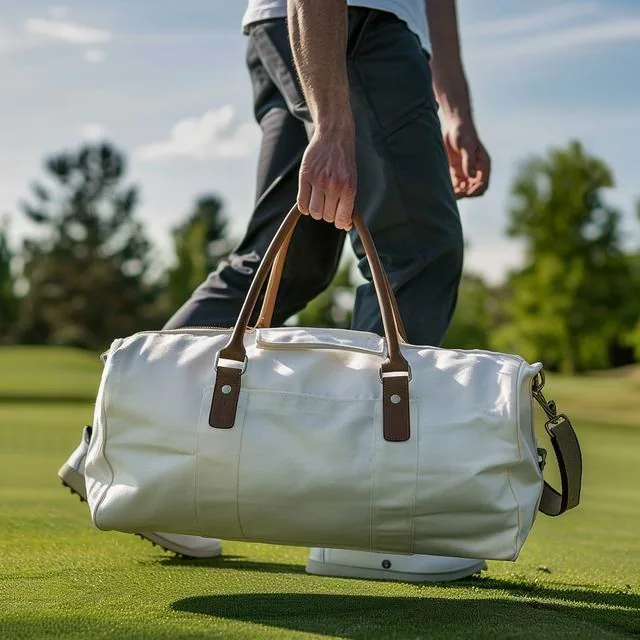
Design for the paddle first. Two paddles in guarded sleeves, a ball compartment that keeps the balls off the paddle faces, and a small pocket for a phone and keys. A pickleball bag that does those three things is finished; anything more is weight the player carries for nothing.
Why Does the Paddle Decide the Bag?
A pickleball paddle is roughly 400 mm by 200 mm with a handle, it is rigid, and its playing surface is the part that must not be damaged. Unlike a ball, which can be packed around, a paddle has to be carried flat and protected on its face. That single object sets the internal dimensions of the bag more than anything else in the kit.
The second consequence is that paddles are usually carried in pairs. Players bring two, clubs buy sets, and a sleeve designed for one paddle with no margin will not take two. Specify the sleeve to two paddles with their edge guards on, and accept that a single paddle will sit loose in it.
| Item | Size | Rigid or soft | Design consequence |
|---|---|---|---|
| Paddle | 400 x 200 mm plus handle | Rigid | A flat guarded sleeve, face protected |
| Paddle, with edge guard | 410 x 210 mm | Rigid | Sleeve dimensioned with the guard on |
| Balls, three or four | 74 mm diameter | Hard | Separate compartment, off the paddle faces |
| Court shoes | Variable | Soft | Separated from the paddle compartment |
| Towel and water | Small | Soft | Any remaining volume |
| Phone and keys | Small | Hard | A lined valuables pocket |
How Should a Paddle Sleeve Be Specified?
Four fields: internal length and width, the number of paddles, whether the sleeve is lined or padded, and how the opening closes. The internal dimensions must be taken with the edge guard fitted, because a paddle with a guard on is wider than one without and a sleeve cut to the bare paddle will not take it.
Lining matters more than padding. A paddle face does not need cushioning — it needs to not be scratched. A smooth lining prevents abrasion from the grit that collects on a grip, and it is lighter and less bulky than foam. Padding is worth adding only where the bag will be carried somewhere the paddle could take an impact.
One Sleeve or Two?
Two, wherever the silhouette allows it. Paddles carried together in one sleeve rub against each other at the edge, and the edge is where a paddle shows wear first. Two sleeves remove that entirely and they make it possible to take one paddle out without disturbing the other.
Where the silhouette is a compact sling or a small holdall, a single divided sleeve is the compromise — one pocket with a divider panel between the two paddles. It works, it is lighter, and it is the right call for a club buying an entry silhouette rather than a competition bag.
Where Do the Balls Go?
Pickleballs are hard, they are small, and they scuff. Three or four loose in a main compartment will roll into everything and mark a paddle face over a season. A separate compartment is the answer, and it should be sized to the number of balls a player actually carries rather than to a round number.
| Ball storage | Scuffs the paddle | Reachable | Best for |
|---|---|---|---|
| Dedicated ball compartment | No | Yes | Everyday play |
| Mesh pocket, external | No | Yes | Wet or dusty courts |
| Clip-on ball holder | No | Yes | Coaching and drill work |
| Loose in the main compartment | Yes | No | Nothing |
| Loose in the paddle sleeve | Yes | No | Nothing — this is the damage case |
What Size Should a Pickleball Bag Be?
Small. The kit is two paddles, four balls, a towel, a bottle, a phone and a pair of court shoes, and it all fits in a compact silhouette. The temptation is to over-size, and over-sizing is the most common fault in picklebag bag design — a large bag gets filled, then carried overloaded, then carried by the strap until the strap fails.
The club context changes one thing. A club buying for a coaching programme or a club team may want a bag that also carries a change of clothes and a jacket, which pushes the volume up. That is a legitimate reason to go larger; carrying a bigger bag because it looks more substantial is not.
What Does the Strap Specification Say for a Compact Bag?
A compact bag is carried on the shoulder and swung, which loads the strap differently from a heavy bag carried dead weight. The webbing needs to be narrow enough to be comfortable and wide enough not to cut, the padding needs to sit where the strap crosses the shoulder, and the root still needs a reinforcement patch with a named stitch.
- Webbing width and material, stated as a specification rather than as a colour.
- Padding position, not just padding — it has to sit where the strap crosses the shoulder.
- A reinforcement patch behind the root and a bar-tack named to ASTM D6193.
- Adjustment hardware in a common size, so a replacement exists.
- Seam strength on the assembled joint, evidenced to ISO 13934-1.
How Does Colour Work on a Pickleball Programme?
Pickleball clubs and brands are unusually design-led, and the bag is often part of a set with a shirt and a cap. That raises the stakes on colour: the bag has to match across three articles made from three different substrates, and the club will see all three together on court.
The discipline is the standard one — one reference, a coupon per substrate, approval under one light — with one addition. Where the shirt is sublimated and the bag is dyed, the metamerism risk is at its highest, because a printed surface and a dyed surface in the same colour will separate in daylight even when they agree indoors. Approve outdoors. The method is set out in Reorder colour consistency.
Which Fabrics Suit a Pickleball Bag?
The loads are light and the bag is small, so heavy cloth is wasted. A mid-weight woven shell is more than adequate, and the money is better spent on the lining of the paddle sleeves and on the base panel, which is the part that gets set down on a court surface.
| Zone | Load | What to specify | Standard to cite |
|---|---|---|---|
| Paddle sleeve lining | Abrasion from grit | A smooth, low-abrasion lining | ISO 12947 abrasion |
| Base panel | Court surface, repeatedly | A coated or heavier denier panel | ISO 12947 abrasion |
| Shell | Light | A mid-weight woven | ISO 13934-1 tensile |
| Strap root | The full bag weight | Reinforcement patch plus a named stitch | ASTM D6193 stitch type |
| Trim and webbing | Light | Colour-matched to the reference | AATCC 16 light fastness |
What Should the Tech Pack Say?
Six fields, and a pickleball tech pack is complete. The two most often left out are the sleeve internal width with the edge guard on, and the ball compartment count.
Tech pack fields for a pickleball bag
- Paddle sleeve: internal length and width, taken with the edge guard fitted.
- Sleeve count: one divided sleeve or two separate sleeves.
- Ball compartment: number of balls it holds and whether it is lined or mesh.
- Base: whether it is coated or heavier denier, and whether there is a board.
- Strap: width, padding position, reinforcement and stitch type to ASTM D6193.
- Colour references for shell, lining, webbing, tape and thread.
How Is the Sample Judged?
With two paddles in it and four balls in the ball compartment. The questions are simple: do the paddles go in and out without force, does the bag close with them in it, do the balls stay out of the paddle sleeve, and does the strap sit where a shoulder is.
The colour check happens outdoors next to the shirt and the cap. Pickleball is a daylight daylight sport played outdoors, and a bag approved under a fluorescent tube has been approved under the wrong light.
How Does the Order Plan Around a Pickleball Season?
Pickleball runs year-round in most indoor markets and peaks in the summer outdoors, which means the production window is less pressured than a winter sport's. That is an advantage worth using: a club that does not need a peak slot can book a quieter one and get a more reliable date.
Sampling runs 6-10 working days from a signed-off tech pack, extending to 12-15 working days for a complex build or a new club colour. Bulk runs 35-50 days from written sample approval, inspected at AQL 2.5 under ISO 2859-1 and shipped FOB Xiamen on T/T 30/70. The calendar is set out in Why 35 to 50 days.
What Does the Inspection Criteria Need to Include?
Six checks: paddle sleeve internal dimensions, sleeve count, ball compartment presence, lining type, colour against the approved coupon set, and crest or mark position measured from a seam. Written as measurable checks and classified as major defects, they are enforceable at the Ac/Re decision.
A generic inspection will pass a bag with the wrong sleeve width, because nothing in a generic checklist asks about a paddle. The club-specific checks are what make the standard useful, and they belong in the criteria agreed before inspection rather than added after.
What Goes Into the Enquiry?
Six fields, and a pickleball enquiry is complete. The paddle dimensions are the ones clubs most often leave out, and they are the ones the sleeve depends on.
- Paddle dimensions with the edge guard fitted, and how many paddles are carried.
- Sleeve preference: two separate sleeves or one divided.
- Ball compartment: how many balls, and lined or mesh.
- Whether the bag also has to carry a change of clothes.
- Colour references for shell, lining, webbing, tape and thread.
- Quantity split by style and colourway, and the date the kit is needed.
What Does a Pickleball Programme Cost to Run?
The same four levers as any club programme: quantity, colourway count, decoration count and silhouette count. Pickleball has one advantage and one disadvantage. The advantage is that the bag is small, so the material cost is low. The disadvantage is that clubs want it in several colourways to match a shirt range, and each colourway carries its own MOQ 500 pcs.
The consolidation lever is the same one every sport uses: one shell colourway, with the second colour in trim and print. For a design-led sport that reads as a compromise, and it is worth saying plainly that it is the single largest saving available.
How Does Personalisation Work on a Pickleball Bag?
A pickleball bag offers less flat area than a team bag, so personalisation has to be planned rather than added. A club crest on the front panel, a player name or number on the end, and nothing else. Two positions, two methods, both measured from a seam.
The size constraint is real. A crest that works on a holdall will overwhelm a compact sling, and the practical ceiling for a mark on a small silhouette is around 70 mm. Clubs that want a bigger mark should put it on the shirt and keep the bag mark small, because a mark that dominates a small bag is a mark the member stops carrying.
How Is the Programme Kept Stable Across Seasons?
With the four artefacts: the reference, the coupon set, the dye-lot record and the shade band. For pickleball the coupon set matters more than usual, because the substrate list includes a lining that has to match the shell closely — a mismatch inside the sleeve is visible every time the bag is opened.
Where the artefacts exist, the reorder is a comparison and 300 pcs is open to discussion on a repeat. Where they do not, the reorder is a re-development and the club pays for it in sampling time as well as in quantity.
What Should a Club Do About Court Shoes and Towels?
Court shoes are the dirtiest item in a pickleball kit, and on an outdoor court they carry dust that marks anything it touches. A small bag has no room for a full shoe compartment, so the usual answer is an external shoe pocket or a loose shoe pouch supplied with the bag.
The towel is the other damp item, and it is smaller than a gym towel, so it needs less provision. A single external strap or a small mesh pocket is enough. The mistake is to specify a full wet compartment on a bag this size — it takes a third of the volume for an item the size of a hand towel.
How Does a Club Choose Between a Sling and a Holdall?
A sling suits a player walking to a court with two paddles and a bottle. It is light, it swings round to the front so the paddles can be reached without putting it down, and it has no business carrying anything else. A holdall suits a player driving to a session with a change of clothes and a jacket as well.
Clubs buying for a team should default to the holdall, because a team bag has to carry whatever the player turns up with. Clubs buying merchandise for members should consider the sling, because it is the silhouette a member will actually use between sessions and it carries the brand mark at eye level.
What Does the Water Bottle Arrangement Need?
A bottle inside a bag leaks eventually, and a leaking bottle inside a bag with two paddles is a bad afternoon. An external bottle sleeve or a lined internal pocket with a sealed base is the answer, and it is worth specifying which, because an unlined internal pocket is the same as no arrangement at all.
The second point is size. Court bottles are taller and narrower than gym bottles, and a sleeve cut for a short bottle will not hold one. Dimension it to the tallest bottle the club sells or the players bring, and the problem disappears.
What Fails First on a Pickleball Bag?
The sleeve mouth and the strap root. The sleeve mouth takes abrasion from a paddle being slid in and out several times a session, and it is the first place a lining shows wear. The strap root takes the whole bag, because a compact bag is swung rather than carried.
Both are prevented with one clause each: a bound sleeve mouth rather than a turned one, and a reinforcement patch with a named stitch at the root. Neither adds weight, which matters on a bag whose whole point is that it is light.
Send the paddle dimensions and get a costed programme
Tell us the paddle size with its guard on, the ball count and the colourway, and we come back with a specified bag and a delivery date you can calculate.
Frequently Asked Questions
How big should a paddle sleeve be?
Dimensioned to the paddle with its edge guard fitted, plus a margin. Around 410 x 210 mm for a guarded paddle.
Should a pickleball bag have one sleeve or two?
Two wherever the silhouette allows. Paddles carried together rub at the edge, which is where they wear first.
Does the paddle sleeve need padding?
A smooth lining matters more than padding. A paddle face needs protection from abrasion, not cushioning.
Where should the balls go?
A dedicated compartment or an external mesh pocket. Loose against a paddle face, they scuff it over a season.
What is the minimum order?
MOQ 500 pcs per style and colourway, with 300 pcs open to discussion on a repeat.
How long does sampling take?
6-10 working days from a signed-off tech pack, extending to 12-15 working days for a complex build or a new colour.
How long is bulk production?
35-50 days from written sample approval, inspected at AQL 2.5 under ISO 2859-1.
Which standards apply?
ASTM D6193 for stitches and seams, ISO 13934-1 for tensile behaviour and ISO 12947 for abrasion on the lining and base.
Why should the colour be approved outdoors?
A printed shirt and a dyed bag can agree indoors and separate in daylight. Pickleball is played outdoors.
Should a pickleball bag carry a change of clothes?
Only if the club needs it to. Over-sizing is the most common design fault in this category.
What fails first on a pickleball bag?
The sleeve mouth, from abrasion, and then the strap root.
How is a reorder kept identical?
By holding the reference, the coupon set, the dye-lot record and the shade band.
People Also Ask
How do you design a pickleball bag?
From the paddle outwards: a guarded sleeve, then balls, then everything else.
Should the paddle sleeve be padded?
A smooth lining matters more than padding — a face needs abrasion protection.
Where should pickleballs go?
A dedicated compartment, away from the paddle faces.
What is the minimum order for pickleball bags?
MOQ 500 pcs per style and colourway, 300 pcs on a repeat.
What fails first on a pickleball bag?
The sleeve mouth, then the strap root.
Sources and further reading
Every figure on this page is either our own programme data or attributed below. Open the originals before you write them into a specification.
- USA Pickleball — equipment standards and paddle specificationsUSA Pickleball
- ASTM D6193 — Standard Practice for Stitches and SeamsASTM International
- ASTM D5034 — Breaking Strength and Elongation of Textile FabricsASTM International