How to Create a Tech Pack for a Team Kit Bag
A team kit bag pack is built around separation and personalisation: how wet kit is kept away from dry, how the bag drains and vents, how each compartment is sized against the kit list, and how names and numbers are applied per unit rather than per style.
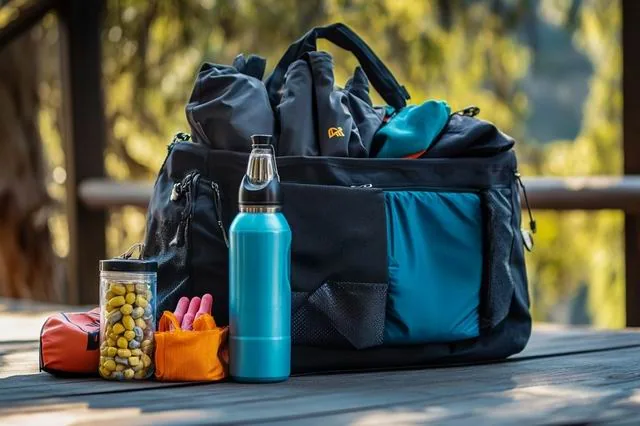
A kit bag tech pack carries four sections an ordinary bag pack does not: the compartment schedule with wet and dry separation, the ventilation and drainage specification, the personalisation block covering names and numbers per unit, and the colour-matching block against team colours. Add the ordinary twelve sections. Sampling runs 6-10 working days, bulk 35-50 days from written approval.
Kit bags fail in a way other bags do not. They come back because the wet compartment is not where the squad expected it, because the boot pocket does not take a size 11, because the numbers are applied to a panel that moves when the bag is carried, or because the team colour is a shade off the jersey. None of those is a materials problem and all of them are specification problems.
The reason is that a kit bag is specified against a kit list rather than against a silhouette. Before the pack is written, somebody has to decide what goes in: boots, shin pads, a training top, a water bottle, a match shirt, and whatever else the squad carries. That list is the first page of the pack and every dimension follows from it.
What Goes on the Kit List and Why Does It Come First?
The kit list is a table of items with a size and a quantity each. It sounds obvious and it is routinely skipped, which is why boot pockets arrive too small. A size 11 boot is roughly 320 mm long and the pocket has to take it with the bag closed, which means the internal dimension and not the external one decides the panel.
Write the list with the largest and the smallest case. A squad has a range of boot sizes and a range of kit volumes, and the bag has to work at both ends. A pack that dimensions the boot pocket for a size 9 and the main cavity for an average kit produces a bag that half the squad cannot use.
How Do You Write the Compartment Schedule?
One row per compartment with a name, an internal dimension in millimetres, what it holds, whether it is lined, whether it is sealed from the others, and how it is accessed. Six fields per row. The sealed-from-the-others field is the one that decides whether wet kit actually stays separate, because a compartment that shares a lining with the main cavity is not separate at all.
Access is the second field buyers get wrong. A compartment accessed from the end of the bag and one accessed from the side behave completely differently when the bag is on a bench or in a boot, and the pack has to say which. Where a compartment is accessed through a zip, state the zip and the pull direction, because a zip that opens the wrong way is a complaint that no amount of quality control will catch.
| Compartment | Internal size (mm) | Holds | Lining | Sealed from the rest? | Access |
|---|---|---|---|---|---|
| Boot pocket, end | 330 x 200 x 150 | One pair to size 11 | Wipe-clean PEVA, welded | Yes, welded liner | End zip, #5 coil, pull towards the centre |
| Main cavity | 520 x 300 x 300 | Training top, shorts, socks | 210D polyester, unsealed | No | Top opening, #8 coil |
| Wet compartment | 300 x 260 x 120 | Wet kit after a session | PEVA, welded seams | Yes, welded and drained | Side zip, #5 coil, pull towards the base |
| Ball pocket, side | 250 diameter x 200 | One inflated ball | Mesh, unlined | No | Side zip, #5 coil |
| Valuables pocket | 200 x 140 x 40 | Phone, keys, cards | Brushed tricot | No | Internal slip, hook-and-loop closure |
| Bottle holder, external | 80 diameter x 200 | A 750 ml bottle | Mesh with an elasticated top | n/a, external | Open top |
| Base drainage well | Full base, 20 mm deep | Water off wet kit | Welded PEVA tray | Yes, welded to the wet liner | Drain grommet at one corner |
How Do Ventilation and Drainage Get Specified?
Ventilation is specified as an area and a position, not as a word. "Ventilated" describes nothing; a mesh panel of 120 mm by 80 mm in the upper third of the end panel, with the mesh named by construction and aperture, is a specification. Position matters because a vent at the base of a wet compartment vents nothing — the moist air sits in the compartment and the bag smells within a season.
Drainage is specified as a component and a path. A drain grommet needs a diameter, a material, a flange type and a position, and the pack has to say where the water goes: out through the grommet, or into the base tray and then out. A grommet fitted to a compartment with no path to it is decoration.
Six lines for ventilation and drainage
- Whether the vent is mesh, grommets or a gap in the panel, named as a component rather than as an intention.
- Mesh construction and aperture, named as a material rather than as "mesh".
- Panel size in millimetres, and the position measured from a named seam.
- Whether the vented compartment is sealed from the dry compartments.
- Drain grommet: internal diameter, material, flange type and position.
- The path water takes from the compartment to the grommet.
- Whether the base tray is welded to the liner or stitched to the shell.
How Is Personalisation Specified When Every Unit Is Different?
As a separate block, because personalisation turns a style into a per-unit operation with its own data file. The block states the process — embroidery, heat transfer, or a printed panel — the position, the size, the font or the artwork file, the colour, and the tolerance on placement. Where names and numbers are applied, the pack states how the data arrives, in what format, and by when.
The two clauses that matter most are the data cut-off and the rejection rule. Personalisation data arriving after a stated date cannot be accommodated inside a 35-50 day bulk window, and a misspelt name is a unit that cannot be sold and cannot be reworked. State the cut-off date and state that the buyer owns the accuracy of the data file.
How Do You Handle Team Colour Matching?
By naming a physical reference rather than a screen colour, and by stating the tolerance in a shade band rather than as a word. A team colour taken from a jersey is matched against the jersey fabric, and the pack should name the jersey reference and state the acceptable deviation, typically assessed under a standard light source against an approved swatch.
Where the bag uses a dyed-to-match component — webbing, zip tape, binding, thread — each of those has to be matched separately and stated separately, because a polyester webbing and a nylon shell take dye differently and will not land on the same shade from the same formula. The colourway matrix carries every dyed component with its own reference.
| Colour decision | What to write | Reference to hold | Failure if unstated |
|---|---|---|---|
| Shell colour | Pantone reference plus an approved physical swatch number | The swatch, held by both sides | A shade argument nobody can settle |
| Matching webbing | Same reference, approved as a separate swatch | A webbing swatch on the same card | Webbing a full shade off the shell |
| Zip tape and teeth | Tape reference and teeth finish separately | A tape swatch | A zip that reads lighter than the panel |
| Thread | Ticket number, fibre, shade reference | A thread cone reference | Topstitching that flashes against the shell |
| Print and transfer | Artwork file, colour space, substrate | A printed proof on the actual shell | A logo that shifts colour on polyester |
| Base and trim | Reference for each, matched separately | A trim card | A trim set that does not read as one colour |
What Does the Construction Section Add for a Kit Bag?
Two things: reinforcement at the carry points and a base specification. Kit bags carry a concentrated, shifting load, and the strap anchors take more punishment than on any other soft bag in the catalogue. The pack should state the reinforcement patch size, the stitch pattern at the anchor, and the bar tack requirement.
The base is specified separately because it is the part that fails first. State whether it is a welded tray, a studded panel, or a reinforced fabric base; state the stud material, the stud count and the stud spacing; and state the abrasion requirement for the base fabric with the test method named. A kit bag dragged across a car park for a season will find the weakest of those three.
How Do Handles, Straps and Carry Points Get Written?
As a schedule: the webbing width and material, the grab handle construction, the shoulder strap with its pad and slider, and the anchor method for each. The pad is the field most often left out, and it is the one that decides whether a loaded bag can be carried across a car park.
State the pad as dimensions and foam rather than as "padded". A pad of 180 mm by 60 mm in 8 mm closed-cell foam covered in the shell fabric is a specification; a padded strap is a hope. Where the strap is detachable, state the hardware at both ends and the pull figure.
How Is the Size Run Handled When the Bag Comes in Sizes?
With a grading sheet rather than with separate packs. One pack, one drawing set, and a grading table that gives the dimension deltas per size. Where the deltas are not uniform — a small that is shorter but not narrower — the table has to say so per axis rather than as a single scale factor.
Personalisation is where size runs break down operationally. A run of 500 pcs split across three sizes and thirty names is thirty different units regardless of size, and the pack should state how the data file maps size to name. That mapping is data, not specification, and it belongs with the personalisation block.
What Testing Belongs on a Kit Bag Pack?
Load and abrasion rather than thermal or leak. State a strap anchor pull test with the figure and the method, a base abrasion requirement with the method, and a colourfastness grade for the shell and for the personalisation. AATCC 16 covers colourfastness to light and the crocking methods sit in the same manual, so name the method number rather than the adjective.
Where the bag is sold as a children's product, add the CPSIA position and the tracking label requirement; where it sells into the European Union, add the REACH restricted-substance statement. Both are documents with numbers, and both belong in the compliance block rather than in an email.
How Are Care and Marking Handled on a Kit Bag?
With the same field discipline as every other section: the label position, the label content, the attachment method and the language set. A kit bag is washed, sometimes weekly, so the care instruction is not a formality — a label that says wipe clean on a bag that will go through a machine is a returns problem waiting for a season to pass.
Where the squad is issued more than one bag — a match bag and a training bag, for instance — the care instruction has to be written for both, and the pack should say which instruction goes on which. A single care label reused across two builds is the common way a bag ends up with an instruction that does not apply to it.
Marking is separate from care and it is a customs matter rather than a design one. The country-of-origin marking has to be on the bag in the position the destination market requires, and where the bag is sold as a children's product the CPSIA tracking label sits alongside it. Both positions belong on the pack, because both are checked at the port rather than at the bench.
How Does a Kit Bag Pack Change the Calendar?
It adds approval steps rather than days. A kit bag needs the kit list signed, the compartment schedule signed, the colour references approved as physical swatches, and the personalisation data received, before bulk can run cleanly. Each of those is a buyer-side step, and each one can stop a 35-50 day window.
Once they are done, sampling runs 6-10 working days and the run is inspected at AQL 2.5 under ISO 2859-1, with the personalisation checked as a per-unit attribute rather than as a style attribute. More on team programmes sits on the team kit bag page, and the development calendar sets out where these approvals sit in the timeline.
Get the compartment schedule checked against your kit list
Send the kit list and the compartment layout. You get the internal dimensions that follow from it and the fields still missing.
Frequently Asked Questions
What makes a team kit bag tech pack different?
Four extra sections: the compartment schedule with wet and dry separation, ventilation and drainage, personalisation per unit, and team colour matching with a physical reference per component.
Why does the kit list come first?
Because every dimension follows from what the squad carries. A boot pocket dimensioned for a size 9 does not take a size 11, and the complaint arrives after the run ships.
How do I specify a wet compartment?
State the internal dimension, the liner material, whether the seams are welded, whether it is sealed from the dry compartments, and how it drains. A compartment sharing a lining with the main cavity is not separate.
What does "ventilated" mean in a specification?
Nothing. Write the mesh construction and aperture, the panel size in millimetres, and the position measured from a named seam. A vent at the base of a wet compartment vents nothing.
How is a drain grommet specified?
By internal diameter, material, flange type and position, plus the path water takes to reach it. A grommet with no path to it is decoration.
How do I specify personalisation?
As its own block: process, position, size, font or artwork file, colour, placement tolerance, the data format, the data cut-off date and the rule on who owns accuracy of the data.
Why does personalisation need a data cut-off?
Because a per-unit operation cannot start without the data, and data arriving late cannot be absorbed inside a 35-50 day bulk window.
How should team colours be matched?
Against a physical reference per component, with a shade band stated. A polyester webbing and a nylon shell take dye differently and will not land on the same shade from one formula.
What carries the load on a kit bag?
The strap anchors and the base. State the reinforcement patch size, the stitch pattern at the anchor, the bar tack, and the base construction with a stud count and spacing.
How is a padded strap specified?
As dimensions and foam: a pad of 180 mm by 60 mm in 8 mm closed-cell foam covered in the shell fabric. "Padded" is not a specification.
Do I need a separate pack for each size in a run?
No. One pack with a grading sheet giving the dimension delta per size and per axis, plus a mapping from size to personalisation data.
What testing belongs on a kit bag?
Strap anchor pull, base abrasion, and colourfastness for the shell and the personalisation, each with the method number named. Add the CPSIA or REACH position by market.
Does a kit bag need a leak test?
Only where a compartment is sealed. A welded wet compartment with a drain gets a leak test; the unsealed main cavity does not.
How long does sampling take on a kit bag?
6-10 working days from a signed pack with approved colour references, widening to 12-15 working days where the style has a welded wet compartment or a studded base.
Where does the origin marking go on a kit bag?
In the position the destination market requires, stated on the pack. It is checked at the port rather than at the bench, which is why the position is specified rather than left to assembly.
People Also Ask
How do you write a tech pack for a kit bag?
Start from the kit list, then write a compartment schedule with six fields per compartment, then ventilation and drainage, then personalisation, then team colour matching with a reference per component.
What is a wet compartment in a kit bag?
A compartment with a welded liner, sealed from the dry compartments, with a drainage path to a grommet. Sharing a lining with the main cavity does not make it wet separation.
How do you specify ventilation on a bag?
By mesh construction and aperture, panel size in millimetres and position measured from a named seam — not by the word ventilated.
How are names and numbers specified on a team bag?
In a personalisation block giving the process, position, size, font, colour, placement tolerance, data format, cut-off date and the rule on data accuracy.
How many colours need matching on a team kit bag?
Every dyed or printed component: shell, webbing, zip tape, thread, print and trim. One Pantone number for the whole bag is not enough.
Sources and further reading
Every figure on this page is either our own programme data or attributed below. Open the originals before you write them into a specification.
- ASTM D6193 — Standard Practice for Stitches and SeamsASTM International
- AATCC 16 — Colorfastness to LightAmerican Association of Textile Chemists and Colorists
- ISO 2859-1:1999 — Sampling procedures for inspection by attributesInternational Organization for Standardization