Mass Balance or Segregated: Which Model Supports a Recycled Content Claim?
Segregated keeps certified material physically separate; mass balance allocates the certified fraction across output over a period. Both are legitimate and each supports a different sentence. State the model in the purchase order and in the copy, and ask which model applies at enquiry, before any fabric is booked.
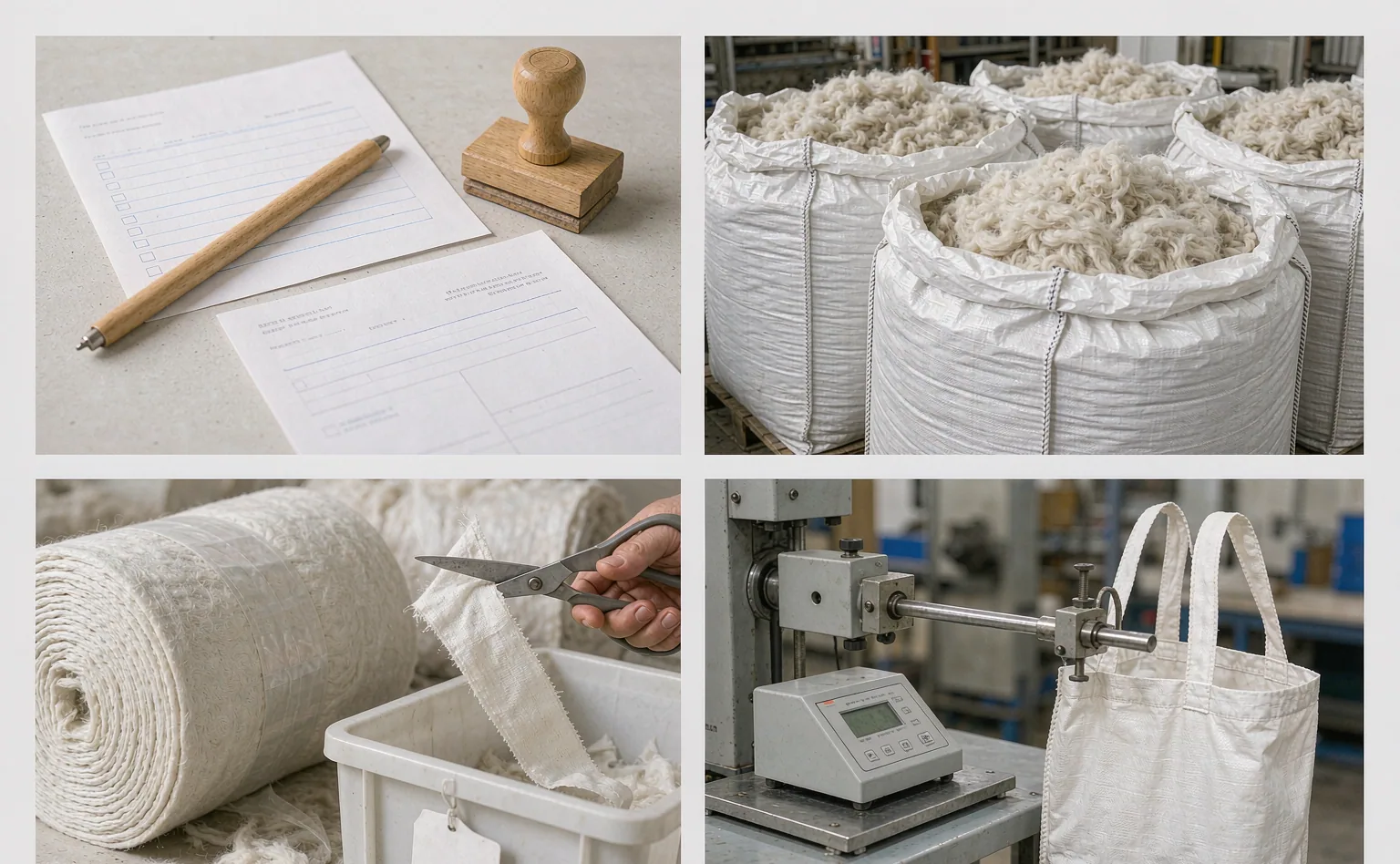
Segregated keeps certified material physically separate through every step, so the output can be traced to the input. Mass balance mixes certified and non-certified material and allocates the certified fraction on paper across the output. Both can support a claim, but they support different claims: segregated supports a statement about the material in the product, mass balance supports a statement about the certified input allocated to it.
Two chains can both be certified, both produce a transaction certificate, and both let a buyer print a recycled content number — while meaning quite different things. The difference is not visible on the certificate and it is rarely explained at quotation. It matters when a customer asks what the number means, and it matters more when the customer is the one being asked by their own regulator.
This page sets out how each model works, what each permits you to say, how the record-keeping differs, where each survives or fails an audit, and what should be written into a purchase order so that the model is disclosed rather than discovered.
What Does Segregated Mean in a Recycled Input Chain?
Certified input is kept physically separate from non-certified input at every step: separate storage, separate production runs where the process allows, separate identification on the goods, and separate records. The output of a segregated run can be tied back to the certified input that produced it, and the transaction certificate describes goods that physically contain it.
The cost of segregation is operational. It requires dedicated storage, scheduling discipline, line cleaning between runs in some processes, and more rigorous internal identification. In a chain with many small steps it is expensive and sometimes impractical, which is the reason the second model exists.
What Does Mass Balance Allocate, and What Does It Not?
In a mass balance chain, certified and non-certified input are processed together, and the certified fraction is allocated to output on a calculated basis over a defined period and a defined site. If a site puts a stated quantity of certified input into a process and produces a larger quantity of output, the certified fraction is allocated across that output proportionally, within the rules of the standard and within a defined allocation period.
What it does not do is guarantee that any particular metre of fabric contains recycled material. It guarantees that the certified input was accounted for and that the total claimed output does not exceed the certified input available. That is a real and useful guarantee, and it is a different guarantee from the one segregation makes.
| Aspect | Segregated | Mass balance |
|---|---|---|
| Physical handling | Certified material kept separate throughout | Certified and non-certified processed together |
| What the certificate describes | Goods that physically contain certified input | An allocated fraction of the output |
| Record requirement | Identification and separation records per run | Input and output reconciliation over an allocation period |
| Operational cost | Higher: storage, scheduling, cleaning | Lower: the process runs as normal |
| Scales to small volumes | Poorly | Well |
| Audit focus | Can you show the material did not mix | Can you show the arithmetic does not over-claim |
| What it supports in copy | A statement about the material in the product | A statement about certified input allocated to the product |
How Does Each Model Treat a Claim of Recycled Content?
Both permit a recycled content statement, and the standards set out how the figure is calculated and presented under each. The important point for a buyer is that the wording has to fit the model. Under segregation, the material in the product is certified, and the copy can say so. Under mass balance, the certified input is allocated to the product, and the honest wording says that rather than implying physical traceability.
Where a printed claim implies more than the model supports, the claim is the problem rather than the material. The remedy is a sentence: state the recycled fraction, state the standard, and where the customer cares, state that the input is allocated on a mass balance basis. That sentence is short, and it is the difference between a claim that survives and one that has to be withdrawn.
Which Model Does Each Standard Permit?
Most recycled input standards in this space permit both, with rules about how the allocation is calculated, over what period, and how much can be carried forward between periods. Some product categories or some claims require segregation. The position is set by the standard version you are working under, and it changes between versions, so the question to ask is not "is mass balance allowed" but "is it allowed for this claim under this version".
Confirm the current position against the standard text and the version named on your certificate before you write copy that depends on it. Where the certificate is silent on the model, ask the issuing site in writing; a site running mass balance will say so, because the allocation rules are part of what it was audited against.
- 1. Model
- Is the input handled segregated or on a mass balance basis?
- 2. Standard version
- Which version does the certificate name, and what does it permit?
- 3. Allocation period
- Over what period is the allocation calculated, and can it be carried forward?
- 4. Wording
- Does the sentence say what the model actually supports?

What Are the Record-Keeping Differences?
Segregation is evidenced by identification and separation records: where the certified material was stored, which run used it, how the goods were marked, and how the non-certified material was kept out. Mass balance is evidenced by an input and output reconciliation: certified input received, output produced, fraction allocated, and the balance carried into the next period, all in one unit and over a stated period.
Both are audited, and both fail in characteristic ways. Segregation fails when a run cannot be identified or when storage was shared. Mass balance fails when the allocation period is not defined, when the unit changes between lines, or when the claimed output exceeds the certified input available. The second failure is arithmetic, which is why it is detectable without a site visit.
How Does Each Model Survive an Audit?
Segregation survives when the physical story can be told from records alone: this input, this run, these goods. Mass balance survives when the arithmetic can be re-performed from the records: this input quantity, this output quantity, this fraction, this period. An auditor will ask for the ledger in both cases; the difference is what they do with it once they have it.
For a buyer, the practical implication is about what you can check. Under segregation you can reasonably ask for run identification. Under mass balance you can reasonably ask for the reconciliation and re-perform the arithmetic yourself. Both requests are normal, and a refusal to either is more informative than the answer would have been.
What Does Each Mean for a Brand Own Reporting?
A brand reporting recycled input to its own stakeholders needs to know which model sits behind the number, because the two models support different statements in a report. A figure derived from mass balance is a statement about certified input purchased or allocated, which is a legitimate and commonly reported metric; a figure derived from segregation is a statement about the material in the goods. Both are reportable, and they should be labelled differently.
Where a brand reports a single recycled percentage across a range, the honest approach is to state the model once, at the level of the report, rather than product by product. Where the range mixes models, state the split, because a reader comparing two products in the same table will otherwise assume they mean the same thing.
How Does the Model Behave Across a Multi-Site Chain?
A bag programme rarely runs through one site. Fabric is made at one, dyed or coated at a second, cut and sewn at a third, and every handover is a point at which the model can change. Segregation is the fragile one here: it has to hold at each step, and a single site that processes certified input alongside non-certified input without separation breaks the physical story for everything downstream, including the steps that did keep the material apart.
Mass balance is more tolerant across sites, and it carries a rule a buyer should know. The allocation is normally calculated at the site where the certified input enters the chain, and what passes to the next site is an allocated quantity rather than a physical one. Where the second site then applies its own allocation on top, the arithmetic compounds, and the claimed fraction has to be traced through both steps to confirm that the total does not exceed the certified input that entered at the front.
The practical instruction follows from that: ask for the model at each handover rather than once at the end. A purchase order that names the model only for the finished article leaves two or three upstream handovers unspecified, and the claim inherited at the end is whatever the weakest step produced.
Where Does Mass Balance Break Down in Practice?
Three places. At the boundary: where one site in the chain runs mass balance and the next assumes segregation, the claim inherited by the second site is not the claim the first one made. Over time: where an allocation period runs longer than the interval between two audits, an error persists for the whole period. And in the copy: where the allocated fraction is presented as a physical property of the goods.
All three are prevented by the same discipline — state the model in writing at every handover, in the purchase order and on the transaction certificate request — and all three are expensive to fix after the goods have shipped.
| Failure mode | Segregated chain | Mass balance chain |
|---|---|---|
| Records cannot identify a run | Fatal; the claim fails for that lot | Not applicable |
| Storage or line shared with non-certified input | Fatal unless separation is documented | Expected and permitted |
| Claimed output exceeds certified input | Impossible by construction | Fatal; the allocation over-claims |
| Allocation period not defined | Not applicable | Fatal; the arithmetic cannot be re-performed |
| Unit changes between lines of the ledger | Not applicable | Fatal; the reconciliation is meaningless |
| Copy implies physical traceability | Accurate | Fatal; the wording exceeds the model |
What Should a Buyer Do When the Certificate Does Not Name the Model?
Ask in writing, and ask the site that issued it rather than an intermediary. The question is two lines long: was this input handled on a segregated or a mass balance basis, and over what allocation period. A site running mass balance will answer, because the allocation rules are part of what its own audit covered; a site that cannot answer is telling you the claim is not evidenced at the level you assumed.
While that answer is in flight, write the copy in the form that is true under both models — the recycled fraction, the standard and the version — and add the model sentence once the position is confirmed. Copy drafted that way does not have to be withdrawn later, and the delay is usually one email.
Where the answer never arrives, treat the certificate as evidence that a certified input entered the chain and as nothing more precise than that. It remains a usable position for an internal report, where the metric is certified input purchased, and it is not enough for a printed claim that implies the material sits in the product.
One further point about carry-forward, because it catches buyers who re-perform the arithmetic: where a standard permits an unused allocation balance to be carried into a later period, the claim in that later period can rest partly on input received in an earlier one. That is permitted and it is auditable, but it means a certificate for a given lot cannot always be read as a statement about input received in that lot month. Ask whether carry-forward was used.
How Should the Model Be Disclosed to the Customer?
In one sentence, at the point the claim is made, and repeated in the substantiation file. Where a customer asks directly, answer directly: the input is certified, and it is handled on a mass balance basis, meaning the certified fraction is allocated to our output rather than physically separated. That answer is complete, it is short, and it is the answer an informed buyer is hoping for.
Where a customer objects to mass balance as a matter of policy, that is a commercial decision for them and it needs to be known before the fabric is booked, not after. Ask the question at enquiry: does your programme require segregated input. It is one line, and it determines whether the sourcing plan is viable at all.
What Should Be Written Into the Purchase Order?
Four lines. The standard and version. The minimum certified fraction. The model — segregated or mass balance — where the programme has a preference. And the evidence: a transaction certificate per lot, tied to the invoice, with the model stated on it where the standard provides for that.
Add a fifth line that costs nothing and resolves most disputes: the allocation period, where mass balance applies. A certificate that states the period lets a buyer re-perform the arithmetic; one that does not leaves the claim resting on a document nobody downstream can check.
Working with traceability models
- Segregated traces the material; mass balance allocates the certified input across output.
- Both are legitimate, and each supports a different sentence in the copy.
- Ask which model at enquiry, and write it into the purchase order and the certificate request.
- The audit object under mass balance is arithmetic that must not over-claim, and you can re-perform it.
- State the model once in your own reporting, and state the split where a range mixes models.
Thresholds, lists and wording rules change when a regulation or a standard is amended. Confirm every figure against the current official text before you rely on it, and ask your importer of record to confirm the version that applies in the destination market.

Send the certificate and the claim you plan to print
Send the transaction certificate or the wording. You get a model check and the sentence that fits it, within one business day.
Frequently Asked Questions
What is the difference between segregated and mass balance?
Segregated keeps certified material physically separate and traces it to the output. Mass balance mixes input and allocates the certified fraction across output on a calculated basis over a period.
Is mass balance legitimate?
Yes. It is permitted under the major recycled input standards with rules on how the allocation is calculated. It supports a different statement from segregation, not a weaker one by definition.
Can I claim recycled content under mass balance?
Yes, with wording that fits the model: a statement about certified input allocated to the product rather than about the physical material in it.
How do I know which model my chain uses?
Ask the issuing site in writing, and check the standard version named on the certificate. Where the certificate is silent, ask before you write copy.
What records prove a segregated chain?
Identification and separation records: storage, run identification, marking of the goods, and how non-certified material was kept out.
What records prove a mass balance chain?
An input and output reconciliation over a stated allocation period, in one unit, showing the certified input, the output and the allocated fraction.
Can I check the arithmetic myself?
Yes, and you should. Under mass balance the reconciliation is the audit object, and a buyer can re-perform it from the certificate and the site ledger.
What is an allocation period?
The period over which the certified input is allocated to output. It has to be defined, and whether it can be carried forward is set by the standard version.
What happens if one site uses mass balance and the next assumes segregation?
The claim inherited by the second site is not the claim the first site made. State the model in writing at every handover.
Should the model be disclosed to my customer?
Yes, in one sentence at the point the claim is made, and again in the substantiation file.
What if my customer requires segregated input?
Ask at enquiry, before the fabric is booked. It changes the sourcing plan, the cost and sometimes whether the programme is viable.
What should the purchase order say?
The standard and version, the minimum certified fraction, the model, the evidence required, and the allocation period where mass balance applies.
Does the model change the MOQ or the lead time?
No. MOQ stays at 500 pcs per style and colourway and bulk production at 35-50 days from sample approval. Segregation can affect fabric availability where a site runs dedicated batches.
How should I report the number in my own reporting?
State the model once at the level of the report, and state the split where a range mixes models, so two products in one table are not read as the same thing.
People Also Ask
What is mass balance in recycled content?
Certified and non-certified input processed together, with the certified fraction allocated to output over a defined period.
Is mass balance the same as segregated?
No. Segregated traces the physical material; mass balance allocates the certified input on paper.
Can I claim recycled content under mass balance?
Yes, with wording that states the certified input allocated rather than implying physical traceability.
How do I check a mass balance claim?
Ask for the input and output reconciliation and re-perform the arithmetic: certified input, output, fraction, period.
What should a purchase order say about traceability?
The standard and version, the minimum fraction, the model, the evidence required and the allocation period.
Sources and further reading
Every figure on this page is either our own programme data or attributed below. Open the originals before you write them into a specification.
- Global Recycled Standard and the recycled-input standard familyTextile Exchange
- Content Claim Standard — chain of custody for certified inputTextile Exchange
- ISO 2859-1:1999 — sampling procedures for inspection by attributesInternational Organization for Standardization