Custom Cooler Bag Manufacturer: What to Check Before You Order
Seven things must be in writing before the first order: the thermal endpoint, the panel build-up, the liner declaration, the seam method, the closure hardware, the inspection plan and the commercial trigger. Fewer than four answered means an estimate, not a quotation.
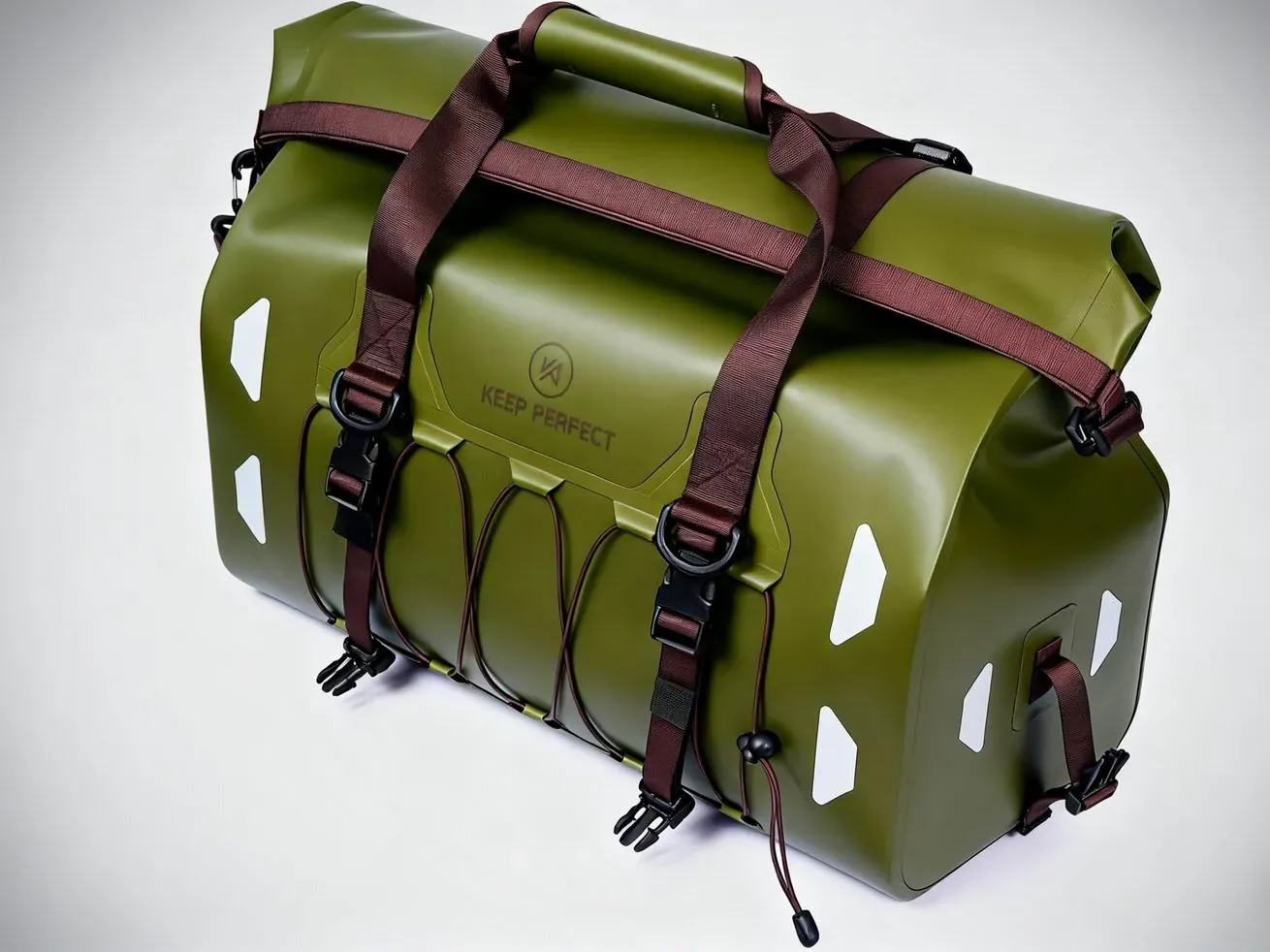
Before a first cooler bag order, seven things have to be in writing: the thermal endpoint and ambient, the wall build-up by panel, the liner material with its food-contact declaration, the seam method, the closure hardware by brand and size, the inspection plan with its AQL and class list, and the commercial terms. A quotation that answers fewer than four of those is an estimate, not a quotation.
The expensive failures in this category are not workmanship failures. They are specification failures: a bag that holds ice for nine hours where twelve was assumed, a liner that passes a leak test but has no food-contact declaration for the market it is sold in, a zipper that works on the sample and jams on unit 400. All three are visible before the order is placed if the buyer knows what to ask for. The checks below are the ones that change the outcome of a first programme, in the order they should be run.
Has the Thermal Endpoint Been Defined in Writing?
The first check is the one most often skipped, because both sides believe they agree. "Keeps ice 12 hours" hides four different tests with results three to five hours apart. Before a quotation is comparable, the buyer has to state the endpoint (core temperature, or percentage of ice remaining), the ambient, the load, the refrigerant mass and its conditioning, and the instrument tolerance. That is one paragraph of text and it is the difference between a verified claim and an argument twelve months later.
Ask what happens when the sample misses. A serious programme states the acceptance rule: two of three production samples pass, or the mean of three passes with no individual result more than one hour short. Without a rule, the first sub-12-hour result becomes a negotiation, and the negotiation always ends with the schedule.
Is the Wall Build-Up Specified Panel by Panel?
A single foam thickness is not a specification. Bags are quoted as "8 mm" when the lid is shell fabric over a zipper, because the lid is the panel nobody checks and the panel that leaks most. Require a build-up table: base, four side walls, lid, and the flap over the closure, each with a thickness and a material. The table belongs in the tech pack next to the dimensions, not in an email.
Then ask for the compression-recovery figure on the foam, stated as thickness retained after a stated load and dwell. Foam that arrives in a container having been under other cartons for five weeks is thinner than the foam in the sample, and a bag that tested at twelve hours in sampling can test at ten on arrival without anything having been done wrong on the line.
| Check | What a complete answer looks like | What an incomplete answer looks like |
|---|---|---|
| Thermal endpoint | Core at or below 5 °C at 12 h, 25 °C ± 2 °C, 20-can load, 3 x 400 g packs | "Keeps ice all day" or "12 hours" |
| Panel build-up | A table: base 8 mm, walls 8 mm, lid 8 mm + 2 mm flap, IXPE 33 kg/m³ | "8 mm foam" |
| Liner | PEVA 0.15 mm, welded, declaration to FDA 21 CFR 177 and EU 1935/2004 | "Food-grade lining" |
| Seam method | RF welded liner, shell sewn to ASTM D6193 stitch class, taped corners | "Strong seams" |
| Closure | YKK #8 coil, closed-end box, covered storm flap, cycle-test figure | "Heavy-duty zipper" |
| Inspection | AQL 2.5 major / 4.0 minor, ISO 2859-1 Level II, class list attached | "We inspect everything" |
Does the Liner Carry a Food-Contact Declaration for Your Market?
A cooler bag liner is a food-contact material in the European Union under Regulation (EC) No 1935/2004 and an indirect food additive in the United States under FDA 21 CFR 177. "Food-grade" on a quotation means nothing without the declaration behind it, and the declaration has to name the polymer and, in the EU, be supported by migration testing to the specific simulants and conditions the bag will meet. Ask for the declaration before sampling, because a liner substitution after sampling invalidates the thermal test as well as the compliance file.
The second half of the liner question is the seam. A film with a perfect declaration sewn with a needle and left untaped is a different article from the same film welded. Ask for both documents together, and ask which film lots they cover: a declaration issued for one resin lot does not travel to the next.
Which Seam Method Is Being Quoted, and Is It the One You Need?
Three constructions cover the category. Radio-frequency welding fuses polar films such as PVC and TPU with a dielectric field and gives a clean, airtight seam; it does not work on polyethylene. Hot-air and hot-wedge welding handle PE and PP films and coated fabrics and is the usual method for PEVA liners. Sewn construction with taped seams is the fallback for shapes a welder cannot reach. Each has a different failure mode and a different cost, and the choice interacts with the thermal result because the seam is where water reaches the foam.
Ask which method is quoted for each seam on the bag, not for the bag as a whole. A common and reasonable answer is a welded liner with a sewn and taped shell; a less reasonable one is a sewn liner with tape presented as equivalent. Where the shell is sewn, ask for the stitch class and density to ASTM D6193 and for a seam-strength figure to ISO 13934-1.
Is the Closure Hardware Named by Brand, Size and Finish?
Zippers are the most common field failure on cooler bags and the easiest to specify properly. "Heavy-duty zipper" is unquotable. A complete specification names the brand, the type (coil or metal), the gauge (#5, #8 or #10), the tape material, whether the slider has a lock, whether the chain is closed-end or separating, and the finish. It also names the puller, because a metal puller on a bag that will be washed is a corrosion and a safety question.
Then ask for the cycle-test figure and the water-resistant variant where the bag will meet rain or washdown. Water-resistant coil zippers with a covered tape are available from the major hardware houses and cost a small premium over the standard chain. Where the programme is a delivery bag that will be opened hundreds of times a week, the cycle rating is the number that decides the warranty cost, and it belongs in the specification.
What Is the Inspection Plan, and Who Signs the Release?
Inspection is where a good specification is either enforced or wasted. The plan has to state the standard (ISO 2859-1 or ANSI Z1.4), the inspection level, the AQL for each defect class, the code letter that follows from the lot size, and the sample size and accept/reject pair that follow from those. A 500-piece order at General Inspection Level II and AQL 2.5 draws code letter H, a sample of 50 units, and an accept/reject pair of 3/4 for major defects.
Ask three further questions. What is the critical class, and is it zero-acceptance? Who signs a waiver when a lot fails and the date is fixed? And what is the switching rule, so that a single clean lot is not read as a programme trend? The answers tell you more about how a partner will behave under pressure than any certificate does.
Are the Commercial Terms Explicit, Including What Starts the Clock?
Four numbers decide whether a programme is planable: MOQ, the sampling window, the bulk window, and what event starts the bulk window. On this programme they are MOQ 500 pcs per style and colourway, sampling 6-10 working days, and bulk production 35-50 days from sample approval. The third figure is only meaningful with the trigger stated, and the trigger is sample approval in writing, not sample dispatch and not deposit.
Ask what is excluded from the window: public holidays at the production base, the fabric and foam lead time where a colour is being dyed to order, and the inspection and re-work cycle. A 35-50 day window that silently assumes a stock colour will become a 60-day window the first time a brand specifies a Pantone shade.
| Programme term | Locked figure on this site | What to confirm in writing |
|---|---|---|
| MOQ | 500 pcs per style and colourway | Whether a colourway counts as a separate style, and the 300-pc repeat discussion |
| Sampling | 6-10 working days, 12-15 for complex builds | That the clock starts from a signed-off tech pack, not from first enquiry |
| Bulk production | 35-50 days from sample approval | The trigger event, and whether dyed-to-order fabric is inside or outside the window |
| Inspection | AQL 2.5 major, ISO 2859-1 Level II | The class list and the critical-defect rule |
| Payment | T/T 30/70 | Whether the 70% is against a passed inspection or a bill of lading |
| Terms | FOB Xiamen; CIF and DDP available | Which port and which Incoterms edition is being quoted |
Has a Reorder Plan Been Agreed Before the First Order?
The second order is where specification drift shows up: a different foam lot, a liner from another film supplier, a weld setting that has been re-tuned. Agree at the first order what will be controlled across runs: the foam density and thickness with a tolerance, the film supplier or an approved equivalent, the weld parameters recorded as a set point with a range, and a retained reference sample from run one held against run two. That is a one-page addendum and it is the difference between a programme and a series of one-off purchases.
Also agree how a change will be communicated. A substitution that improves the product is still a change, and an unannounced change to a food-contact material is a compliance event, not a courtesy. Ask for written notice with a stated lead time before any material substitution, and for the right to re-test.
Seven checks to run before the first order
- The thermal endpoint, ambient, load and refrigerant, written as a test protocol.
- A panel-by-panel wall build-up table, with a foam compression-recovery figure.
- A liner food-contact declaration naming the polymer and covering the film lot.
- The seam method for each seam on the bag, plus stitch class where the shell is sewn.
- Closure hardware by brand, type, gauge, finish and cycle rating.
- An inspection plan with standard, level, AQL, class list and switching rule.
- Commercial terms with the trigger event named, plus a reorder control addendum.
What Should a Buyer Ask For Instead of a Certificate Folder?
Certificate folders are easy to assemble and hard to verify. Ask instead for four artefacts, each of which costs the vendor real effort: a dimensioned tech pack signed by both sides, a sample that was made on production tooling rather than by a sample room, a test report for the actual build with the load and ambient stated, and a production schedule with milestones. A partner that can produce those four can usually produce the bag. A partner that produces only certificates may not be able to.
For compliance, the useful documents are specific: a REACH declaration against the current SVHC list, a California Proposition 65 statement where the bag is sold into California, a CPSIA children-product certificate and tracking label where the bag is marketed to children, and an EN 71-3 migration report for any component that could be mouthed. Ask which of those apply to your market rather than requesting all of them.
How Do You Compare Two Quotations That Look the Same?
Put them side by side on the seven checks and count the blanks. Two quotations at the same unit price with different panel build-ups, different liners and different closure hardware are not the same quotation. Normalise them: same endpoint, same build-up, same hardware, same inspection plan. Then the price difference is real and the decision is a decision rather than a guess.
Where the price difference survives normalisation, look at the cube and the weight rather than at the unit price. A bag that is 20 mm larger in each dimension can cost four percent less per unit and eight percent more per delivered unit once container utilisation is counted. The landed-cost view is the only one that survives contact with a freight quote.
The third comparison is the one nobody runs: ask both vendors to quote a repeat order of the same 500 pcs twelve months later, with the same reference sample held against it. The answers will differ more than the first-order prices do, because one of them is pricing a programme and the other is pricing a transaction. A vendor who will not commit to a reorder specification is telling you what the second order will cost in re-work.
What Does the First Order Have to Prove for the Second One to Work?
The purpose of a first order is to produce evidence, not only goods. Four artefacts should come out of it: an approved reference sample retained by both sides, a recorded parameter set for the weld and the foam lamination, a test report for the actual production build, and an inspection report with the defect class counts rather than only a pass verdict. Those four turn the second order from a fresh negotiation into a controlled repeat.
Ask for them at the time of the order, not after it. A reference sample retained informally tends to be the prettiest unit from the sample room; a parameter set never written down tends to be re-tuned by an operator who is trying to fix an unrelated problem. Specify what will be recorded, in what form, and where it will be held, and the reorder conversation a year later becomes short.
Get a quotation you can compare
Send your tech pack or the seven answers you have. You get a normalised quotation, a sampling window and a production schedule with milestones within one business day.
Frequently Asked Questions
What should I check before ordering custom cooler bags?
The seven fields: thermal endpoint, panel build-up, liner declaration, seam method, closure hardware, inspection plan and commercial terms with a named trigger event.
How do I know whether a cooler bag quotation is comparable?
Normalise the seven fields first. Two quotes at the same unit price with different panel build-ups or different hardware are not comparable until they are rebuilt on the same specification.
What is the MOQ for custom cooler bags?
MOQ is 500 pcs per style and colourway. On a repeat programme the figure can be discussed down to 300 pcs, because the tooling, the pattern and the reference sample already exist.
How long does sampling take?
6-10 working days from a signed-off tech pack for a standard build, and 12-15 working days for a complex one with moulded parts, dyed-to-order fabric or a new weld tool.
What does the bulk production window start from?
From sample approval in writing. State the trigger explicitly: not sample dispatch, not deposit, not purchase-order issue.
Do I need a food-contact declaration for the liner?
Yes. In the EU the liner falls under Regulation (EC) No 1935/2004 and in the US under FDA 21 CFR 177. Ask for the declaration naming the polymer before sampling starts.
Which inspection standard should be named?
ISO 2859-1, or ANSI Z1.4 as the equivalent, at General Inspection Level II, with AQL 2.5 for major defects, 4.0 for minor, and zero acceptance for critical.
What sample size applies to a 500-piece order?
Code letter H at General Inspection Level II: 50 units drawn, accept 3 and reject 4 at AQL 2.5 for major defects.
Should the sample be made on production tooling?
Yes. A sample-room sample can hide a weld problem, a pattern problem or a foam compression problem that only appears when the production tools run.
What compliance documents matter for cooler bags?
A REACH declaration against the current SVHC list, a California Proposition 65 statement for that market, and CPSIA with EN 71-3 where the product is for children.
How do I stop a reorder drifting from the first run?
Agree a one-page control addendum: foam density and thickness with tolerance, film supplier or approved equivalent, recorded weld parameters, and a retained reference sample.
Is a lower unit price always the better quote?
Not once cube and weight are counted. A bag 20 mm larger in each dimension can be four percent lower per unit and eight percent dearer per delivered unit.
What is the payment term?
T/T 30/70: 30% to start, 70% before shipment, quoted FOB Xiamen, with CIF and DDP available on request.
Can I change the specification after sampling?
Yes, but a thermal change means re-cutting the pattern and re-running the test. Treat any change to foam, liner or closure as a new sampling cycle rather than an amendment.
People Also Ask
What should I check before ordering custom cooler bags?
The thermal endpoint, the panel build-up, the liner declaration, the seam method, the closure hardware, the inspection plan and the commercial trigger.
What is a realistic MOQ for custom cooler bags?
500 pcs per style and colourway, with repeat programmes open to discussion at 300 pcs.
How do I compare cooler bag quotations?
Rebuild both on the same seven-field specification, then compare cube and weight as well as unit price.
Do cooler bag liners need food-contact certification?
They need a declaration naming the polymer, supported by migration data in the EU and by a 21 CFR 177 citation in the US.
What AQL applies to a bag order?
AQL 2.5 for major defects and 4.0 for minor, to ISO 2859-1 at General Inspection Level II, with zero acceptance for critical defects.
Sources and further reading
Every figure on this page is either our own programme data or attributed below. Open the originals before you write them into a specification.
- Regulation (EC) No 1935/2004 on materials and articles intended to come into contact with foodEuropean Union
- ISO 2859-1:1999 Sampling procedures for inspection by attributesInternational Organization for Standardization
- REACH — Registration, Evaluation, Authorisation and Restriction of ChemicalsEuropean Chemicals Agency