How Many Ice Packs Do You Need for a 20-Can Insulated Bag?
Three 400 g packs for a 12-hour window at 25 °C ambient with the load pre-chilled to 4 °C, two for eight hours and four for sixteen; add one whenever the ambient rises above 30 °C. Pre-chilling the load is worth more than an extra pack.
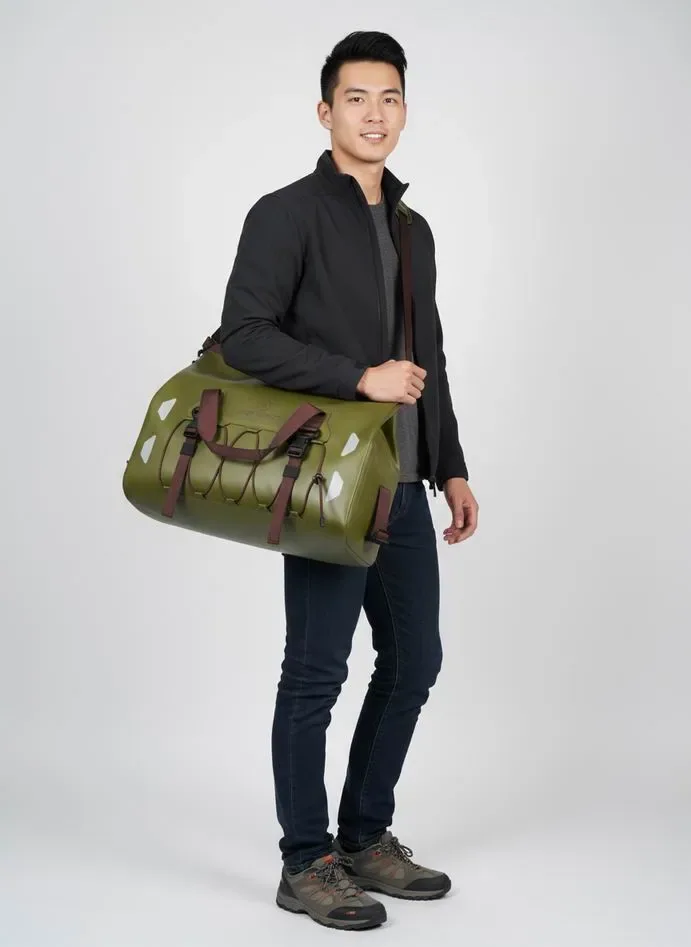
A 20-can insulated bag holding a load pre-chilled to 4 °C needs three 400 g gel packs for a 12-hour window at 25 °C ambient, two for an 8-hour window and four for 16 hours; at 32 °C ambient add one more. Those figures assume the packs are conditioned 12 hours at -18 °C and placed above the load, and they assume an 8 mm closed-cell wall with a welded liner.
How many ice packs a bag needs is an arithmetic question with a known answer, and it is almost never calculated. Buyers ask for "two packs included" because that is what the incumbent product ships, and then the field result varies with the ambient, the starting temperature of the load and where in the bag the packs sit. The arithmetic is not hard: it is the heat that will enter over the window plus the heat the load itself brings, divided by the enthalpy the refrigerant can absorb. This piece sets out the sum, the table that comes out of it, and the placement rules that decide whether the answer holds.
What Has to Be Cooled, and by How Much?
Two loads, not one. The first is the payload: 20 cans of 330 ml is 6.6 kg of liquid, and if it starts at 25 °C and has to reach 4 °C, that is roughly 580 kJ of sensible heat that the refrigerant has to absorb before the clock usefully starts. If the load is already pre-chilled to 4 °C, that term is close to zero, which is why pre-chilling is worth more than an extra pack. The second load is the heat that leaks in through the walls during the window: on an 8 mm 20-can bag at 25 °C that is roughly 25 to 35 watts, or about 90 to 125 kJ per hour.
The refrigerant absorbs both by melting. The latent heat of fusion of water is 334 kJ per kilogram, and a gel pack is mostly water, so a 400 g pack absorbs about 130 kJ as it melts through, plus a smaller sensible term as it warms from its conditioning temperature. Three packs give roughly 390 kJ of latent capacity. Against a pre-chilled load and a 25-35 watt leak, that is about four hours of latent capacity alone — which sounds short of twelve, and is, because the packs also absorb the heat that enters while they are still frozen and because the real bag leaks more than the ideal one.
| Window at 25 °C | Load pre-chilled to 4 °C | Load at 20 °C | Window at 32 °C, pre-chilled |
|---|---|---|---|
| 4 hours | 1 x 400 g | 2 x 400 g | 2 x 400 g |
| 8 hours | 2 x 400 g | 3 x 400 g | 3 x 400 g |
| 12 hours | 3 x 400 g | 4 x 400 g | 4 x 400 g |
| 16 hours | 4 x 400 g | 5 x 400 g | 5 x 400 g |
| 24 hours | 6 x 400 g | Not achievable in a soft bag | Not achievable in a soft bag |
Why Does the Starting Temperature of the Load Matter So Much?
Because the sensible heat of a warm load is large compared with the leak over a short window. Twenty cans at 25 °C carry about 580 kJ of heat above the target; the same cans at 4 °C carry almost none. At a 25-35 watt leak, removing that 580 kJ is the equivalent of four to six hours of leak, which means a warm load costs the same as two extra gel packs. Pre-chilling the load is the single most effective thing a user can do, and it is free.
This is why a bag that performs beautifully in a test with a pre-chilled load performs badly in the field with cans bought at ambient from a shop. The test protocol has to state the starting temperature of the load, and the product instruction has to tell the user to pre-chill. Both cost nothing; neither is usually done.
Does the Type of Refrigerant Change the Count?
Yes, in three ways: enthalpy per kilogram, melt point and contact. Loose cubed ice has the full 334 kJ per kilogram and fills the void between cans, so it cools by contact as well as by absorbing heat; it performs best per kilogram and produces meltwater, which most food programmes cannot accept. Gel packs deliver slightly less than water per kilogram, hold their shape, and produce no free water until the film fails. A eutectic pack formulated to melt at a specific temperature — 0 °C, -11 °C or -21 °C, for example — trades enthalpy for a controlled payload temperature, and it is the right choice where the payload must not freeze.
Contact is the underrated variable. A gel pack lying flat against a row of cans cools the two cans it touches and the air around them; a pack standing in the void between rows cools more of the load. Where the pack-out allows it, distribute the refrigerant through the load rather than stacking it at the bottom, and the same mass does more work.
Where Should the Packs Sit in the Bag?
Cold air sinks, so the intuitive answer — packs at the bottom — is wrong for a bag that is opened from the top. A pack at the bottom cools the lower half of the load and leaves the top warm, and every opening dumps the cold air out of the top of the bag. The working answer is one pack on top of the load, against the lid, and the rest distributed through the load, so the cold is generated where the loss happens.
Where the bag is opened rarely, top placement still wins, because the lid is the largest loss path and a pack against it intercepts that heat before it reaches the load. Where the bag is opened often, the top pack is the one that gets warmest fastest and the distributed packs carry the window. A lid sleeve or pocket that holds the top pack in place is worth specifying, because a loose pack slides to one side on the first corner.
How Does Ambient Change the Answer?
Roughly linearly, because conduction through the wall scales with the temperature difference between the inside and the outside. A bag losing 25 watts at a 21 °C difference loses about 36 watts at a 30 °C difference, so the same three packs that deliver twelve hours at 25 °C deliver about eight to nine at 34 °C. The practical rule is to add one pack when the ambient rises above 30 °C, and to state the ambient the recommendation was calculated for.
Direct sun is a separate and larger effect. A dark shell in full sun can run 15 °C above the air temperature, which roughly doubles the leak. Where a bag will be used outdoors, either specify a light-coloured shell or a reflective facing, or allow for the sun rather than for the air temperature. The instruction on the product should say so, because a customer who leaves the bag on a dashboard will otherwise blame the bag.
Does Wall Thickness Change the Number of Packs?
It changes the leak term and therefore the count, but less than buyers expect once the wall is above about 5 mm. Going from 5 mm to 8 mm roughly halves the wall leak, which is worth about one pack over a twelve-hour window. Going from 8 mm to 10 mm is worth less than half a pack. Where the choice is between another pack and another 2 mm of wall foam, the pack usually wins on cost and the foam wins on convenience, because a pack has to be frozen.
The lid and the closure are the exception. Because the lid is the largest loss path on most bags, a foam-filled lid flap reduces the leak more per unit of cost than either another pack or another 2 mm of wall. On a bag that tests short of its window, the order of interventions is the lid flap, then the refrigerant, then the wall.
| Intervention | Typical gain on a 12-hour window | Cost | Needs user action? |
|---|---|---|---|
| Pre-chill the load to 4 °C | 4-6 hours | None | Yes, and it must be on the instruction |
| Add one 400 g pack | 2-3 hours | Low | Yes, it has to be frozen |
| Foam-filled lid flap | 1-2 hours | Low at build, none after | No |
| 5 mm to 8 mm walls | 3-5 hours | Medium, plus weight and cube | No |
| Reflective facing | 1 hour, more in sun | Low | No |
| Distribute packs through the load | 1 hour | None | Yes, through the pack-out instruction |
How Do You Turn This Into a Specification?
- Refrigerant type
- Gel pack, or a eutectic pack where the payload must not freeze
- Mass per unit
- 400 g nominal, with a tolerance
- Count
- Three for a 12-hour window at 25 °C, four above 30 °C
- Melt point
- Stated: 0 °C for beverage, around 5 °C for chilled food
- Conditioning
- 12 hours at -18 °C, or at the stated temperature for a eutectic
- Placement
- One against the lid, the rest distributed through the load
- Load start
- Pre-chilled to 4 °C, stated in the instruction
- Sleeve
- A lid pocket or sleeve that holds the top pack in position
- Enthalpy
- Stated per pack, with a cycle life figure
- Verification
- A route or static test with the stated pack-out
Two of those fields are the ones that get argued about later: the conditioning and the enthalpy. A pack that has been conditioned for two hours instead of twelve delivers a fraction of its capacity, and a pack that has been through five hundred freeze-thaw cycles has lost some of it. State both, and where the programme is a fleet, put the packs on a replacement cycle as well.
Working out how many packs you need
- Pre-chilling the load buys more hours than an extra pack, and it costs nothing.
- Three 400 g packs for twelve hours at 25 °C; add one above 30 °C ambient.
- Put one pack against the lid, because cold air sinks and the lid leaks most.
- Distribute the rest through the load; contact area is the underrated variable.
- Fix the lid flap before adding wall foam or another pack.
How Should the Claim Be Tested?
With the stated pack-out, the stated conditioning and the stated ambient, run to the endpoint the buyer cares about — 5 °C for food, or 50% ice remaining by mass for beverage — on three units with two passing. Log the whole curve rather than the endpoint, because the shape of the curve tells you whether the load was pre-chilled and whether the packs were conditioned, and the endpoint alone does not.
One practical question decides the shape of the run: whether the bag is opened. A static test with no opening is reproducible and it answers a different question from the one a delivery or courier programme is asking. Where the duty involves openings, run both — a closed static run for comparability and an opening run for prediction — and report the two numbers separately rather than blending them. A blended number is the one that cannot be defended in either direction.
Where the number matters commercially, the thermal-profile logic of the ISTA 7 Series is worth adopting for the reporting format even though it is written for rigid shippers. A report that states the conditioning time, the ambient profile and the full curve can be compared with the next test; a report that says "twelve hours" cannot.
One more placement question comes up on every programme: should the pack be inside the liner or in a sleeve outside it. Inside the liner, the pack is in the cooled volume and works directly on the load; outside it, in a sleeve against the wall, the pack does not take up payload space but has to work through the liner film. Inside is marginally more effective and marginally more likely to be left behind by the user; a sleeve in the lid is the compromise most programmes settle on.
A sleeve also solves the loss problem. Loose packs go missing, and a fleet that started with three packs per bag has two per bag within a month. A sleeve stitched or welded into the lid makes the pack part of the bag, and the pack-out instruction then says what it is supposed to say.
What Are the Programme Numbers Around a Pack-Out Decision?
The refrigerant decision does not change the commercial frame: MOQ 500 pcs per style and colourway, sampling 6-10 working days from a signed-off tech pack, bulk production 35-50 days from sample approval, inspection at AQL 2.5 under ISO 2859-1 General Inspection Level II, T/T 30/70, FOB Xiamen. What it changes is the document set, because a pack supplied with the bag is a component with its own compliance position and its own lead time.
A gel pack is a food-contact article in its own right where it can touch food, and its film needs the same declaration as the liner. Where the pack is supplied separately, that is the supplier problem; where it is packed in with the bag, it is the programme problem. Decide which before the first shipment rather than at a retailer review.
Calculate the pack-out before you quote it
Send the format, the window, the ambient and the quantity. You get a refrigerant allowance and a build recommendation within one business day.
Frequently Asked Questions
How many ice packs does a 20-can cooler bag need?
Three 400 g packs for a 12-hour window at 25 °C ambient with the load pre-chilled to 4 °C. Two for eight hours, four for sixteen, and one more whenever the ambient rises above 30 °C.
Should ice packs go on the top or the bottom?
One on top, against the lid, and the rest distributed through the load. Cold air sinks and every opening dumps cold air out of the top of the bag.
Does pre-chilling the cans matter?
More than an extra pack. A load at 25 °C carries about 580 kJ of heat above the target, which is the equivalent of four to six hours of leakage.
Is loose ice better than gel packs?
Per kilogram, yes: it fills the void between cans and cools by contact. It produces meltwater, which most food programmes cannot accept.
What is a eutectic pack?
A pack formulated to melt at a specific temperature, such as 0 °C or -11 °C. It trades some enthalpy for a controlled payload temperature, and it is right where the payload must not freeze.
How long should gel packs be frozen before use?
Twelve hours at -18 °C for a standard 400 g pack. A pack conditioned for two hours is surface-frozen and delivers a fraction of its capacity.
How much heat does a 400 g gel pack absorb?
About 130 kJ as it melts, based on the latent heat of fusion of water at 334 kJ per kilogram, plus a smaller sensible term.
Does adding wall foam reduce the number of packs?
Moving from 5 mm to 8 mm roughly halves the wall leak, worth about one pack over twelve hours. A foam-filled lid flap is the more efficient intervention.
How does ambient temperature change the count?
Roughly linearly: a bag losing 25 watts at a 21 °C difference loses about 36 watts at a 30 °C difference. Add one pack above 30 °C.
Does direct sun change the calculation?
Yes, and by more than the ambient does. A dark shell in full sun can run 15 °C above the air temperature, which roughly doubles the leak.
Do gel packs need their own food-contact documents?
Where the pack can touch food, yes: its film needs the same declaration as the liner under EU 1935/2004 or FDA 21 CFR 177.
Does the pack count change the MOQ or the lead time?
No. MOQ stays at 500 pcs per style and colourway, sampling 6-10 working days, bulk 35-50 days. A supplied pack adds a component and a compliance file.
What inspection applies to a bag supplied with packs?
AQL 2.5 for major defects to ISO 2859-1 at General Inspection Level II, with the pack treated as a component under the same class list.
Do gel packs lose capacity over time?
Yes. After several hundred freeze-thaw cycles the enthalpy falls, which is why a fleet programme should put the packs on a replacement cycle.
People Also Ask
How many ice packs for a 20-can cooler bag?
Three 400 g packs for twelve hours at 25 °C with a pre-chilled load; four above 30 °C ambient.
Where should ice packs go in a cooler bag?
One against the lid and the rest distributed through the load, because cold air sinks and the lid leaks most.
Do I need to pre-chill cans before packing?
Yes. A warm load costs the equivalent of two extra packs, and pre-chilling is free.
Is loose ice better than gel packs?
It performs better per kilogram but produces meltwater, so gel or eutectic packs are usual for food programmes.
How long do gel packs last in a cooler bag?
About four hours of latent capacity each on a 20-can bag at 25 °C, extended by pre-chilling the load.
Sources and further reading
Every figure on this page is either our own programme data or attributed below. Open the originals before you write them into a specification.
- ISTA 7 Series — Thermal transport packaging performance testsInternational Safe Transit Association
- ISO 2859-1:1999 Sampling procedures for inspection by attributesInternational Organization for Standardization
- ASTM C518 — Steady-state thermal transmission properties by heat flow meterASTM International