What Is a Thermal Courier Bag and How Is It Built for 4-Hour Routes?
A courier bag for a four-hour route is a refrigerant allowance and an opening discipline more than a wall thickness: 6-8 mm closed-cell foam, a welded liner, a covered sealable closure, about 150 g of gel per litre of payload at 25 °C, and a fixed pouch for the logger.

A thermal courier bag built for a four-hour route is a specification about refrigerant mass and opening discipline, not about wall thickness. The working build is 6-8 mm closed-cell foam, a welded liner, a covered closure, a documented refrigerant load of roughly 150 g of gel per litre of payload for a four-hour window at 25 °C, and a pouch for the temperature logger and the paperwork.
Courier duty sits between grocery delivery and pharmaceutical shipping, and it inherits requirements from both. The load is valuable and often regulated, the route is four hours or longer, the bag is opened at each stop, and the customer wants evidence of what happened in transit. This piece sets out how a four-hour courier bag differs from a delivery bag, how to size the refrigerant for the window, and what has to be in the bag besides the insulation.
What Makes a Courier Bag Different From a Delivery Bag?
Three things: the window, the consequence and the evidence. A delivery bag is judged over 45 minutes and its failure is a cold meal; a courier bag is judged over four hours and its failure can be a rejected pharmaceutical consignment or a spoiled laboratory sample. That difference moves the specification from "keep it cool" to "keep it within a stated band for a stated time, and prove it".
The consequence is that a courier bag is specified with a refrigerant, a logger and a chain-of-custody method as part of the article, rather than as accessories the operator adds. Where a delivery specification ends at the bag, a courier specification ends at the record: what was loaded, at what temperature, how long it travelled, and what the logger says at the far end.
How Much Refrigerant Does a Four-Hour Window Need?
Enough to absorb the heat that will enter over four hours plus the sensible heat of anything loaded above the target band. As a working rule for a chilled payload at 2-8 °C, allow about 150 g of gel per litre of payload for a four-hour window at 25 °C ambient, rising to roughly 220 g per litre at 32 °C, on a 6-8 mm build. That is a starting point, not a result: it has to be verified against the actual pack-out and the actual route.
Two corrections matter more than the base figure. The payload usually arrives warmer than the target band, and every kilogram that has to be pulled down from 20 °C to 5 °C consumes refrigerant that was allowed for the route. And the gel has to be conditioned properly: a pack taken from a -18 °C freezer and loaded immediately is close to -18 °C and will freeze the payload, while a pack conditioned at 0 °C will not freeze it but delivers less cooling. State the conditioning regime in the pack-out instruction.
| Payload | Volume | Gel at 25 °C, 4 hours | Gel at 32 °C, 4 hours | Conditioning |
|---|---|---|---|---|
| Small pouch | 4 L | 600 g | 880 g | 12 hours at the stated temperature |
| Courier satchel | 10 L | 1,500 g | 2,200 g | 12 hours at the stated temperature |
| Sample case | 16 L | 2,400 g | 3,500 g | 12 hours at the stated temperature |
| Multi-drop crate liner | 30 L | 4,500 g | 6,600 g | 12 hours at the stated temperature |
| Frozen payload | 10 L | 2,600 g eutectic | 3,600 g eutectic | 24 hours below -18 °C |
Does the Bag Need a Temperature Logger Pouch?
Where the customer needs evidence, yes, and the pouch is a specification item rather than a convenience. A logger left loose in the bag ends up against a gel pack, reads the pack temperature rather than the payload temperature, and produces a record that shows an excursion nobody can interpret. A fixed pouch in a defined position — against the payload, away from the refrigerant and away from the wall — produces a record that can be defended.
Specify the pouch by position and by access: it has to be reachable without unpacking the payload, because the operator is going to retrieve the logger at the drop. A mesh or open-mesh pocket keeps the logger in the air stream rather than insulated against a wall, and a colour-contrasted liner makes it findable in a hurry.
What Closure and Security Features Does Courier Duty Need?
A courier bag carries a chain of custody, so the closure has to do two jobs: seal the thermal envelope and show whether it has been opened. The common answers are a coil zipper with a slider that accepts a cable tie or a numbered seal, a zipper with a locking slider, and a roll-top with a buckle and a seal point. Each has a thermal cost: a roll-top seals best and is slowest to work, a zipper is fastest and seals least well.
Where the payload is regulated — pharmaceuticals, clinical samples, certain food categories — the seal is part of the record and the seal number goes on the paperwork. Specify the seal point on the drawing, because a slider with no hole for a tie is a slider that cannot be sealed, and retrofitting it in the field means the operator uses tape.
How Does the Opening Pattern Change the Build?
A courier route has fewer stops than a delivery route but longer dwell per stop, and the bag is often opened in a vehicle or on a doorstep in full ambient. The dominant loss is still the opening, so the same answers apply: a smaller internal volume than the payload strictly needs, a divider so only part of the bag opens, and a pack-out order that puts the last drop at the bottom. Where the route has many stops, a multi-compartment build outperforms a single large cavity at equal foam thickness.
There is a second pattern worth designing for: the bag that is opened, closed, and then left in a hot vehicle between stops. A bag in a closed vehicle in summer reaches an internal ambient far above the outside temperature, and the refrigerant is consumed by the cabin rather than the route. Where that is the operating pattern, either the bag travels in a cooled compartment or the refrigerant allowance has to be set for the cabin temperature.
Which Materials Suit Four-Hour Duty?
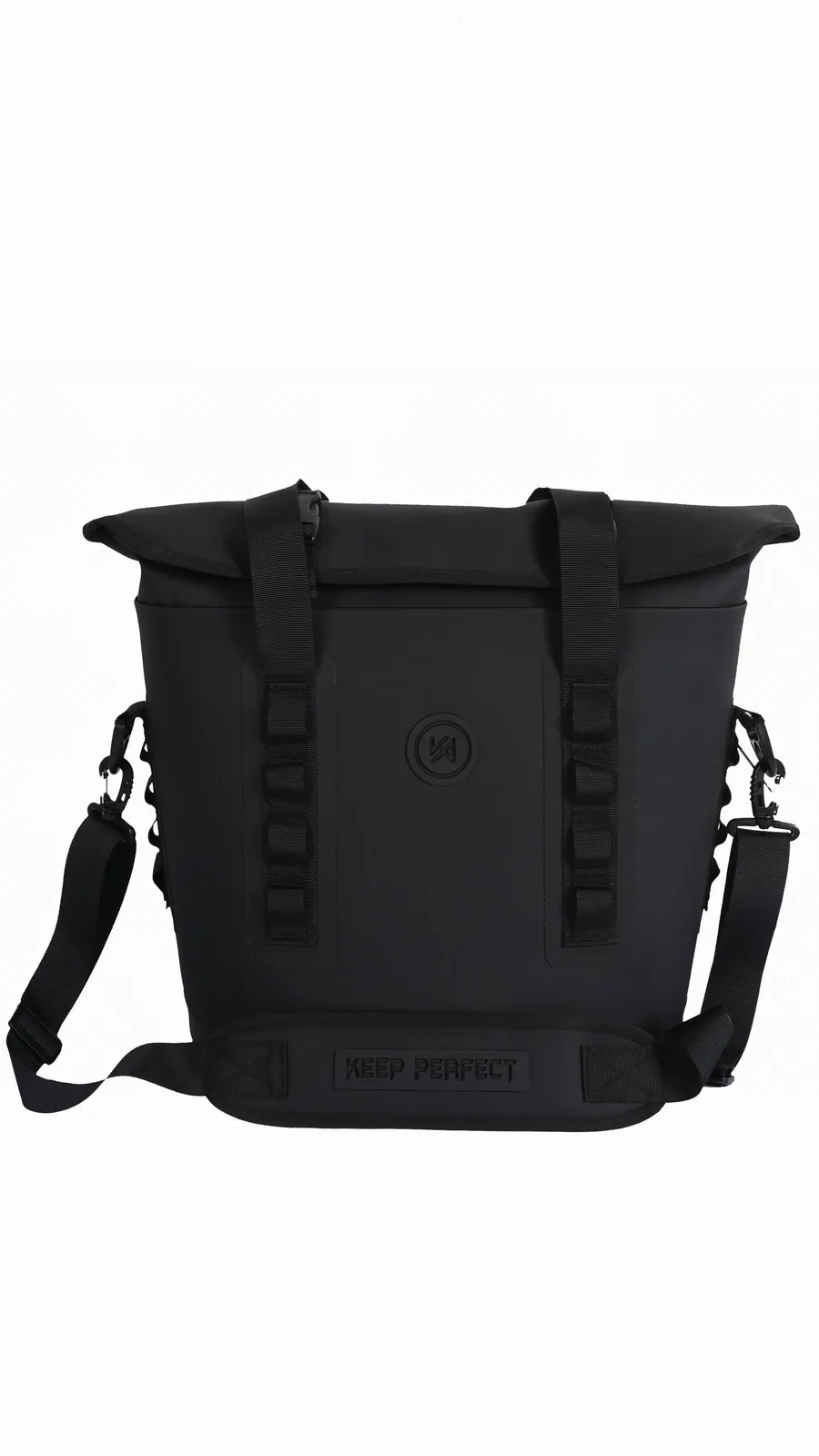
A 6-8 mm closed-cell PE or IXPE wall with a welded liner is the working build, and the material decision is mostly about the liner and the shell. A welded PEVA liner at 0.15 mm is adequate for chilled duty and wipes clean; where the payload is frozen or the bag is washed at temperature, TPU is the better film. The shell wants abrasion resistance more than it wants denier: a 600D polyester with a PU coating outlasts a heavier uncoated fabric in courier service, because the failure is abrasion at the base and the corners rather than tearing in the panel.
Where the bag is carried on a shoulder for hours, the strap is a specification item: a 38 to 50 mm webbing with a pad, anchored into a reinforced panel and stitched to a stated stitch class under ASTM D6193. A strap that pulls out is a dropped payload, and on courier duty that is the most expensive failure in the article.
How Is a Courier Bag Tested for a Four-Hour Claim?
As a route simulation with the refrigerant, the payload simulant, the opening pattern and the ambient all stated, run to the endpoint the customer cares about — usually the upper or lower bound of a stated band rather than a single temperature. A 2-8 °C payload is tested to 8 °C, not to 5 °C, and a frozen payload to -12 °C. Run three units and require two to pass, and log the whole curve rather than the endpoint alone.
Then run the abuse tests that a courier bag meets and a delivery bag does not: a loaded drop test, a strap pull test to a stated load, and a seal-integrity check. Those three cost little to specify and they are the ones that decide whether the bag survives its second month.
| Test | Method | Acceptance | Why courier duty needs it |
|---|---|---|---|
| Thermal route simulation | Payload simulant, stated gel mass, stated openings, 25 °C or 32 °C | Two of three units within the band at four hours | The claim is the product |
| Loaded drop test | Filled to rated weight, dropped from a stated height onto a stated surface | No seam opening, no hardware failure | A dropped payload is the expensive failure |
| Strap pull test | Stated load applied to the strap attachment | No detachment, no stitch failure | Hours of carrying on one shoulder |
| Seal integrity | Seal applied, opened, inspected | Evidence of opening is unambiguous | Chain of custody |
| Weld leak test | Inflation or water bath on the liner | No leak at a stated pressure | The payload cannot get wet |
What Goes in the Bag Besides the Insulation?
- Wall build-up
- 6-8 mm closed-cell foam, base and walls, 8 mm lid
- Liner
- Welded PEVA at 0.15 mm, or TPU for frozen or washed duty
- Shell
- 600D polyester with a PU coating, abrasion specified
- Closure
- Coil zipper with a sealable slider, covered storm flap
- Refrigerant
- Mass, melt point and conditioning regime, stated
- Logger pouch
- Fixed position against the payload, open mesh
- Strap
- 38-50 mm webbing with a pad, anchored into a reinforced panel
- Identification
- Numbered panel for fleet and consignment tracking
- Documentation
- A pouch for the paperwork, sized to the document
- Change control
- Written notice before any material substitution
The last two are the ones operators ask for after the first month. A numbered panel turns a fleet of identical bags into a tracked asset population, and a document pouch that fits the actual paperwork stops the paperwork being folded into the payload cavity, where it interferes with the seal and the thermal envelope.
Building for a four-hour route
- Size the refrigerant by payload volume and ambient, then verify on the route.
- Condition the gel properly: a -18 °C pack will freeze a chilled payload.
- Fix the logger position, or the record cannot be defended.
- Design the closure for the seal as well as the thermal envelope.
- Specify the strap and run a loaded drop test, because courier duty is hard duty.
How Do the Programme Numbers Work for a Courier Fleet?
The same frame as every other insulated style: MOQ 500 pcs per style and colourway, sampling 6-10 working days from a signed-off tech pack, bulk production 35-50 days from sample approval, inspection at AQL 2.5 under ISO 2859-1 General Inspection Level II, T/T 30/70, FOB Xiamen. Courier builds often include a sourced component — a branded slider, a moulded base or a divider — which moves sampling toward the 12-15 working day end.
Courier fleets also reorder in tranches and replace on condition rather than on a calendar, which makes the reorder addendum more valuable here than in any other duty. Hold the reference sample, record the weld parameters, and require notice before a substitution, because a courier bag that performs differently from the one that was validated is a bag whose validation is void.
The refrigerant also needs a home. A gel pack loose in the cavity ends up against the payload, can freeze it, and slides to the bottom of the bag at every stop; a sleeve or a pocket in the lid or the wall holds it where the pack-out instruction says it should be. That pocket is low in cost, it is the difference between a validated system and a hopeful one, and it belongs on the drawing rather than in the instruction alone.
A third design question deserves its own answer: how the bag carries. Courier work is hours of carrying, often on one shoulder, frequently with the bag partly loaded and shifting. A single strap concentrates the load on one shoulder and produces the posture that causes the strap attachment to fail; a two-strap harness distributes it and is faster to stabilise on a step. Where the payload is heavy, a waist stabiliser is worth the cost because it stops the bag swinging at every stop.
The strap specification that follows is width, padding and anchorage. Thirty-eight millimetres is the working minimum for a four-hour carry, 50 mm where the payload exceeds 10 kg, and the anchor has to be a box-stitch and bar-tack into a reinforced panel that reaches the base rather than a side seam stitched to ASTM D6193 with no reinforcement behind it. Those two sentences prevent the majority of courier bag warranty claims.
What Is the Most Common Mistake on Courier Programmes?
Validating the bag and not the system. A bag validated with a stated gel mass, a stated conditioning regime and a stated pack-out performs as validated; the same bag loaded by an operator who uses one pack instead of two, straight from a domestic freezer, in a hot vehicle, will not. The validation belongs to the system, and the pack-out instruction is part of the deliverable.
The second mistake is validating once and treating it as permanent. Refrigerant lots change, gel packs age and lose enthalpy, and a bag that held four hours in year one can hold three and a half in year three for no reason visible on the bag. Put a re-validation on the calendar and the number stays true.
Specify the bag as part of the system
Send the payload, the window, the ambient and the quantity. You get a build and a refrigerant allowance within one business day.
Frequently Asked Questions
What is a thermal courier bag?
An insulated bag specified for a multi-stop route of several hours where the payload has to stay inside a stated temperature band and the transit has to be evidenced, usually with a logger and a seal.
How much gel does a four-hour route need?
About 150 g per litre of payload at 25 °C ambient and roughly 220 g per litre at 32 °C, on a 6-8 mm build, then verified against the actual pack-out.
Should the gel be frozen solid?
It depends on the payload. A pack at -18 °C will freeze a chilled payload; condition the pack at the temperature the payload can tolerate and state that in the instruction.
Where should the temperature logger sit?
In a fixed pouch against the payload, away from the refrigerant and away from the wall, in open mesh so it reads the air rather than the pack surface.
Does the zipper need to be sealable?
Where the payload carries a chain of custody, yes. Specify a slider that accepts a numbered tie or a lock, and put the seal point on the drawing.
How is a four-hour claim tested?
As a route simulation with the payload simulant, the gel mass, the opening pattern and the ambient stated, run to the bound the customer cares about, with two of three units passing.
What band should a chilled payload be held in?
Commonly 2-8 °C, tested to the upper bound of 8 °C. A frozen payload is commonly tested to -12 °C.
What abuse tests should be specified?
A loaded drop test, a strap pull test to a stated load, a seal-integrity check and a weld leak test. Those decide whether the bag survives its second month.
Does the vehicle matter?
Enormously. A bag left in a closed vehicle in summer sees a cabin temperature far above the outside ambient, and the refrigerant allowance has to be set for the cabin.
What is the MOQ for a courier bag?
500 pcs per style and colourway, with repeat tranches open to discussion at 300 pcs.
How long does sampling take?
6-10 working days, moving toward 12-15 where a sourced component such as a branded slider or a moulded base is involved.
Why does a validated bag stop performing?
Usually the system rather than the bag: one pack instead of two, a different conditioning regime, or gel that has aged and lost enthalpy.
Should the validation be repeated?
Yes, on a calendar. Refrigerant lots change and gel packs age, so a bag that held four hours in year one can hold less in year three.
What inspection applies to a courier fleet order?
AQL 2.5 for major defects to ISO 2859-1 at General Inspection Level II, with a class list written for courier duty and zero acceptance for critical defects.
People Also Ask
What is a thermal courier bag?
An insulated bag specified for multi-hour routes where the payload must stay inside a temperature band and the transit is evidenced.
How long will a courier bag hold temperature?
Four hours with the correct refrigerant mass on a 6-8 mm build, verified against the route rather than in a chamber.
How many gel packs do I need for four hours?
About 150 g of gel per litre of payload at 25 °C ambient, rising to roughly 220 g at 32 °C.
Do courier bags need temperature loggers?
Where the customer needs evidence, yes, in a fixed pouch positioned against the payload.
What makes a courier bag different from a pizza bag?
The window, the consequence of failure, and the requirement to evidence the transit.
Sources and further reading
Every figure on this page is either our own programme data or attributed below. Open the originals before you write them into a specification.
- ISTA 7 Series — Thermal transport packaging performance testsInternational Safe Transit Association
- ISO 2859-1:1999 Sampling procedures for inspection by attributesInternational Organization for Standardization
- ASTM D6193 — Standard Practice for Stitches and SeamsASTM International