Does a Rain Cover or a Sealed Zipper Keep a Camera Bag Dry?
The two are not competing answers to the same question. A covered coil zipper with a coated tape handles the light shower with nothing to deploy, and a rain cover handles an hour of driving rain. Name the condition before choosing between them.
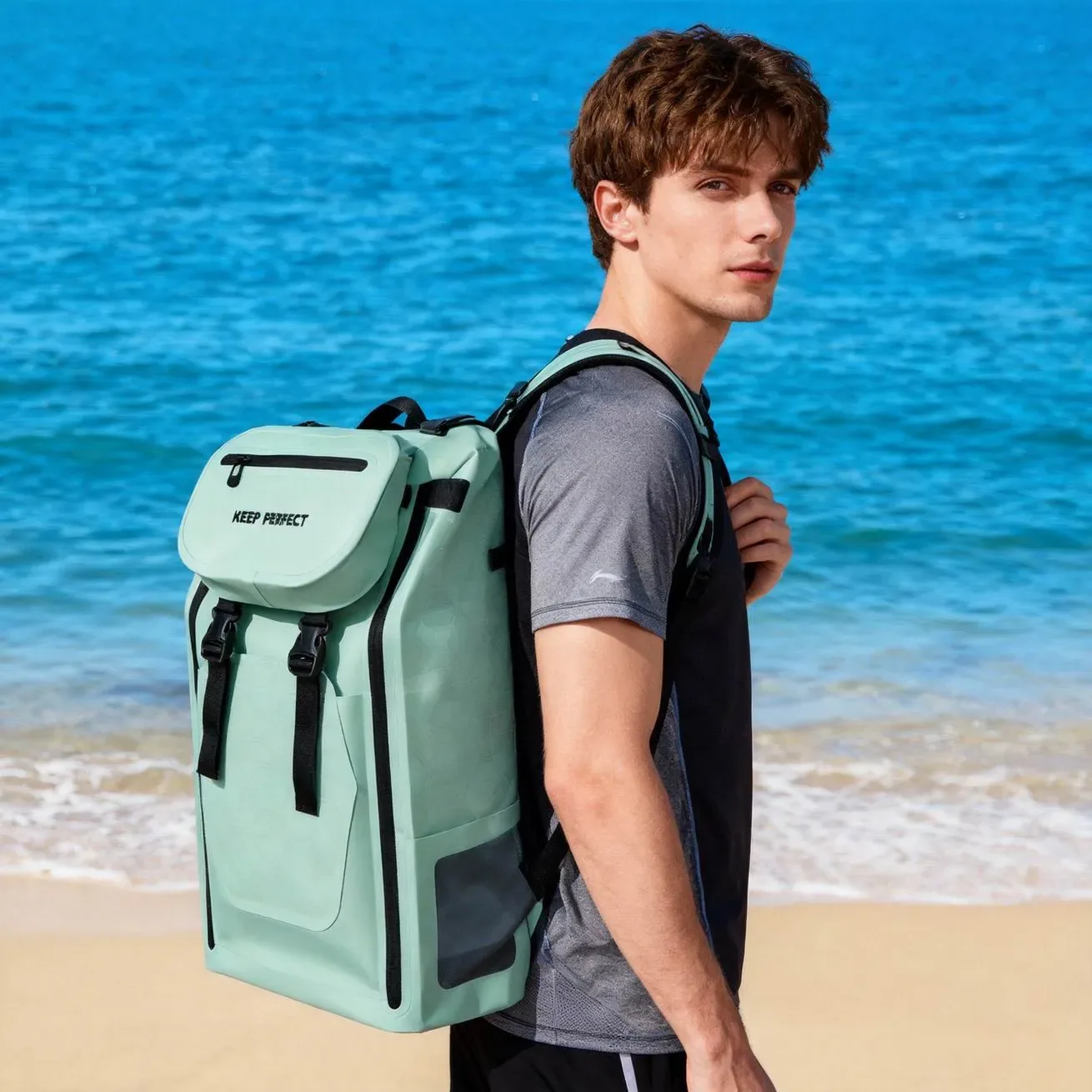
A rain cover is a barrier over the outside of the bag and it works in a real downpour, but it has to be found, fitted and not lost. A weather-resistant zipper under a covered flap is always in place and always working, and it handles the shower that catches nine users out of ten, but it is not a submersible seal. Most programmes should specify the covered zipper as standard and the rain cover as an included accessory, because they fail in different conditions.
Weather protection on a camera bag is sold as a single word and delivered as a choice between two incompatible strategies. One puts a barrier over the outside of the bag: a rain cover that deploys from a pocket and sheds water over the whole shell. The other seals the components that leak: a coated zipper under a covered flap, taped seams, and a shell with a durable water-repellent finish. They cost differently, they weigh differently, and they fail in completely different conditions.
The reason to be precise about this is that the two are frequently confused in a specification and the confusion ends in a returned bag. A buyer asks for weather resistance, receives a bag with a coated zipper, sells it as stormproof, and discovers that the coat is fine but the shoulder strap stitching wets through in twenty minutes. Neither strategy is wrong. Both are incomplete on their own.
What Is Actually Being Kept Out, and From Where?
There are three conditions and the specification has to name one. A shower is ten minutes of light rain from above, and it is the condition that catches most users and that a covered zipper handles well. A downpour is an hour of driving rain from a direction, and it needs a barrier because water finds the strap roots, the back panel and the base seam regardless of the zipper. Immersion is the bag being set down in standing water, and no soft camera bag survives it without a welded liner and a roll closure.
The distinction matters because the tests differ. Surface wetting, which is the shower case, is tested by a spray test under ISO 4920 and reported as a rating. Resistance to penetration under pressure, which is the standing-water case, is tested by hydrostatic head under ISO 811 and reported in millimetres of water column. A fabric can score well on the spray test and fail the hydrostatic head test, and the two numbers are not interchangeable.
| Condition | What the weather does | What works | What to test |
|---|---|---|---|
| Shower | Light rain for ten minutes, from above | Durable water-repellent finish plus a covered coil zipper | Spray test, ISO 4920 |
| Downpour | Driving rain for an hour, from a direction | A deployed rain cover over the whole shell | Rain test, AATCC 35, with a stated duration |
| Standing water | The bag set down in a puddle | A welded liner and a roll closure; no soft bag is otherwise safe | Hydrostatic head, ISO 811 |
| Splash and spray | Boat deck, waterfall viewpoint, sea spray | Coated shell plus a covered zipper plus a rain cover | Spray test plus a visual inspection after drying |
How Does Water Actually Get Into a Camera Bag?
Water enters at four places and the zipper is only one of them. The zipper line is the most obvious, because teeth and tape are a continuous gap in the shell. The second is the seam: a sewn seam is a line of needle holes, and on the base seam those holes sit in whatever the bag is standing in. The third is the strap root and the handle root, where stitching passes through the shell and where water runs down the webbing and in.
The fourth is the back panel and it is the one nobody thinks about. A back panel with padding and a mesh covering holds water against the wearer for an hour and transfers it slowly into the interior by capillary action through the foam. A programme that seals the zipper and ignores the back panel will produce a bag that keeps the camera dry and gives the user a wet shirt, which is a different complaint and the same return.
What Does a Rain Cover Do Well?
A rain cover is the only thing on a soft bag that genuinely handles an hour of driving rain, because it removes the whole problem rather than treating its parts. It sheds water over the shell, over the seams, over the strap roots and over the back panel at once, and it does it with a single component that costs a fraction of a sealed build. Where a programme expects real weather, a rain cover is not an accessory, it is the product.
It also has a property that matters commercially: it is visible. A customer who sees a rain cover in the lid pocket understands that the bag was designed for weather, whereas a coated zipper under a flap is invisible and has to be explained in copy. For a brand selling into a market where weather is a purchase driver, the visible component is worth more than the marginal performance it adds.
What Does a Rain Cover Do Badly?
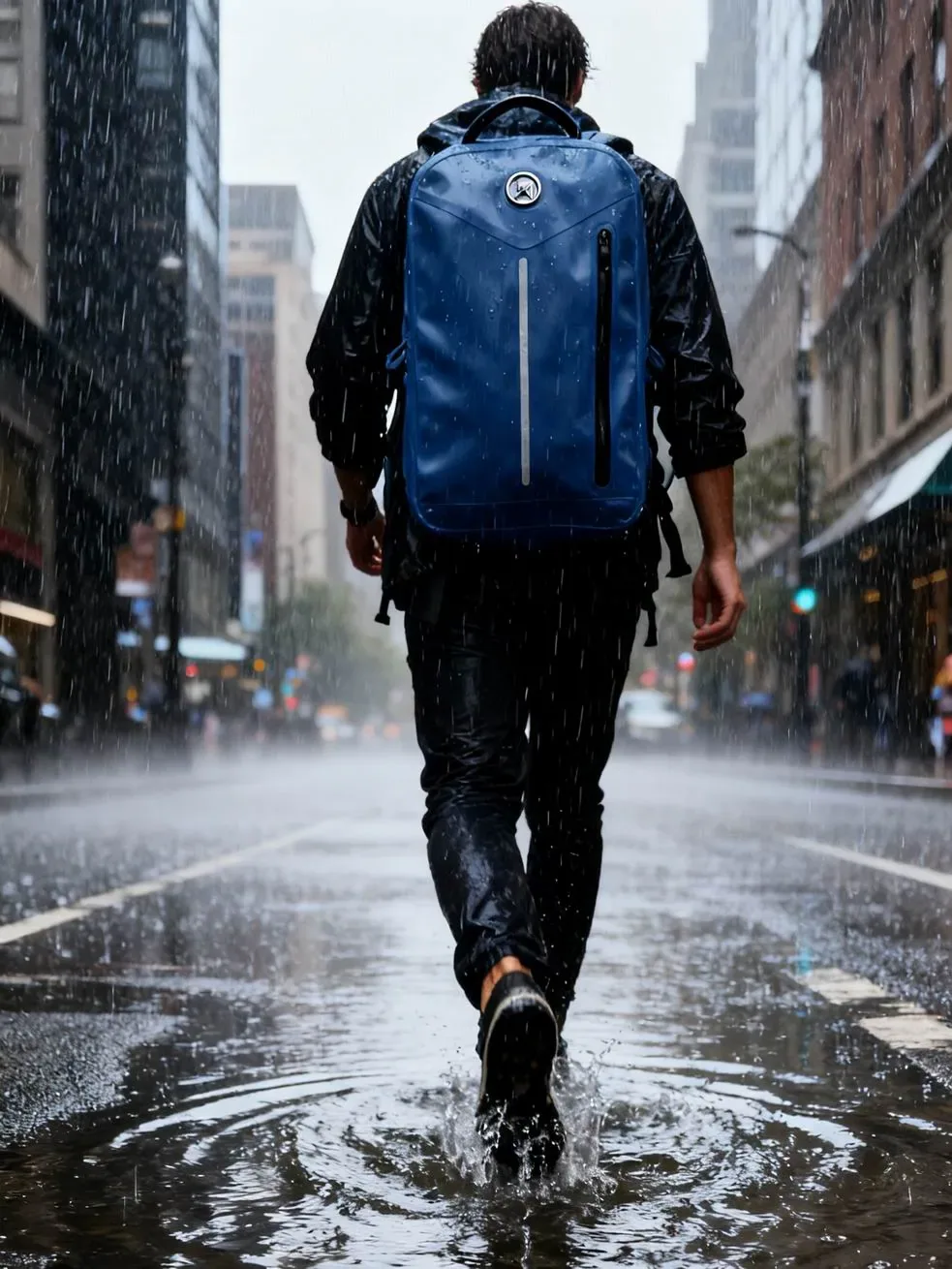
The failure mode of a rain cover is human rather than technical, and it is the reason the covered zipper exists. A cover has to be found, unfolded, fitted over the bag and secured, and it has to be done before the gear is wet. Users do not do it in a light shower, because a light shower does not feel serious, and a light shower is exactly the condition a covered zipper handles and an unfolded cover does not.
The second failure is loss. A cover removed after use gets stuffed into a pocket, dries stiff, and is left behind; the replacement rate on detachable covers is high enough that some programmes now tether them to the bag with a short webbing leash and a cord lock, which costs almost nothing and removes the complaint. A cover that is tethered, labelled and stored in a dedicated pocket is a different product from one that is not.
What Makes a Zipper Weather-Resistant?
Three things, in order. The first is the tape: a coated or laminated tape does not wet out, whereas an uncoated polyester tape wicks water along its length and into the bag. The second is the construction: a reverse coil, where the coil sits on the inside of the tape and the outside is a smooth coated face, sheds water where a standard coil holds it in the teeth. The third is the cover: a storm flap over the line, which is what actually does the work.
The flap is the part that is most often undersized. A flap that covers the line by 10 mm will lift in wind and let water run down behind it; 25 mm of cover, with the flap held down by hook-and-loop or by a magnetic closure at each end, keeps the line dry in a shower. Where the zipper runs around a corner or down a vertical face, the flap has to be cut to follow it, and that is a pattern decision rather than a trim decision.
Which Zipper Size and Type for a Camera Bag?
Camera bags use coil zippers in the #5 to #10 range. A #5 is right for a small pouch or an accessory pocket, a #8 for the main opening on a shoulder bag, and a #10 for a long main opening on a larger bag or for a bag whose opening is under load from the contents. The size is a measure of the tape and tooth width, and it decides both the strength of the line and how well a covered flap sits over it.
The type matters as much as the size. A coated reverse coil is the usual answer for weather, a standard coil for a lining or an internal pocket, and a moulded tooth zipper where the line has to be very strong or has to run through a curve. Separating zippers, which open fully at the bottom, are needed for a lid that has to come off and are a known leak point at the bottom stop, so a separating line needs a garage or a covered box at the end.
| Zipper | Where it belongs | Weather behaviour | Note |
|---|---|---|---|
| #5 coated reverse coil | Accessory pockets, small pouches | Good under a flap | Too light for a loaded main opening |
| #8 coated reverse coil | Main opening on a shoulder bag | Good under a 25 mm flap | The default choice for most camera bags |
| #10 coated coil | Long main opening, opening under load | Good, needs a wider flap | Heavier pull, more tape to cover |
| #8 moulded tooth | Lines that run through a curve | Fair: the teeth hold water | Strong, but needs a generous cover |
| #8 separating coil | A lid that comes off completely | Weak at the bottom stop | Needs a garage or a covered end box |
Do the Seams Have to Be Sealed Too?
On the base seam, yes. A sewn base seam is a line of needle holes at the lowest point of the bag, and it is the first place a bag standing in wet grass lets water in. The two options are a taped seam, where a waterproof tape is heat-applied over the stitching on the inside, and a welded seam, where the panels are joined without needle penetration at all. Taping is the usual answer on a fabric bag; welding requires a coatable substrate.
The rest of the seams usually do not need sealing if the shell carries a durable water-repellent finish and the panels are cut so that the seam does not sit on a horizontal surface. The specification decision is therefore about geometry as much as about tape: move the seam off the base and up the wall by 20 mm, and the same shell performs better without any added component. That is a free improvement and it is usually missed.
How Is Weather Resistance Tested and Reported?
Fabric is tested by two laboratory methods and reported as two different numbers. Resistance to surface wetting is a spray test, ISO 4920, reported as a rating from 0 to 5 after a stated exposure. Resistance to penetration under pressure is a hydrostatic head test, ISO 811, reported as the height of a water column in millimetres at which the third drop penetrates. Both are run on flat fabric, not on a made-up bag, which is the limitation to state in any claim.
Made-up product is tested by a rain test, of which the best known is AATCC 35, where the item is exposed to a controlled spray for a stated duration and the interior is then inspected for moisture. There is no pass or fail limit in the method, so the programme has to set its own: for example, no more than a stated area of dampness on a blotter placed in the main compartment after twenty minutes. Write that limit into the protocol before sampling.
- Condition
- Shower, downpour or standing water, named and not implied
- Shell fabric
- Denier and construction, plus the finish and its durability in wash cycles
- Spray rating
- Minimum rating under ISO 4920 after a stated number of launderings
- Hydrostatic head
- Minimum head in millimetres under ISO 811 where standing water applies
- Zipper
- Size, type, tape coating, and orientation of the coil
- Storm flap
- Cover width, 25 mm minimum, and the closure at each end
- Seams
- Taped or welded on the base; seam moved off the base by 20 mm
- Back panel
- Closed-cell foam that does not wick, with a drain path at the base
- Rain cover
- Fabric, taped seams, dedicated pocket, tether and cord lock
- Product test
- Rain test with a stated duration and a stated acceptance limit
What Does a Sealed Build Cost in Weight and Price?
The zipper step is the expensive one. Moving a main opening from a standard #8 coil to a coated reverse coil with a laminated tape roughly doubles the cost of that line, and the storm flap adds the fabric, the hook-and-loop or magnetic closures and two more sewing operations. The shell finish costs far less by comparison, and it is the best value of the three: a durable water-repellent finish costs a small amount per metre and does most of the work in the shower case.
The rain cover is the lowest-cost component of the four and the heaviest in use: a cover for a mid-size bag is about 60 to 90 g with its tether, adds a pocket and a label, and adds one more thing that can be wrong on an inspection. Weight is not the deciding factor; the deciding factor is that a cover works in the condition the sealed zipper does not. Specify both and the bag handles all four conditions in the table above.
Should a Programme Specify One or Both?
Both, in most cases, and the reason is that the two strategies cover different events rather than the same event twice. The covered zipper with a shell finish handles the light shower, which is the common case, and it does so with nothing to deploy and nothing to lose. The rain cover handles the downpour, which is the case that produces a damaged camera and an insurance claim rather than a complaint.
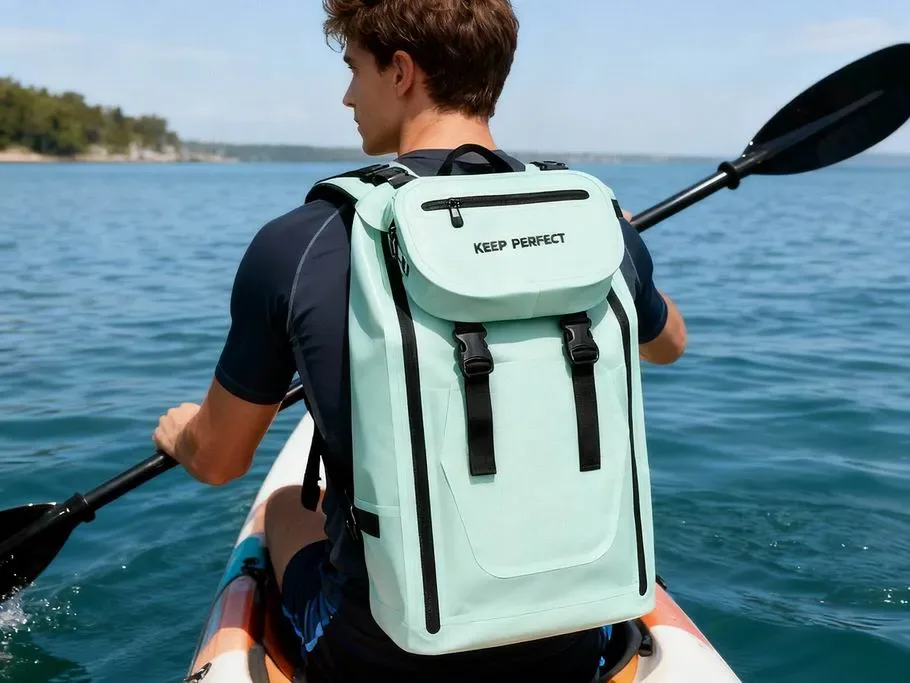
Where a programme can only afford one, the choice depends on the market. A bag sold for urban and studio use should take the covered zipper, because the user will never deploy a cover in the conditions they meet. A bag sold for landscape, wildlife or marine use should take the rain cover, because the user will meet a downpour and will expect to fit one. The wrong choice is a sealed zipper sold into a market that gets real weather.
What decides rain cover versus sealed zipper
- Name the condition first: a shower, a downpour or standing water need three different answers.
- A covered zipper handles the common shower case with nothing to deploy and nothing to lose.
- A rain cover is the only soft-bag answer for an hour of driving rain, and it should be tethered.
- Water enters at the zipper, the base seam, the strap roots and the back panel, in that order of frequency.
- ISO 4920 and ISO 811 test flat fabric; a made-up bag is tested by a rain test with a stated limit.
- Moving the base seam 20 mm up the wall is free and removes the most common leak point.
How Do You Write the Weather Requirement Into a Tech Pack?
The tech pack has to separate the fabric requirement from the product requirement, because they are tested differently and are reported differently. The fabric requirement is a spray rating and a hydrostatic head with the finish and its durability named. The product requirement is a rain test with a duration, an orientation and an acceptance limit written as an area of dampness on a blotter, not as the word dry.
Then name the components. Zipper by size, type and tape coating; flap by cover width and end closure; seam by method and by position; cover by fabric, seam method, storage, tether and marking. A specification that says weather-resistant and stops there gives the pattern room four decisions it will make on price, and the result will be a bag that fails the condition the user actually meets.
Programme arithmetic does not change with the weather specification: MOQ 500 pcs per style and colourway, sampling 6-10 working days from a signed-off tech pack, bulk production 35-50 days from written sample approval, inspection at AQL 2.5 under ISO 2859-1 General Inspection Level II, payment T/T 30/70, quoted FOB Xiamen. What changes is the trim list, and a coated zipper is a trim item that has to be ordered in before sampling starts.
Send the weather condition with the enquiry
Send where the bag will be used, the zipper sizes you need and the target quantity. You get a build recommendation, indicative pricing and a sampling window within one business day.
Frequently Asked Questions
Is a rain cover better than a sealed zipper on a camera bag?
They handle different conditions. A covered zipper handles a shower with nothing to deploy; a rain cover handles an hour of driving rain. Most programmes should specify both.
What does a weather-resistant zipper actually do?
A coated or laminated tape does not wet out, a reverse coil puts the smooth face outwards, and a storm flap over the line does most of the work. The flap needs at least 25 mm of cover.
What zipper size should a camera bag main opening use?
A #8 coated reverse coil for a shoulder bag, a #10 for a long opening or one under load, and a #5 for accessory pockets.
How is water resistance on a camera bag tested?
Flat fabric by spray test ISO 4920 and hydrostatic head ISO 811. A made-up bag by a rain test with a stated duration and a stated acceptance limit, because the standard carries no pass or fail figure.
Where does water get into a camera bag first?
The zipper line, then the base seam, then the strap and handle roots, then the back panel which holds water against the wearer and wicks it through the foam.
Do all the seams need taping?
The base seam does, because it is a line of needle holes at the lowest point. The rest usually do not, provided the panels are cut so the seam sits 20 mm up the wall rather than on the base.
Why do rain covers go missing?
They are removed after use, dry stiff and get left behind. Tethering the cover to the bag with a short webbing leash and storing it in a dedicated labelled pocket removes most of the complaint.
Is a coated zipper enough for heavy rain?
No. A coated zipper under a flap handles a shower. An hour of driving rain finds the strap roots, the base seam and the back panel regardless of the closure.
What is the difference between the spray test and the hydrostatic head test?
The spray test measures how the surface wets and is reported as a rating; the hydrostatic head test measures resistance to penetration under pressure and is reported in millimetres of water column. Both run on flat fabric.
How much does a rain cover add to a camera bag?
About 60 to 90 g with its tether, a pocket, a label and one more inspection item. It is the lowest-cost of the weather components and the one that works in the worst conditions.
Can a roll closure make a camera bag fully sealed?
With a welded liner, yes for standing water. Without one, a roll closure on a sewn bag still leaks at the seams, because the needle holes are not at the closure.
Does the weather specification change the lead time?
Not the bulk window, which stays at 35-50 days from sample approval. It can affect the sampling start, because a coated zipper is a trim item that has to be ordered in.
People Also Ask
Do I need a rain cover for a camera bag?
If the bag will meet an hour of driving rain, yes. A covered zipper handles a shower; only a barrier over the whole shell handles a downpour.
What makes a camera bag weather-resistant?
A coated reverse coil zipper under a 25 mm storm flap, a shell with a durable water-repellent finish, and a base seam that is taped or moved off the base.
Are coated zippers fully sealed?
No. A coated tape sheds water and a flap covers the line, but a coil zipper is not a submersible seal. Standing water needs a welded liner and a roll closure.
How do you test whether a camera bag keeps water out?
Fabric by ISO 4920 spray and ISO 811 hydrostatic head; the made-up bag by a rain test at a stated duration with an acceptance limit written into the protocol.
Why is the inside of my camera bag damp after light rain?
Usually the back panel or the base seam. Padded back panels hold water against the wearer and wick it in; a sewn base seam sits in whatever the bag stands in.
Sources and further reading
Every figure on this page is either our own programme data or attributed below. Open the originals before you write them into a specification.
- ISO 811 — resistance to water penetration, hydrostatic pressure testInternational Organization for Standardization
- ISO 4920 — resistance to surface wetting of textile fabrics (spray test)International Organization for Standardization
- AATCC test methods — colourfastness, water resistance and abrasionAmerican Association of Textile Chemists and Colorists