What Insert Does a Champagne Wine Carrier Need?
A champagne bottle is wider, heavier and taller at the shoulder than a still bottle. The cell needs about 96 mm rather than 84 mm, the partition has to reach the shoulder, and a shaped neck block has to hold the neck of one bottle off the shoulder of the next.
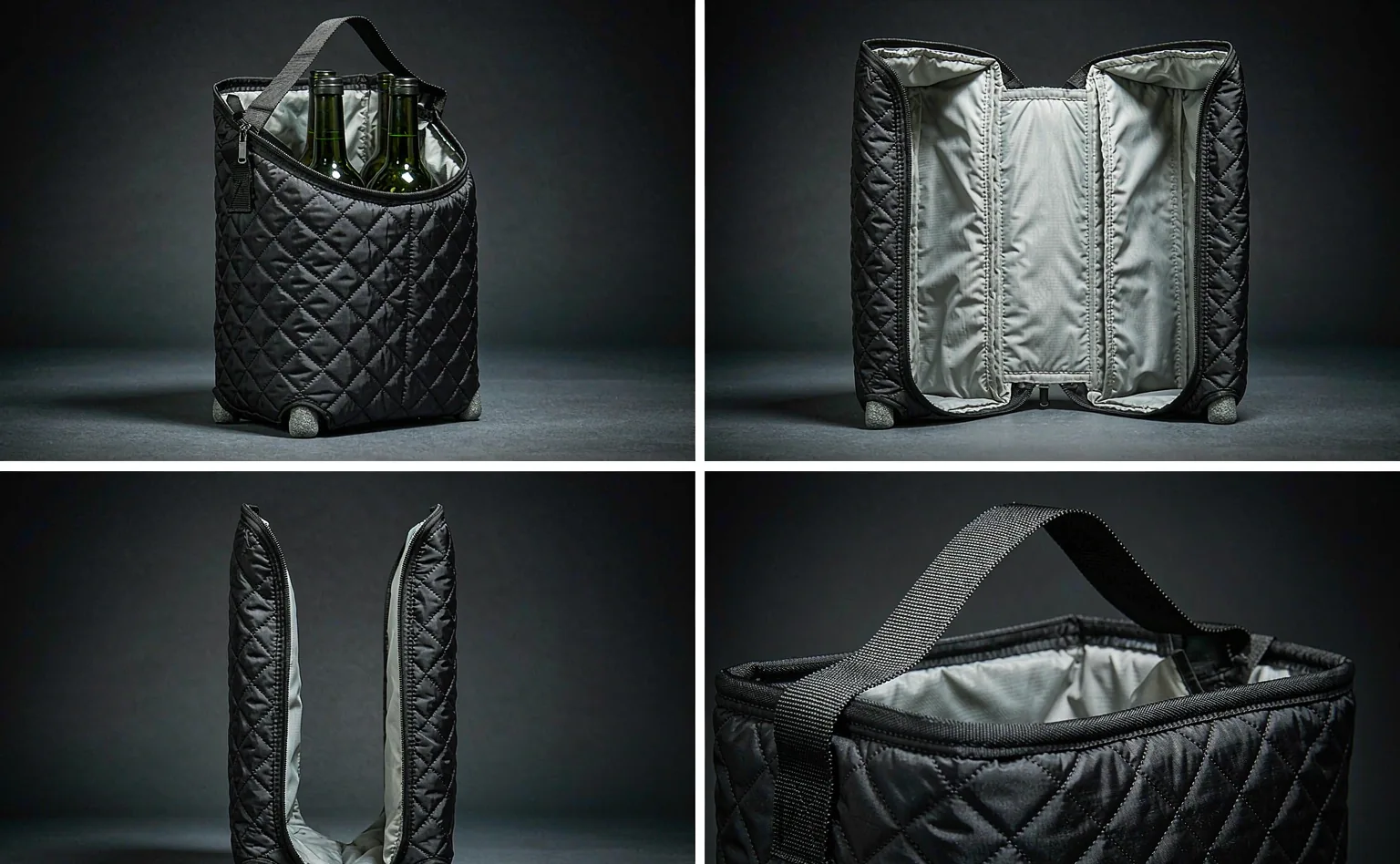
A champagne bottle is wider, heavier and taller at the shoulder than a still bottle, and it needs three things a still carrier does not: a cell about 96 mm across rather than 84 mm, a neck block that stops the neck of one bottle meeting the shoulder of the next, and a partition tall enough to work at the neck rather than at the body. A 750 ml sparkling bottle weighs about 1.6 kg against 1.25 kg for a still one.
Sparkling wine is shipped in glass that is built to hold pressure, and the glass is different in every dimension that matters to a bag. It is wider, it is heavier, the shoulder starts higher and the neck is a different shape. A carrier built around a Bordeaux bottle will accept a champagne bottle only if the cell was cut generously, and it will then let the bottles touch at the neck, which is the one place two bottles must never meet.
The bottle dimensions across the whole range are in the wine bag programme hub; this piece takes the sparkling case on its own, because the insert is a different part and it is specified wrongly often enough to be worth its own page.
Why Does a Sparkling Bottle Need a Different Insert?
Three reasons, and they are all geometry rather than marketing. The body is wider — about 88 mm across against 76 mm for a Bordeaux — so the cell has to be about 96 mm rather than 84 mm. The bottle is heavier, at about 1.6 kg filled against 1.25 kg, so the base and the handle carry more. And the shoulder starts higher up the bottle, so two bottles standing side by side in a cell touch at the neck and the shoulder rather than at the body.
That last point is the one that decides the insert. Two still bottles in adjacent cells touch along their cylindrical bodies, and a full-height divider of any material keeps them apart. Two sparkling bottles in adjacent cells touch where the body curves into the shoulder, which is above the point where a body-height divider is doing its work, and it is the most fragile part of the bottle after the neck itself.
There is a fourth reason that is commercial rather than physical. A champagne or sparkling purchase is a gift purchase far more often than a still one, and it travels further — through a parcel network to a recipient rather than out of a shop in a customer hands. The insert therefore has to survive a network and to look right when it is opened, and those two pull in different directions.
| Dimension | Still 750 ml, Bordeaux | Sparkling 750 ml | What the insert has to do |
|---|---|---|---|
| Body diameter | 76 mm | 88 mm | Cell of about 96 mm rather than 84 mm |
| Height | 295-305 mm | 300-320 mm | Set the height from the tallest shape in the range |
| Filled weight | 1.25 kg | 1.60 kg | Base insert and handle take about 28% more |
| Shoulder start | lower, a long gentle curve | higher and sharper | The divider has to work at the shoulder, not only at the body |
| Neck and finish | a standard bore and a short capsule | a mushroom stopper under a foil and a wire cage | A neck block shaped to the stopper |
| Internal cell | 84 x 84 mm | 96 x 96 mm | Eight millimetres over the widest glass, measured on the bottle |
How Wide Is a Champagne Bottle Next to a Still Bottle?
About 12 mm wider across the body and wider again across the foil, which is the part people measure and the part that is misleading. A sparkling bottle is finished with a foil skirt over a wire cage over a mushroom stopper, and the cage is wider than the glass underneath it. Measure the bottle as it will be packed, with the foil on, and measure at the widest point of the finish rather than at the body.
The working figure for a sparkling cell is 96 mm, which is 8 mm over the 88 mm body and takes the foil. Where the programme also ships a still bottle in the same bag, the cell has to be cut to the sparkling one, and the still bottle then has 20 mm of space around it — which is above the 12 mm at which a bottle starts to accelerate inside its cell before the drop test starts failing at the corner.
That is the reason a mixed still and sparkling bag is usually a bad idea, and it is worth stating plainly: it is not that the bag cannot be built, it is that one of the two bottles will be loose in it. Where a programme genuinely needs both, the answer is a removable spacer for the still bottle rather than a compromise cell.
What Does a Neck Block Actually Do?
It does two jobs and both are about contact. It stops the neck of one bottle meeting the shoulder of the next when the bag is tilted, which is the failure a body-height divider cannot prevent. And it stops the bottle moving up and down in its cell, which is what happens when a carrier is set down hard and the bottle rebounds off the base board.
The second job is the one people forget. A bottle in a cell with no top restraint is held at the base and free at the top, and a vertical impact accelerates it upward until the neck meets whatever is above it. In a closed bag that is the closure; in an open carrier it is nothing at all, and the bottle comes out. A neck block that bears on the shoulder converts that into a held bottle.
The block is shaped, not flat. It has a concave face that matches the curve where the neck meets the shoulder, and it bears on that curve rather than on the neck itself. A flat block bearing on the cylindrical neck does nothing, because the neck is narrower than the shoulder and the bottle simply slides past it.
Which Partition Height Suits a Champagne Neck?
Full height, plus the neck block, and the partition should reach at least to the top of the shoulder. On a 750 ml sparkling bottle that is roughly 240 to 260 mm from the base, leaving the neck and the finish above it. A partition that stops at the body — 160 to 180 mm on the same bottle — keeps the bodies apart and leaves the shoulders free to meet.
Where a neck block is added on top of a full-height partition, the two work together: the partition carries the compression and keeps the bodies apart, and the block carries the tilt and the vertical restraint. Neither works alone, and a programme that fits a block to a short partition has bought half the fix.
The measurement to write on the drawing is the height of the partition above the base board, with a tolerance, and the height of the block above the partition. Both are invisible in a photograph of the finished bag and both are the drift that shows up on a reorder.
How Much Extra Weight Does a Sparkling Format Carry?
A 750 ml sparkling bottle is about 1.6 kg filled against 1.25 kg for a still one, which is about 28% more per bottle. On a two-bottle carrier that is 3.2 kg of glass against 2.5 kg, which is still inside the range a 25 mm side handle carries, though 38 mm is the better specification. On a six-bottle carrier it is 9.6 kg of glass and about 10.3 kg carried, which moves the bag out of the 9.5 kg drop band and into the 300 mm one.
That crossover matters and it is worth planning for rather than discovering. A six-bottle sparkling carrier is tested at a lower height than a six-bottle still carrier, not because it is weaker but because the weight band sets the height. It is also the weight at which a continuous loop under a boarded base stops being a recommendation and becomes the only construction that holds.
A Magnum of champagne is a different object again: 1.5 litres, about 3 kg filled, and a six-Magnum shipper is over 18 kg. At that weight the bag is a shipper with a handhold rather than a carrying bag, and the specification is a pallet question rather than a handle question.
Does the Punt Need Support in a Champagne Cell?
It does, and it is the one detail that separates a sparkling insert from a still one. The punt is the deep indentation in the base of a wine bottle, and on a sparkling bottle it is deeper because the base has to resist internal pressure. A flat base board under a deeply punted bottle supports the bottle on the rim of the punt rather than on the base of it, and the bottle rocks.
Two answers work. A shaped cell with a raised boss that enters the punt and supports the bottle around it, which is what a moulded pulp or a moulded foam cell does naturally. Or a flat board with a compressible layer on top thick enough to be displaced by the rim of the punt and to reach the base of it, which is what a 6 mm or thicker closed-cell foam does.
Where a rigid board is used with no shaped support, the symptom is a rattle that no amount of cell tolerance fixes, because the bottle is not moving sideways — it is rocking on its own base. It is a characteristic sound and it is worth listening for in the pack-out test.
| Insert element | Still 750 ml carrier | Sparkling 750 ml carrier | Why it differs |
|---|---|---|---|
| Internal cell | 84 x 84 mm | 96 x 96 mm, measured over the foil | A wider body and a foil skirt over a wire cage |
| Partition height | full height, to the rim | full height, at least to the top of the shoulder | The shoulder starts higher and it is where bottles meet |
| Neck block | not needed | shaped, bearing on the shoulder curve | Stops the neck of one bottle meeting the shoulder of the next |
| Base support | flat board on the cell footprint | a shaped boss, or a compressible layer over the board | A deep punt means the bottle rests on the rim of the punt |
| Divider material | paperboard on a dry lane | closed cell wherever the lane is chilled | Sparkling wine is often shipped cold |
| Carried weight | 2.8 kg for two | 3.5 kg for two, about 10.3 kg for six | About 28% more glass per bottle |
Which Material Suits a Neck Block?
EVA sheet and closed-cell foam are the working answers, and moulded pulp is the single-use one. A neck block has to be shaped, it has to be compressible enough not to transmit a shock directly into the neck, and it has to recover so that the second trip is as held as the first. EVA at 3 to 5 mm laminated into the top of the partition does all three and it is unaffected by condensation.
Moulded pulp gives the best shape and it is a single material at end of life, which is the reason it appears on gift shippers. It absorbs water, so it belongs on a dry lane and on a single-use shipper rather than on a reusable carrier, and the tooling only pays for itself at volume.
The material to be careful with is paperboard. A shaped paperboard neck block is rigid, it is printable and it holds its shape until it meets condensation — and sparkling wine is shipped cold more often than still wine is. A chilled bottle in a warm room produces condensation at the top of the cell, which is exactly where the block sits.
Building an insert for a sparkling bottle
- Measure the bottle with the foil on, and set the cell at about 96 mm rather than 84 mm.
- The partition has to reach the top of the shoulder, not stop at the body.
- A neck block bears on the shoulder curve; a flat block on the cylindrical neck does nothing.
- Support the punt, or the bottle rocks on the rim of its own base and no cell tolerance fixes it.
- Use a closed cell wherever the lane is chilled: sparkling wine travels cold and the block sits at the top.
How Is a Champagne Carrier Drop-Tested?
The same way as any bottle bag, with one addition: the neck has to be inspected as a separate item. ASTM D5276, free fall of the filled bag, base then the weakest bottom corner then a flat side then the handle, one fresh production sample per orientation, and the pass criterion is no breakage, no opened seam and no glass exposed.
The addition is that a sparkling bottle is under pressure, and a crack at the shoulder or at the neck has a different consequence from the same crack on a still bottle. Inspect the neck and the shoulder under a light against a dark background, and treat any crack as a failure rather than as a hairline to be argued about.
The weight band is the other addition. A six-bottle sparkling carrier is about 10.3 kg carried, which puts it in the 9.5 to 18.5 kg band and a 300 mm height rather than 460 mm. Weigh a production unit to set the band rather than calculating from the bottles, because the bag itself is over a kilogram at that count.
- Bottle
- Named shape, measured with the foil on, height and widest diameter stated
- Internal cell
- 96 x 96 mm for a 750 ml sparkling bottle, with a tolerance
- Partition height
- Full height, at least to the top of the shoulder, stated in millimetres
- Neck block
- Material, thickness and the profile that bears on the shoulder curve
- Base support
- A shaped boss into the punt, or a compressible layer over the board
- Carried weight
- Weighed on a production unit, stated, and used to set the drop height
- Drop test
- ASTM D5276 with the neck inspection added to the pass criterion
- Chilled lane
- Stated: a closed cell throughout if the bottle travels cold
- Reference
- A sealed sample and one packed with the actual bottle and foil
- Reorder control
- Written notice before any change to the block profile or the partition height
What Changes When One Case Carries Still and Sparkling?
The insert has to be built for the sparkling bottle and the still bottle has to be accommodated inside it, rather than the other way round. A cell cut for a champagne bottle leaves a Bordeaux bottle with about 20 mm of space, which is above the point at which the bottle accelerates inside the cell and the corner drop starts to fail. A removable spacer for the still column is the fix, and it is one extra component and one extra operation.
The other route is to design two inserts and one shell, which is often the better answer commercially. The shell, the handle, the base and the print stay the same; the divider and the neck block change. The customer sees one programme and the bag is specified twice, which is the same pattern a multi-count programme uses.
Whichever route is taken, the pack-out instruction has to be explicit about which cell takes which bottle, because a mixed pack-out done by an operator in a hurry is the failure mode. A printed cell marker is a low-cost control and it is the kind of detail that prevents a season of complaints.
On the programme side nothing moves: MOQ 500 pcs per style and colourway, sampling 6-10 working days from a signed-off tech pack with the physical bottles in hand, bulk production 35-50 days from written sample approval, inspection at AQL 2.5 under ISO 2859-1 General Inspection Level II, T/T 30/70, FOB Xiamen. What does move is the sampling clock, because a shaped neck block needs a die or a tool, and that is the usual reason a sparkling build sits at the 12-15 working day end.
Send the bottle with the foil on
A champagne carrier is specified from the bottle as it is packed. Send two bottles of every shape with the foil and the cage in place, the count and the network, and you get an insert specification within one business day.
Frequently Asked Questions
What size wine bag do I need for a champagne bottle?
An internal cell of about 96 x 96 mm for a 750 ml sparkling bottle, measured with the foil on, and a height set from the tallest bottle in the range. A still Bordeaux cell of 84 mm is too narrow.
Is a champagne bottle wider than a wine bottle?
Yes, about 88 mm across the body against 76 mm for a Bordeaux, and wider again across the foil and the wire cage. Measure the bottle as it will be packed.
What is a neck block on a wine bag?
A shaped insert at the top of the cell that bears on the shoulder curve of the bottle. It stops the neck of one bottle meeting the shoulder of the next and it stops the bottle rising in its cell.
How high should a champagne partition be?
Full height, and at least to the top of the shoulder — roughly 240 to 260 mm on a 750 ml sparkling bottle. A partition stopping at the body leaves the shoulders free to meet.
Does a champagne bottle need a special base?
It needs support in the punt. A deep punt means the bottle rests on its rim on a flat board and rocks, so the answer is a shaped boss or a compressible layer over the board.
How much heavier is a sparkling bottle?
About 1.6 kg filled against 1.25 kg for a still 750 ml bottle, roughly 28% more. Two bottles is about 3.5 kg carried and six is about 10.3 kg.
What drop height applies to a six-bottle champagne carrier?
At about 10.3 kg carried it is in the 9.5 to 18.5 kg band, so 300 mm is the height commonly set. Weigh a production unit to set the band rather than calculating from the bottles.
Which material should a neck block be?
EVA sheet or a closed-cell foam at 3 to 5 mm, laminated into the top of the partition. Moulded pulp shapes best and suits a single-use dry lane; paperboard softens where the lane is chilled.
Can one bag carry still and sparkling bottles?
Not well in one cell. Cut the cell for the sparkling bottle and add a removable spacer for the still one, or run two inserts in one shell.
How is a champagne carrier drop-tested?
ASTM D5276, one fresh production bag per orientation, with the neck and shoulder inspected separately because a sparkling bottle is under pressure.
What is the MOQ for a champagne carrier?
MOQ is 500 pcs per style and colourway, and 300 pcs can be discussed on a repeat. A shaped neck block needs a die or a tool, which is a one-off line on the first invoice.
Does a shaped neck block change the sampling window?
It usually moves it toward 12-15 working days, because the profile has to be cut or tooled before the sample can be built.
Should the bottle be sent with the foil on?
Yes. The foil skirt over the wire cage is wider than the glass underneath it, and a cell measured on a bare bottle will be too tight on the finished one.
What inspection applies to a sparkling carrier order?
ISO 2859-1 at General Inspection Level II with AQL 2.5 for major defects, and a class list that treats a missing or short neck block as a major defect.
People Also Ask
What size bag fits a champagne bottle?
An internal cell of about 96 x 96 mm, measured with the foil on, and a height set from the tallest bottle in the range.
Why do champagne bottles need a different insert?
The body is wider, the bottle is heavier and the shoulder starts higher, so two bottles meet at the neck and the shoulder rather than at the body.
What is a neck block?
A shaped insert bearing on the shoulder curve that keeps the neck of one bottle off the shoulder of the next and stops the bottle rising in its cell.
How much does a bottle of champagne weigh?
About 1.6 kg filled for a 750 ml sparkling bottle, against about 1.25 kg for a still one, and about 3 kg for a Magnum.
Can one wine bag carry still and sparkling bottles?
Only with a spacer. Cut the cell for the sparkling bottle and add a removable spacer for the still column, or run two inserts in one shell.
Sources and further reading
Every figure on this page is either our own programme data or attributed below. Open the originals before you write them into a specification.
- CETIE — international technical centre for bottling: bottle finish and dimension data sheetsCETIE (Centre International Technique de l'Embouteillage)
- ASTM D5276 — drop test of loaded containers by free fallASTM International
- FEVE — the European container glass federation: glass container design and specificationFEVE — European Container Glass Federation