What Does a Wine Bag Tech Pack Have to Contain?
A wine bag tech pack is nine sections and the bottle table is the first. Shape, height, diameter measured with the label and the foil, filled weight — then the cell, the divider, the handle, the base, the materials, the tolerances and the tests.
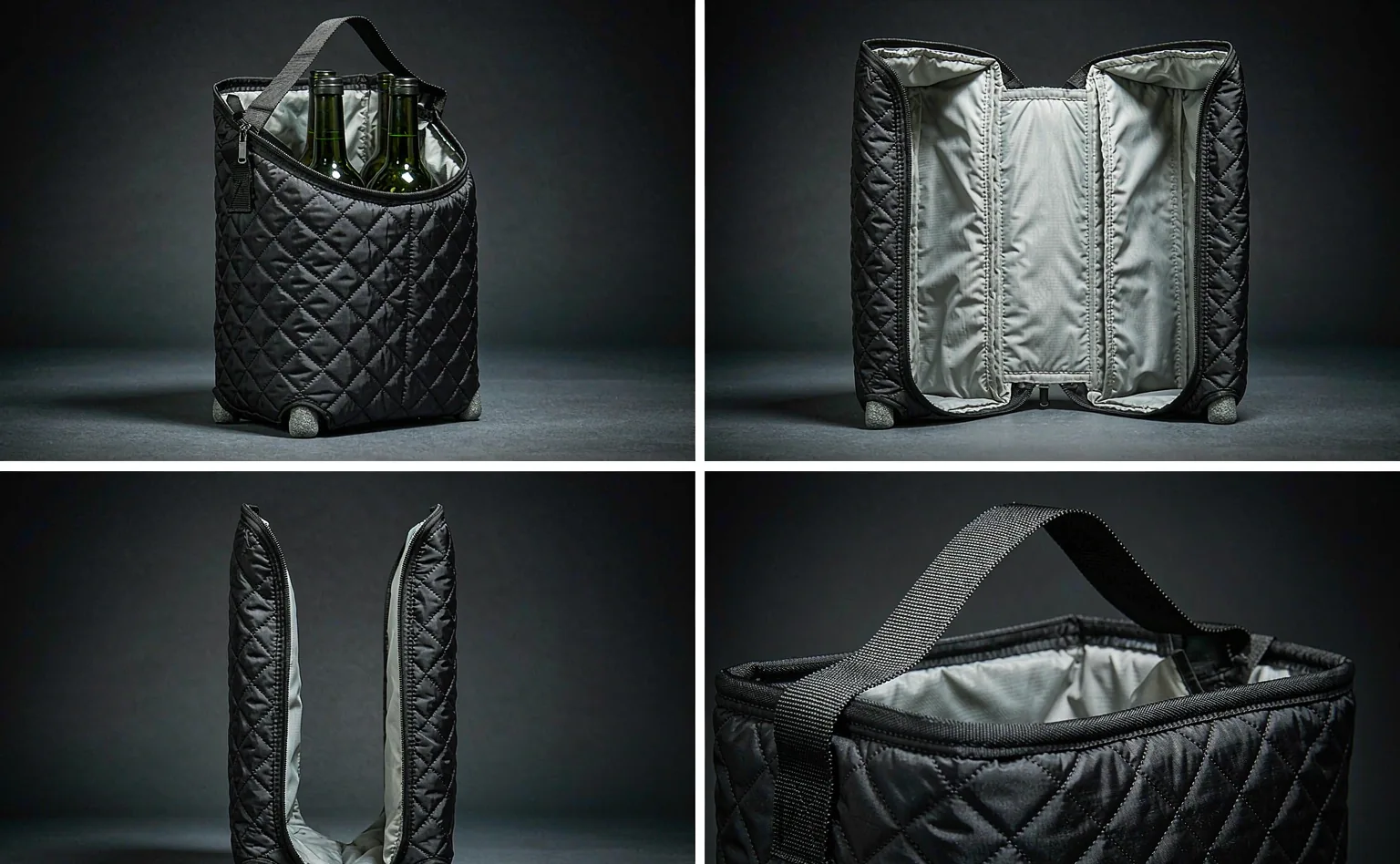
A wine bag tech pack is nine sections and the bottle table is the first. Shape, height, diameter measured with the label and the foil, filled weight. Then internal cell, bag height, divider height, hand gap, handle construction, base construction, the bill of materials, the tolerances, and the test and inspection section. Anything left as a description rather than a number will be decided on the line instead.
A tech pack is not a drawing and it is not a specification sheet; it is both plus the decisions nobody has written down. On a wine bag the decisions that matter most are the ones that are usually left out: which bottle the bag was dimensioned from, whether the divider is full height, and what the handle is attached into. All three are invisible in a photograph of a finished bag and all three are the difference between a first run and a fifth one that matches it.
The bottle dimensions live in the wine bag programme hub and the sampling calendar that runs off this pack is in Wine Bag MOQ and Sampling. What follows is the pack itself, section by section.
What Does a Wine Bag Tech Pack Have to Contain?
Nine sections, in the order a reader needs them: the bottle table, the internal dimensions, the external dimensions, the divider, the handle, the base, the bill of materials, the tolerances, and the test and inspection section. A pack missing any one of the nine will be completed by somebody on the line, and that person will make a decision the programme did not make.
The order matters because of how the pack is read. The bottle table is first because everything else is derived from it. The internal dimensions come next because they are what the customer experiences. The construction comes after that because it is how the dimensions are achieved. Materials and tolerances come last because they are how the construction is held.
The test that a pack is finished is simple and it is worth applying before it is sent: can somebody who has never seen the bag build it from the pack alone, and then measure the result against the pack? If either answer is no, the pack is a drawing with a specification attached rather than a tech pack.
| Section | What it contains | The field most often missing | What happens when it is missing |
|---|---|---|---|
| 1. Bottle table | Every shape: height, diameter, weight | Diameter measured with the label and foil | The cell is cut too tight for the finished bottle |
| 2. Internal dimensions | Cell, height, divider height, hand gap | Divider height in millimetres from the board | The divider stops short and the bottles tilt |
| 3. External dimensions | Width, depth, height, carton | The packed height rather than the empty one | The carton cube is wrong and the freight line moves |
| 4. Divider | Material, thickness, density, assembly, fixing | The density of a foam | The cell loosens over a season |
| 5. Handle | Construction, width, termination, bar-tack pattern | The number of bar-tacks | The count drops when the line is under pressure |
| 6. Base | Insert, thickness, footprint, fixing points | The number of fixing points | The board rotates and the cells go out of square |
| 7. Bill of materials | Every component including board, foam and thread | The board and the thread | A substitution nobody notices until month three |
| 8. Tolerances | A number on every dimension above | A tolerance on thickness as well as on length | A dimension nobody can reject against |
| 9. Test and inspection | Method, criterion, class list, sample size | The class list | A defect that is real and unclassifiable at goods in |
How Is the Bottle Specified on the First Page?
As a table of shapes rather than as a nominal volume, and with four numbers per shape: the name of the shape, the height, the diameter measured at the widest point with the label and the foil in place, and the filled weight. Two physical bottles of every shape accompany the pack, and the pack names them.
The reason the diameter is measured with the label and the foil is that those are the parts that make a bottle wider than the glass. A label adds a millimetre or two, and a sparkling foil over a wire cage adds more. A cell dimensioned from the glass is a cell that will not take the finished bottle without a fight.
The reason the filled weight is in the table is that it sets two things the drawing does not: the handle width and the drop-test band. A 750 ml sparkling bottle at 1.6 kg and a 750 ml still bottle at 1.25 kg are the same volume and they are different structural problems, and the pack has to say which one the bag was built for.
Which Dimensions Are Internal and Which Are External?
Internal dimensions are the ones the bottle touches and they are the ones that decide whether the bag works: the cell, the internal height, the divider height and the hand gap. External dimensions are the ones the carton and the freight care about: the width, the depth, the packed height and the units per carton. Both sets belong on the pack and they are different numbers.
The field that is usually missing from the external set is the packed height rather than the empty one. A bag standing empty is shorter than the same bag with bottles in it, because the bottles lift the base and the mouth. A carton dimensioned from the empty bag is a carton that does not close, and the fix is a re-pack at the warehouse rather than a re-quote.
The second missing one is the hand gap, which is neither internal nor external and belongs in both. It is measured from the rim to the inside of the handle, and 90 mm is the working minimum. It is internal because it decides how the bag is carried and external because it decides how tall the bag is.
How Is the Divider Specified So It Cannot Drift?
By material, thickness, density, height, assembly and fixing — six fields, and the drift happens in the two that are usually left out. Density is the one that lets a foam be substituted for a lower-density one without any visible difference, and height is the one that lets a divider stop 30 mm short of the rim and still photograph well.
Write the height in millimetres from the base board rather than as a proportion of the bag, because the base board is the datum the whole bag is built from. A divider described as full height is a divider whose height depends on how the shell was cut. A divider at 300 mm from the board, plus or minus 2 mm, is a specification.
The assembly and the fixing are the two that decide whether the divider stays put. Slotted and interlocked, slotted into the base board, and the board fixed to the shell at more than one point. A divider described as inserted is a divider that floats, and a floating divider converts every handling event into a load on a seam.
How Are Handle and Base Written as Constructions?
As load paths rather than as parts. The handle entry is the construction — a continuous loop under the base, or two side handles below 4 kg — then the webbing material and width, then the termination, then the bar-tack pattern with a number of tacks and a stitch count, then the reinforcement patch and where it reaches. The base entry is the insert material and thickness, then the footprint, then the number of fixing points.
The two fields that carry the most weight are the ones most likely to be written as descriptions. "Bar-tacked securely" is not a pattern and it does not reproduce on a second run. "Three fixing points" is a number and it does. Where a field can be drawn, draw it rather than describe it — a bar-tack pattern is a rectangle with four crosses in it and it takes ten seconds.
The third is the interface between them, and it is usually on neither entry. A continuous loop is only as good as the board it runs under, so the pack has to say that the handle terminates into the base construction. Where the two are specified independently, the loop pulls the floor up and the load path is never closed.
Writing a wine bag tech pack
- Nine sections, in the order a reader needs them, with the bottle table first.
- Every shape in the range: height, diameter with the label and the foil, filled weight.
- Internal dimensions are what the bottle touches; external ones are what the carton cares about.
- The divider gets six fields, and the two that drift are the density and the height.
- Write the handle and the base as load paths, and draw the bar-tack pattern rather than describing it.
What Materials Belong in the Bill of Materials?
Every component, including the ones nobody thinks of as components: the shell, the lining, the interlining if there is one, the divider, any neck block, the base board, the frame if there is one, the webbing, the thread, the binding, the closure, the label and the print. A bill of materials that stops at the fabric is a bill of materials that cannot hold a reorder.
The two that are most often left out are the board and the thread, and both are load-bearing. The board carries the cell geometry and the handle loop. The thread carries the handle attachment and every seam. A substitution in either is invisible in a photograph and structural in use.
The bill of materials is also the source of the composition statement a retailer will ask for, and it is the reason to assemble it at sampling rather than after the question arrives. A composition statement assembled from a five-line bill of materials is a statement that is wrong, because it names the shell and not the bag.
| Component | Fields to record | Why it is on the list |
|---|---|---|
| Shell | Fibre or polymer, weight or gauge, finish | Decides the print, the lining and the wet-duty |
| Lining | Polymer, gauge, seam method | Decides whether water reaches the foam |
| Interlining | Material and weight | Stops the divider showing through a solid print |
| Divider | Material, thickness, density, height | The part that drifts and the part in the wet |
| Neck block | Material, thickness, profile | Sparkling formats only, and it is a die |
| Base board | Material, thickness, footprint, fixings | Carries the cell geometry and the handle loop |
| Webbing | Material, width, breaking force | The load path |
| Thread | Material and ticket | Carries every seam and the handle attachment |
| Closure | Type, gauge, puller | A network opens what a closure does not hold |
| Label and print | Method, colours, position | The brand, and the thing a customer notices first |
Which Tolerances Need a Number?
Every dimension on the pack, and the tolerance belongs on the thicknesses as well as on the lengths. A cell of 84 mm plus or minus 2 mm is a specification; a cell of 84 mm is a hope. A divider at 3 mm plus or minus 0.3 mm is a specification; a divider at 3 mm is a sheet that will be substituted at 2 mm on the second run.
Three tolerances are worth stating explicitly because they are the ones that accumulate. The cell, because six of them in a row turn 2 mm each into a rattle across the row. The divider height, because it sets where the bottles are held. And the print position, because it is the one a customer sees and the one a goods-in team can check with a rule.
The tolerance that is usually too tight is the one on the external dimensions. A sewn bag is not a machined part and asking for plus or minus 1 mm on a packed height is asking for a re-work rather than for accuracy. Two to three millimetres on a sewn dimension is realistic, and below that the panel has to be jigged.
What Does the Test and Inspection Section Say?
Four things: the method, the criterion, the class list and the sample size. The method is named with the standard — ASTM D5276 for the drop, ISO 2859-1 for the inspection — and the criterion is written so two people reach the same answer: no bottle breakage, no opened seam or closure, no glass exposed.
The class list is the part that is almost always missing and it is the part that decides whether a lot ships. Minor is what a customer will not see at arm length. Major is what they will: a handle attachment that fails the stated pull, a base board that is not fixed, a hand gap below 90 mm, a cell outside tolerance, a divider short of the rim. Critical is what makes the bag unsafe: a seam that releases a bottle at the drop height.
The sample size follows from the lot size and the level: at General Inspection Level II under ISO 2859-1, a 500-piece lot draws code letter H and 50 units, with accept 3 and reject 4 at AQL 2.5 for major defects. Criticals are zero-tolerance at every level. Where the programme wants a tighter figure, the argument for and against AQL 1.5 is set out in AQL 1.5 against AQL 2.5.
How Is Version Control Handled on a Wine Bag Pack?
With a version number, a date, a change log and a named owner, and every version accompanied by a sealed sample. The version number goes on every page, because a pack is printed, annotated and photographed and the three drift apart. The change log records what moved and why, because a change to the divider height is a change to the die and a change to a stitch colour is not.
The sealed sample is the part that makes the system work. One approved bag, signed and dated, held by both sides, referenced by version number. Every later disagreement is settled by measuring the sample rather than by reading the pack, and a sample settles in a minute what a pack argues about for a week.
The second discipline is that a change to a dimension restarts the affected section rather than the whole pack. A change to the cell changes the divider, the external width and the carton. A change to the print does not. Knowing which sections a change touches is what keeps a revision from becoming a re-sampling.
- 1. Bottle table
- Shape, height, diameter with label and foil, filled weight, two physical bottles
- 2. Internal
- Cell with tolerance, internal height, divider height from the board, hand gap
- 3. External
- Width, depth, packed height, units per carton
- 4. Divider
- Material, thickness, density, height, assembly, fixing
- 5. Handle
- Construction, webbing, termination, bar-tack pattern, reinforcement patch
- 6. Base
- Insert material and thickness, footprint, number of fixing points
- 7. Bill of materials
- Every component, including the board, the foam and the thread
- 8. Tolerances
- A number on every dimension, including the thicknesses
- 9. Test and inspection
- Method, criterion, class list, sample size
- Version control
- Number, date, change log, owner, and a sealed sample per version
On the programme side the pack is the document the clock runs from: sampling is 6-10 working days from a signed-off pack with the physical bottles in hand, moving to 12-15 where a die, a shaped block or a sourced component has to be made first. Bulk production is 35-50 days from written sample approval, inspected at AQL 2.5 under ISO 2859-1 General Inspection Level II, on T/T 30/70, FOB Xiamen, at MOQ 500 pcs per style and colourway.
Send the pack with the bottles
Send the bottle shapes and a draft pack and the gaps get marked up against these nine sections within one business day, before the sampling clock starts.
Frequently Asked Questions
What should a wine bag tech pack include?
Nine sections: the bottle table, internal dimensions, external dimensions, the divider, the handle, the base, the bill of materials, the tolerances, and the test and inspection section.
Why does a wine bag tech pack need a bottle table?
Because a nominal volume fixes how much wine is in the bottle and nothing about its shape. The cell, the height and the handle are all derived from the glass.
Should the bottle diameter include the label?
Yes, and the foil and the cage on a sparkling bottle. A cell dimensioned from the glass will not take the finished bottle without a fight.
What is the difference between internal and external dimensions?
Internal ones are what the bottle touches: cell, internal height, divider height, hand gap. External ones are what the carton cares about: width, depth, packed height.
How is a divider specified so it cannot drift?
Six fields: material, thickness, density, height in millimetres from the base board, assembly and fixing. The two that drift are the density and the height.
How should a handle be written on a tech pack?
As a load path: construction, webbing material and width, termination, bar-tack pattern with a number of tacks, and where the reinforcement patch reaches.
Why does the board need to be in the bill of materials?
Because it carries the cell geometry and the handle loop, and a substitution in it is invisible in a photograph and structural in use.
What tolerance is realistic on a wine bag?
Two to three millimetres on a sewn dimension, plus or minus 0.3 mm on a thickness, and two dimensions from two seams for print position. Below that a panel has to be jigged.
What goes in the class list?
Minor is what a customer will not see at arm length; major is what they will; critical is a seam that releases a bottle at the drop height, and criticals are zero-tolerance.
What sample size does a 500-piece wine bag order draw?
ISO 2859-1 at General Inspection Level II: code letter H, 50 units, accept 3 and reject 4 at AQL 2.5 for major defects.
How is a tech pack versioned?
A version number on every page, a date, a change log, a named owner, and a sealed sample per version referenced by number.
Does a change to one field restart the whole pack?
No. A change to the cell changes the divider, the width and the carton. A change to a print does not. Knowing which sections a change touches keeps a revision from becoming a re-sampling.
What is the MOQ and sampling window once the pack is signed off?
MOQ 500 pcs per style and colourway, sampling 6-10 working days with the bottles in hand, and 12-15 where a die or a shaped block has to be made first.
Why do you need two physical bottles of every shape?
Because the pack is dimensioned from the glass and a catalogue figure does not fix a shape. Two bottles let the fit be checked at sampling rather than at goods in.
People Also Ask
What is a tech pack for a bag?
A drawing plus a specification plus the decisions nobody has written down. On a wine bag that is nine sections, starting with a table of the bottles.
What should be on a bag specification sheet?
The bottle table, internal and external dimensions, the divider, the handle, the base, a full bill of materials, tolerances on everything, and the test and inspection section.
Do I need to send real bottles with a tech pack?
Yes, two of every shape. A wine bag is dimensioned from the glass and a nominal volume does not fix a shape.
How do you stop a bag drifting on a reorder?
A full bill of materials with a figure and a tolerance on every line, a sealed sample per version, and written notice before any substitution.
What is the difference between a tech pack and a spec sheet?
A spec sheet has the dimensions. A tech pack has the dimensions, the construction, the materials, the tolerances and the test — which is what a reorder needs.
Sources and further reading
Every figure on this page is either our own programme data or attributed below. Open the originals before you write them into a specification.
- ISO 2859-1:1999 — sampling procedures for inspection by attributesInternational Organization for Standardization
- ASTM D5276 — drop test of loaded containers by free fallASTM International
- CETIE — international technical centre for bottling: bottle finish and dimension data sheetsCETIE (Centre International Technique de l'Embouteillage)