What Are the Real MOQ and Sampling Terms for a Wine Bag?
MOQ and sampling are one calendar rather than two negotiations. The minimum is 500 pcs per style and colourway with 300 pcs open to discussion on a repeat, sampling runs 6-10 working days, and bulk production is 35-50 days from written approval.
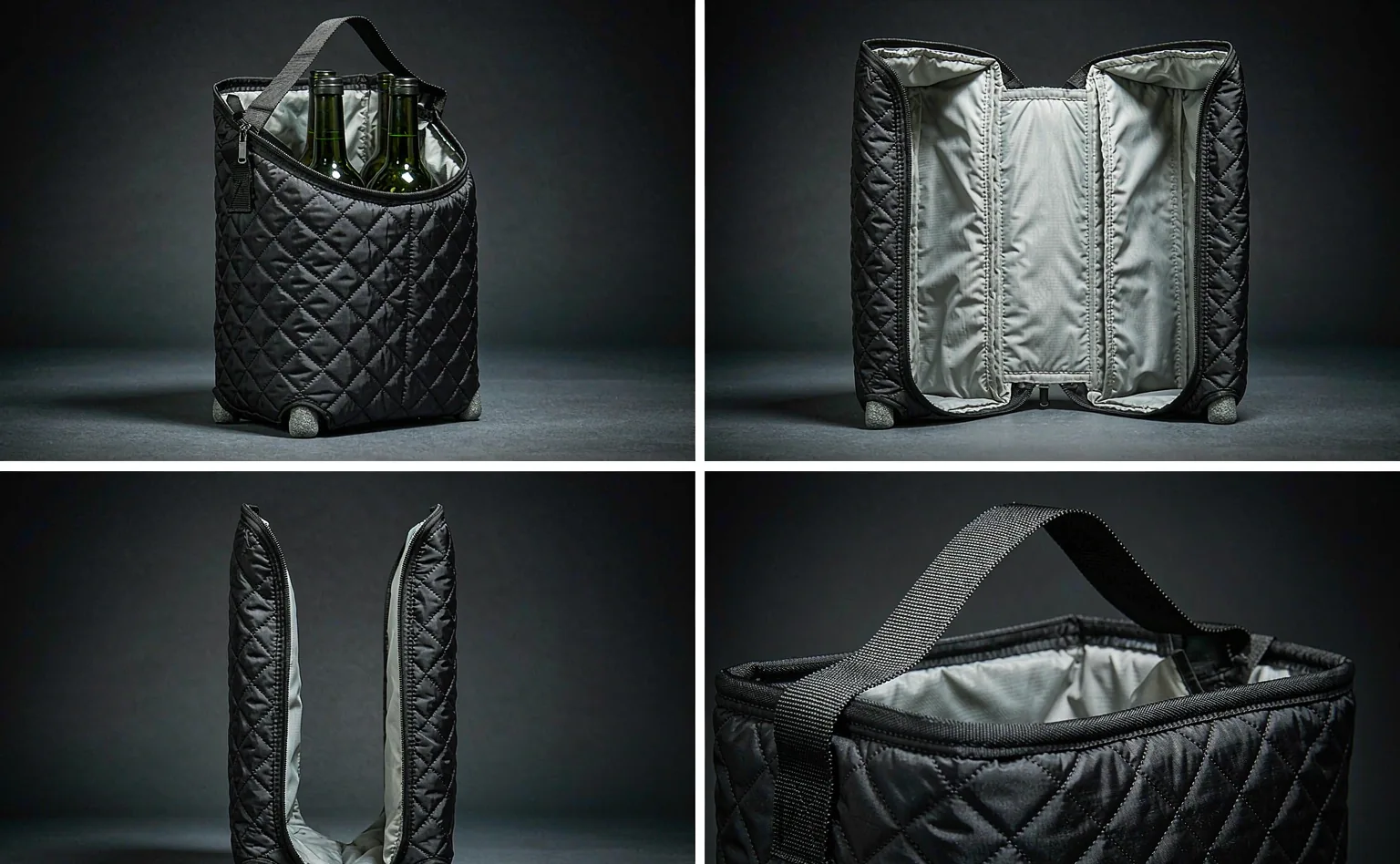
MOQ and sampling are one calendar rather than two negotiations. The minimum is 500 pcs per style and colourway, and 300 pcs can be discussed on a repeat. Sampling runs 6-10 working days from a signed-off tech pack with the physical bottles in hand, moving to 12-15 on a complex build. Bulk production is 35-50 days from written sample approval, and every day added to sampling is a day added to the release date.
Buyers treat the minimum order quantity as a price term and the sampling window as a service term, and both are schedule terms. The minimum exists because of what has to be set up before the first unit can be made, and the sampling window exists because of what has to happen between the first unit and the approval. Neither is negotiable in the way a price is, and both are predictable in the way a schedule is.
This piece sets out why the figures are what they are, what has to be in hand before the clock starts, and how the two numbers combine into the date the programme actually cares about. The rest of the wine category is in the wine bag programme hub.
Why Is the Minimum 500 Pieces Per Style and Colourway?
Because of what has to be set up before the first unit, and the setup is the same whether the order is 500 or 5,000. A wine bag has a panel die, a divider die, a pattern, a print setup and, on a structured build, an assembly jig. Each one is bought, cut or programmed once. Below a certain quantity the setup cost per unit is a larger share of the price than the material, and the unit price stops being meaningful.
The second reason is material. A shell, a lining, a webbing and a board are bought in rolls and sheets with their own minimums, and a colourway is dyed or printed to a shade with a minimum of its own. A 500-piece style is the point at which the material order is a normal purchase rather than a special one, which is also why a repeat can be discussed at a smaller quantity — the material specification already exists.
The third reason is the one buyers find most useful and it is about the line rather than the money: a run below about 500 units does not reach a stable state on a sewing line. The first units off a line are the ones that get the tolerances dialled in, and on a short run the whole order is that part of the run. The defect profile of a very short run is worse, not better.
| Setup item | What it is | When it is paid | What it means for a reorder |
|---|---|---|---|
| Panel die | A cutting die for the shell panels | Once, on the first invoice | Not charged again |
| Divider die | A die for the divider and any neck block | Once, on the first invoice | Not charged again |
| Print setup | Screens, a transfer film or an embroidery file | Once, per artwork | Not charged again unless the artwork changes |
| Material minimums | Roll and sheet minimums, a dyed shade | Per order | Lower on a repeat, because the specification exists |
| Assembly jig | On a structured or a double-walled build | Once, on the first invoice | Not charged again |
| Line setup | Getting the line to a stable state | Per run | The reason a very short run has a worse defect profile |
What Counts as One Style and One Colourway?
A style is one construction: one shell, one divider, one base, one handle and one set of dimensions. A colourway is one shade combination of that style. Two-bottle and six-bottle carriers are two styles even when they share an artwork, because the divider die, the base board and the handle are different. A navy and a natural canvas version of the same bag are two colourways of one style, and each carries its own minimum.
The question that causes the most arguments is whether a print change makes a new style. It does not, if the construction is unchanged: a different brand panel on the same bag is a print setup on one style. It does, if the print changes the substrate or the construction — a different shell to take a different method is a new style with a new material order.
The practical way to plan it is to write the styles and the colourways on the quotation as separate lines, because that is the only form in which the minimum can be checked. A quotation that says 2,000 pieces of wine bags can mean four styles, two styles in two colourways, or one style in four colourways, and the three are different orders with different setup costs.
When Can a Repeat Be Discussed at 300 Pieces?
On a repeat of a style that has already been made, because the setup exists. The dies are cut, the pattern is graded, the material specification is written and the line has run the bag before. What remains is the material minimum and the line setup, and 300 pcs is the point at which those still work.
Three conditions apply and they are worth stating because they are the ones that get missed. The construction must be unchanged, because a changed construction needs a new die or a new jig and it is a first order again. The material must still be available at its minimum, because a shade that was dyed for the first run may have a new minimum. And the artwork must be unchanged, or the print setup is a new line.
The reason to plan the first order around this is simple: a programme that orders 500 of one style and then reorders 300 of the same style has bought 800 units with one setup. A programme that orders 250 of three styles has bought 750 units with three setups. The first is a programme and the second is three samples.
What Has to Be in Hand Before the Sampling Clock Starts?
Four things, and the fourth is the one that is always late. A signed-off tech pack with the dimensions, the materials, the tolerances and the test section. Vector artwork for any print, embroidery or label, with a physical colour reference. The construction decisions that have not been written down — the divider material, the base thickness, the handle. And two physical bottles of every shape the bag has to carry.
The bottles are the one that delays wine programmes specifically and it is worth being blunt about it. A wine bag is dimensioned from the bottle, and the bottle is not a number in a catalogue — a Bordeaux, a Burgundy and a Riesling in the same nominal volume differ by tens of millimetres in height and in diameter. Sampling cannot start on a drawing that says 750 ml. It starts when the glass is on the bench.
The second thing that is late is the decision rather than the object. A tech pack that says "divider to be confirmed" has not started any clock, because the divider is the part with a die. Where a programme wants to sample the shell first and decide the divider later, that is two sampling rounds and two windows, and it is usually the reason a sampling schedule slips.
What Happens During Six to Ten Working Days?
A fixed sequence, and it is worth knowing because it tells you where a change costs time. Material is called in against the specification. The panel and divider dies are cut. A first unit is sewn or assembled, and it is checked against the tech pack rather than against a photograph. The bottles are packed into it and the fit is checked. Any print, embroidery or label is applied. The unit is photographed and sent for approval.
The step that is not visible in the sequence is the fit check with the actual bottles, and it is the one that decides whether the first unit is the one that gets approved. A cell that is 2 mm tight will not take a bottle with a wet label. A divider that is 30 mm short of the rim lets the bottles tilt. Both are found in a minute with the glass in hand and both are invisible in a photograph.
Where the first unit fails the fit check, the clock does not restart; it extends by the length of the correction. That is the useful way to think about the window: 6-10 working days is the time for one correct build, and each correction adds to it. A programme that has made the decisions before the pack is signed off is the programme that lands at six.
| Day | What happens | What can delay it |
|---|---|---|
| 1-2 | Material called in, dies cut | A non-stock shell or a dyed-to-order shade |
| 2-4 | First unit sewn and assembled | A construction decision still open |
| 4-5 | Fit check with the physical bottles | The bottles are not on the bench yet |
| 5-7 | Print, embroidery or label applied | Artwork not vector, or a colour reference missing |
| 7-8 | Photographed and sent for approval | Approval authority not named |
| 8-10 | Corrections, if the first unit was not right | A change to a dimension rather than to a trim |
When Does Sampling Move to Twelve to Fifteen Working Days?
When something has to be made before the unit can be made. A new divider die on a complex grid. A shaped neck block for a sparkling bottle. A moulded base or a frame. A sourced component that is not on the shelf — a specific zip, a magnetic closure, a moulded puller. A dyed-to-order shade or a laminated face. Each of those has its own lead time and each of them is outside the sewing operation.
The second cause is a test rather than a part. A drop test, a logged thermal run or a wash cycle test adds days to the approval rather than to the build, and it is worth planning for explicitly rather than discovering it: a build that is ready on day eight and tested by day fifteen has a sampling window of fifteen working days even though the sewing took six.
The useful discipline is to name the long-lead item at the quotation stage. A programme that knows its neck block die is the long pole can cut it in parallel with the shell sampling, and the two windows overlap rather than stack.
How Many Rounds of Samples Should a Programme Plan For?
Two, and the second one should be planned as a filled pre-production unit rather than as a correction. The first round answers the dimensional questions: does the bottle fit, is the cell right, is the divider full height, does the handle clear the rim. The second answers the production question: is this what the line will make, from bulk materials, with the print applied at production parameters.
The mistake is to use the second round to fix decisions that were left open in the first. A sample round that changes the divider material is a new sampling window, because the divider is the part with a die. A sample round that changes a stitch colour is not. Programme the open decisions into the first round and the second round is a confirmation.
For a wine bag specifically, the pattern that works is one round on the empty bag for construction and one round packed with bottles for fit and for the drop test. The second is the one that approves the build, and an empty bag has approved nothing.
MOQ and sampling as one calendar
- The minimum is 500 pcs per style and colourway because five of the six setup items are one-off.
- 300 pcs can be discussed on a repeat, where the construction, the material and the artwork are unchanged.
- A style is a construction and a colourway is a shade of it: write both as separate quotation lines.
- The sampling clock starts when the physical bottles are on the bench, not when the pack is sent.
- 6-10 working days is one correct build. 12-15 is a build with something made before it.
Who Approves the Sample and What Does Approval Commit?
One named person, and approval should commit the programme to the specification rather than to the object. The distinction matters: approving a sample commits the dimensions, the materials and the tolerances written on the tech pack, and it is those that the bulk run is made to. Approving a photograph commits nothing, because neither side can measure a photograph.
The approval should also start the bulk clock, and it should be written. Approval in writing on a stated date is the event that the 35-50 day bulk window runs from, and an approval given verbally in a meeting and confirmed three weeks later has moved the release date by three weeks. That is the single most common cause of a missed season in this category.
The second thing approval commits is the reference sample. A sealed sample of the approved build, held by both sides, is the object any later disagreement is measured against. Where a programme is going to repeat, that sample is the single most valuable document in the file and it costs nothing to keep.
How Do MOQ and Sampling Decisions Affect the Bulk Window?
They add to it, and the arithmetic is worth doing explicitly rather than feeling. Bulk production is 35-50 days from written sample approval. Add the sampling window, add the approval delay and add the freight transit, and the result is the number of days before the release date that the order has to be placed. On a wine bag programme with a sparkling neck block that is 15 working days of sampling, 50 days of bulk and a month of transit,
that is a hundred days before the shelf date, and a seasonal programme that discovers it in August has missed it.
The lever that is genuinely available is overlap. A neck block die or a divider die can be cut while the shell is being sampled, and a material that is known to be long can be called in at the same time. That is why the long-lead item is named at quotation rather than at sampling: overlap is the only thing that shortens the calendar, and it has to be planned.
The second lever is the reorder, and it is the larger one. A second season on the same style has no die, no new pattern and no new material minimum, so it is a shorter calendar and a smaller quantity. Programmes that plan a second season from the first are the ones that hit their dates, and the mechanism is set out in why bulk takes 35-50 days.
- Styles
- Each construction listed as a separate line, with its own quantity
- Colourways
- Each shade listed, with its own quantity and any shade minimum
- Artwork
- Vector, with a physical colour reference and the method
- Bottles
- Two of every shape, sent before the sampling clock
- Long-lead item
- Named at quotation so it can be cut in parallel
- Sampling
- 6-10 working days, or 12-15 with the reason stated
- Approval
- In writing, on a stated date, by a named person
- Bulk
- 35-50 days from written approval
- Inspection
- AQL 2.5, ISO 2859-1, General Inspection Level II
- Terms
- T/T 30/70, FOB Xiamen, with CIF and DDP available
Send the bottles before you send the pack
Two bottles of every shape and a vector artwork start the clock. Send them with the tech pack and the sampling window is the shortest one available.
Frequently Asked Questions
What is the MOQ for custom wine bags?
MOQ is 500 pcs per style and colourway. On a repeat of a style that has already been made, 300 pcs can be discussed, because the dies, the pattern and the material specification already exist.
Why is the minimum 500 pieces?
Because five of the six setup items are one-off costs: the panel die, the divider die, the print setup, the assembly jig and the line setup. Below 500 the setup is a larger share of the price than the material.
What counts as one style?
One construction: one shell, one divider, one base, one handle and one set of dimensions. A two-bottle and a six-bottle carrier are two styles even with the same artwork.
Does a different colour count as a new style?
No, it is a colourway of the same style, and it carries its own minimum because the material is bought to a shade.
When can a repeat be discussed at 300 pieces?
When the construction, the material and the artwork are all unchanged. Any change to a dimension or a substrate makes it a first order again.
How long does sampling take for a wine bag?
6-10 working days from a signed-off tech pack with the physical bottles in hand. A new divider die, a shaped neck block, a moulded base or a sourced component moves it to 12-15.
What has to be in hand before sampling starts?
A signed-off tech pack, vector artwork with a physical colour reference, the construction decisions written down, and two physical bottles of every shape the bag has to carry.
Why do you need real bottles to sample a wine bag?
A wine bag is dimensioned from the bottle and a nominal volume does not fix a shape. A Bordeaux, a Burgundy and a Riesling differ by tens of millimetres in height and in diameter.
How many sample rounds should a programme plan for?
Two: one on the empty bag for construction and one packed with bottles for fit and for the drop test. The packed one is the one that approves the build.
What does sample approval commit?
The dimensions, materials and tolerances on the tech pack, given in writing on a stated date by a named person. It also starts the 35-50 day bulk window.
Why does approval have to be in writing?
Because the bulk clock runs from it. An approval given verbally and confirmed three weeks later has moved the release date by three weeks.
How long is bulk production?
35-50 days from written sample approval, inspected at AQL 2.5 under ISO 2859-1 General Inspection Level II, on T/T 30/70, FOB Xiamen.
Can sampling and tooling overlap?
Yes, and it is the only thing that shortens the calendar. Name the long-lead item at quotation so the die can be cut while the shell is sampled.
What makes a second season shorter?
No die, no new pattern and no new material minimum. That is why the reorder quantity can be discussed at 300 pcs and why the reorder calendar is shorter.
People Also Ask
What is the minimum order for custom wine bags?
MOQ 500 pcs per style and colourway, and 300 pcs can be discussed on a repeat where the construction, material and artwork are unchanged.
How long does a wine bag sample take?
6-10 working days from a signed-off tech pack with the physical bottles in hand; 12-15 where a die, a shaped block or a sourced component has to be made first.
Why do suppliers need real bottles to quote?
A nominal volume does not fix a shape. Two 750 ml bottles can differ by tens of millimetres in height and diameter, and the bag is dimensioned from the glass.
How many samples do I get before bulk?
Plan two rounds: one empty for construction and one packed with bottles for fit and for the drop test.
How long does production take after approval?
35-50 days from written sample approval, plus inspection at AQL 2.5 and the transit to the destination.
Sources and further reading
Every figure on this page is either our own programme data or attributed below. Open the originals before you write them into a specification.
- ISO 2859-1:1999 — sampling procedures for inspection by attributesInternational Organization for Standardization
- CETIE — international technical centre for bottling: bottle finish and dimension data sheetsCETIE (Centre International Technique de l'Embouteillage)
- FEVE — the European container glass federation: glass container design and specificationFEVE — European Container Glass Federation