How Do You Design a Wine Bag for 750 ml, 1 L and Magnum?
A wine bag is dimensioned from the glass and the nominal volume is the least useful number on the bottle. The cell is eight millimetres over the widest shape, the height comes from the tallest, and the handle and the base follow the heaviest.
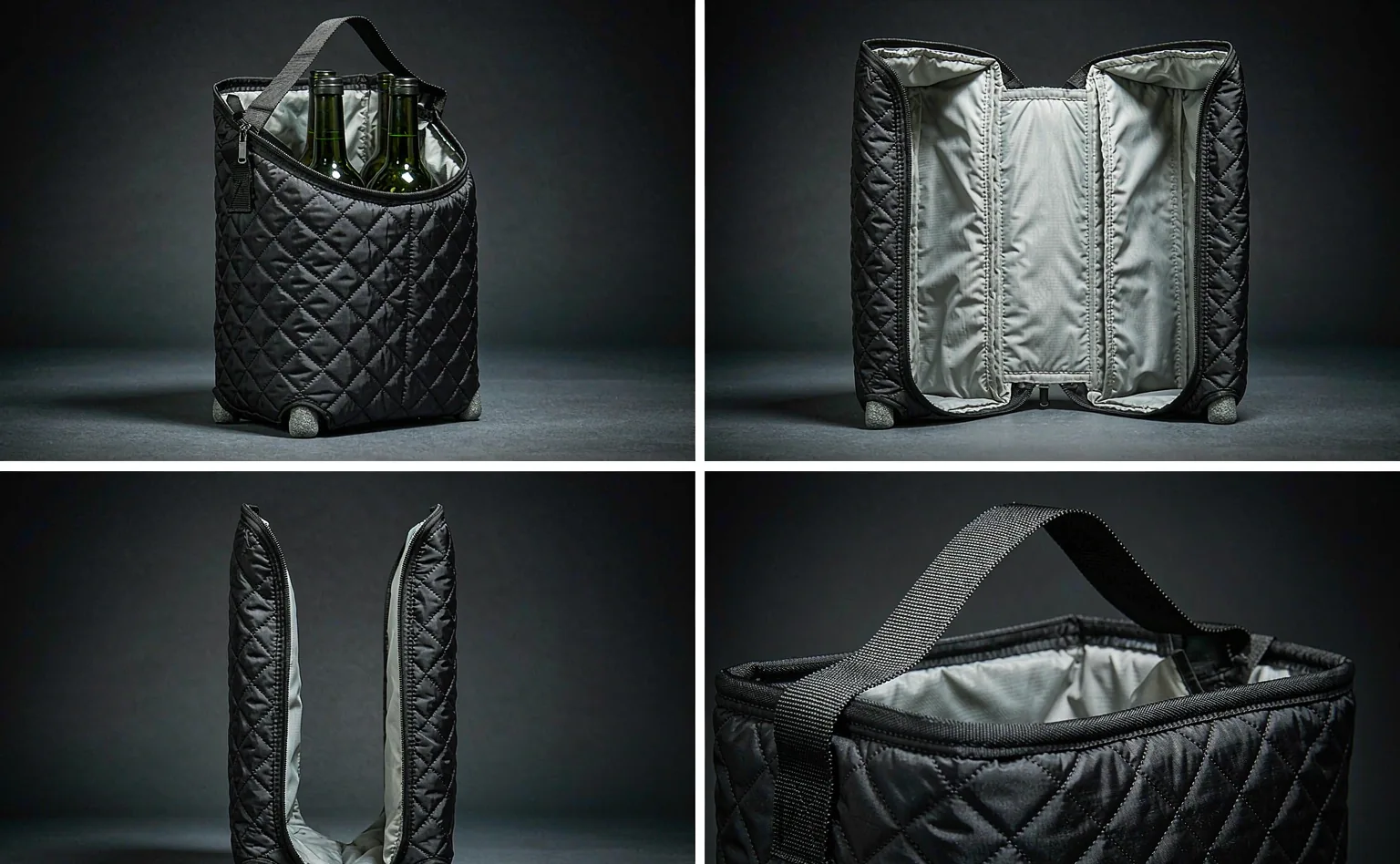
A wine bag is dimensioned from the glass and the nominal volume is the least useful number on the bottle. A 750 ml Bordeaux is about 300 mm tall and 76 mm across; a Riesling in the same volume is about 340 mm and 70 mm; a Magnum is about 370 mm and 100 mm. The cell is eight millimetres over the widest bottle, the height is set from the tallest, and every other dimension follows.
This is the page to read before the drawing is started, because every other specification in the category is downstream of it. The cell width sets the divider. The height sets the handle and the rim. The diameter sets the count and the base. The weight sets the handle width and the drop height. Get the bottle wrong and every one of those is wrong in the same direction.
The count-driven changes that sit on top of this are in 2 vs 4 vs 6-Bottle Wine Totes, and the sparkling geometry is in Champagne Carrier Inserts.
What Are the Real Dimensions Behind Each Nominal Volume?
A nominal volume fixes how much wine is in the bottle and it fixes nothing about the shape. Within 750 ml there are at least four common silhouettes and they differ by more than 40 mm in height and 12 mm in diameter, which is a wider spread than the difference between some adjacent nominal volumes. A bag drawn from a table of volumes rather than from a bottle on the bench will be wrong for at least one shape in the range.
The working dimensions, measured on the glass rather than read from a catalogue: a 750 ml Bordeaux is about 295 to 305 mm tall and 76 mm across the body. A Burgundy in the same volume is about 290 to 300 mm and 82 mm. A Riesling or an Alsace flute is about 325 to 345 mm and 70 mm. A litre bottle is about 330 to 345 mm and 86 mm. A Magnum is about 355 to 375 mm and 100 mm.
The weight follows the glass rather than the volume, and it is the number the bag is actually built around. A 750 ml bottle is about 1.25 kg filled, a litre about 1.6 kg, a Magnum about 2.6 kg, and a sparkling 750 ml about 1.6 kg because the glass is heavier to hold the pressure. A six-bottle Magnum carrier is over 16 kg and it is not a carrying bag at all.
| Shape | Nominal volume | Height | Body diameter | Filled weight | Internal cell |
|---|---|---|---|---|---|
| Bordeaux | 750 ml | 295-305 mm | 76 mm | 1.25 kg | 84 x 84 mm |
| Burgundy | 750 ml | 290-300 mm | 82 mm | 1.25 kg | 90 x 90 mm |
| Riesling flute | 750 ml | 325-345 mm | 70 mm | 1.25 kg | 78 x 78 mm |
| Sparkling | 750 ml | 300-320 mm | 88 mm over the foil | 1.60 kg | 96 x 96 mm |
| Litre | 1 L | 330-345 mm | 86 mm | 1.60 kg | 94 x 94 mm |
| Magnum | 1.5 L | 355-375 mm | 100 mm | 2.60 kg | 110 x 110 mm |
| Half bottle | 375 ml | 240-260 mm | 60 mm | 0.65 kg | 68 x 68 mm |
Why Does the Shape Matter More Than the Volume?
Because the bag is a container around a solid object and the object has three dimensions, two of which the volume says nothing about. The height decides whether the bottle fits at all and whether the rim clears it. The diameter decides how many fit across and how wide the base is. The shoulder profile decides where two bottles will touch. The volume decides none of these.
The consequence for a programme is that a range is specified from its extremes rather than from its typical bottle. The tallest shape sets the bag height and the hand gap. The widest shape sets the cell. Heaviest sets the handle and the drop band. A bag specified from the house shape is a bag that does not fit the Riesling, and the Riesling is always in the range.
The second consequence is that a nominal volume is a legal quantity rather than a design dimension. Nominal quantities for pre-packed products are regulated in the European Union, and what that fixes is how much wine is in the bottle, not what the bottle measures. Design from the glass.
How Is the Internal Cell Calculated From the Bottle?
Eight millimetres over the widest point of the bottle, measured on the bottle with its label and, on a sparkling bottle, with the foil and the cage in place. That gives the working figures in the table above: 84 mm for a Bordeaux, 90 mm for a Burgundy, 78 mm for a flute, 96 mm for a sparkling bottle, 94 mm for a litre and 110 mm for a Magnum.
The eight millimetres is a floor rather than a target, and both directions have a cost. Below it a bottle with a wet label will not drop in, and a wet label is the normal case rather than the exception. Above about 12 mm of total space the bottle has room to accelerate inside the cell before it meets the divider, and the corner drop starts failing for a reason that has nothing to do with the divider material.
Write the cell as a dimension and a tolerance rather than as a dimension. A cell of 84 mm plus or minus 2 mm is a specification; a cell of 84 mm is a hope. On a row of six cells the tolerance accumulates, and 4 mm of drift per cell across a row is a rattle that the customer will hear before they see it.
What Height Should the Bag Set for a Mixed Range?
The tallest bottle in the range plus a rim distance, and the rim distance is the part that gets forgotten. A Riesling flute at 345 mm needs a bag with an internal height of about 355 mm to clear it and leave a rim the hand can get over. Set the height from the house Bordeaux at 305 mm and the flute stands 40 mm proud of the rim, which is a bag that looks wrong and a bottle that gets carried by the neck.
The second height decision is the divider, and it is separate from the bag height. The divider should be full height, meaning it reaches the rim, because a divider that stops 30 mm short lets the bottles tilt until glass meets glass. Write the divider height in millimetres from the base board, with a tolerance, because it is invisible in a photograph of the finished bag.
The third is the hand gap, and it interacts with the height: 90 mm between the inside of the handle and the rim, set against the tallest bottle in the range. Set it against a short shape and the tall one gets carried by the rim, which is not a load path at all.
How Does a Magnum Change the Handle and the Base?
It changes both and it changes the category of the object. A Magnum is about 2.6 kg filled, so four of them are over 10 kg and six are over 16 kg. At that weight the bag is a shipper with a handhold rather than a carrying bag: the handle is a grab point for moving it rather than a strap for carrying it across a room, and the base is a frame rather than a board.
The handle answer is a continuous loop or a pair of reinforced handholds in the side panels, and both have to be tested to a stated pull force with a stated dwell. A Magnum carrier that relies on two webbing handles stitched to the panels is relying on a seam in peel at over 10 kg, and that is the failure the drop test finds at the corner.
The base answer is a frame rather than a flat panel: a turned-up edge, a moulded tray, or a board with a support under the middle of the span. At 2.6 kg per bottle the point load at the centre of a long span is large, and a flat board bowing between two fixings is the failure. The drop height also falls: a six-Magnum shipper is above 9.5 kg, so the height commonly set is 300 mm rather than 460 mm.
Dimensioning a wine bag from the glass
- Measure the bottle; a nominal volume fixes how much wine is inside and nothing about the shape.
- The cell is eight millimetres over the widest bottle, with the label and the foil on.
- Set the height from the tallest shape in the range and add a rim distance the hand can clear.
- The divider is full height, in millimetres from the base board, with a tolerance.
- A Magnum carrier is a shipper with a handhold: a frame in the base and a tested grab point.
Can One Bag Carry 750 ml and a Litre?
Yes, and it is the most common mixed requirement in the category, because a litre bottle is about 86 mm across and a Bordeaux is 76 mm. A cell cut at 94 mm takes both. The cost is the space around the 750 ml bottle: 18 mm of it, which is above the 12 mm at which a bottle starts to accelerate in its cell and the corner drop starts to fail.
The fix is a spacer rather than a compromise. A removable insert that narrows the cell for the 750 ml bottle, or a divider with a second position, keeps both shapes held. It is one extra component and one extra operation, and it is the difference between a bag that fits both and a bag that fits one well.
The height is the easier part: a litre at 345 mm and a Bordeaux at 305 mm are within 40 mm, so a bag set to the litre height carries both with the shorter bottle sitting deeper. Where the range also includes a Riesling flute, that is the tallest of the three and it sets the height.
What Neck and Shoulder Space Does Each Shape Need?
The shoulder is where two bottles meet and it is the part of the bottle that is most often ignored, because it is not on any specification sheet. A Bordeaux has a long, gentle shoulder that starts high on the body and a pronounced neck; a Burgundy has a sloped shoulder; a flute has almost no shoulder at all and a long neck; a sparkling bottle has a sharp shoulder and a thick neck under a foil.
What follows from it is the divider height and, on a sparkling bottle, the neck block. Two flutes side by side touch along their bodies and a body-height divider keeps them apart. Two sparkling bottles touch at the shoulder, which is higher, so the divider has to reach the shoulder and a shaped block has to bear on the curve. That is the whole argument in Champagne Carrier Inserts.
The neck itself needs space at the top of the bag, and it is the reason a bag that is exactly bottle height is a bag that will not close. Where the mouth closes over the bottles, the closure needs the neck length plus a working distance, and on a tall flute that is 60 mm above the shoulder.
| Range | Tallest shape | Widest shape | Heaviest shape | What each one sets |
|---|---|---|---|---|
| Still 750 ml only | Riesling flute, 345 mm | Burgundy, 82 mm | 1.25 kg | Height from the flute, cell from the Burgundy |
| 750 ml and 1 L | Litre, 345 mm | Litre, 86 mm | 1.60 kg | A 94 mm cell and a spacer for the 750 ml bottle |
| Still and sparkling | Riesling flute, 345 mm | Sparkling, 88 mm over the foil | 1.60 kg | A 96 mm cell, a neck block and a shoulder-height divider |
| Including Magnum | Magnum, 375 mm | Magnum, 100 mm | 2.60 kg | A shipper with a handhold and a framed base |
| Including half bottles | Riesling flute, 345 mm | Burgundy, 82 mm | 1.25 kg | A separate small format, or a spacer in the same cell |
How Are Half Bottles and Splits Handled?
Usually as a separate format rather than as a spacer in the same bag, and it is worth saying why. A half bottle is about 250 mm tall and 60 mm across, which is 95 mm shorter and 22 mm narrower than a standard bottle. A spacer that closes that gap is a large piece of material sitting in a bag that was built for something twice the size, and it is a bag that looks wrong when it is empty.
A two-bottle half-bottle bag is a different product with a different cell — 68 mm — and a different height, and it is a reasonable addition to a range rather than an accommodation inside one. Where a programme sells a half bottle at all, it usually sells it as a pair, and a two-bottle half format is the natural bag for it.
The one case where a spacer is the right answer is a mixed case: a shipper carrying a full-size bottle and two halves, where the halves share a cell and a shaped insert holds them. That is a shipper design rather than a bag design and it is built once, tested once and shipped as a case.
What Belongs on the Drawing for a Mixed-Size Programme?
A bottle table rather than a single bottle dimension, with the shape named, the height, the diameter measured with the label and the foil, and the filled weight. Then the cell, the bag height, the divider height and the hand gap, each as a dimension with a tolerance. Then the handle and the base, set from the heaviest shape in the range rather than from the typical one.
The second thing that belongs on the drawing is which bottle the bag was tested with. A drop test on a Bordeaux does not cover a flute, and the flute is the one with the shoulder in a different place. Where a range has four shapes, test the two extremes rather than the house shape.
The third is a note about what happens when the range changes, because it always does. A new supplier, a new vintage, a new shape — and a bag built to the old glass does not fit the new. Where the range is likely to move, a slotted divider with a die that can be re-cut is more forgiving than a moulded cell, and the re-cut is a fraction of a new tool.
- Bottle table
- Every shape: name, height, diameter with label and foil, filled weight
- Internal cell
- Eight millimetres over the widest shape, with a tolerance
- Bag height
- From the tallest shape, plus a rim distance the hand can clear
- Divider height
- Full height, in millimetres from the base board, with a tolerance
- Hand gap
- 90 mm minimum, set against the tallest shape in the range
- Handle
- Set from the heaviest shape: 25 mm below 4 kg, 38 mm or padded above 6 kg
- Base
- Board thickness and fixing points from the span and the heaviest weight
- Drop height
- From the filled weight of a production unit, not from the glass alone
- Test bottles
- Named: which two shapes the drop test was run with
- Change note
- What happens to the divider die if the glass changes
On the programme side the frame is unchanged and worth restating: MOQ 500 pcs per style and colourway, sampling 6-10 working days from a signed-off tech pack with two physical bottles of every shape in hand, bulk production 35-50 days from written sample approval, inspection at AQL 2.5 under ISO 2859-1 General Inspection Level II, T/T 30/70, FOB Xiamen. The two bottles per shape is not a formality — it is the thing the whole drawing is built from.
Draw from the glass, not from the catalogue
Send two bottles of every shape in the range with the labels and foils on. You get a cell, a height, a divider and a handle set from the extremes, within one business day.
Frequently Asked Questions
What size wine bag do I need for a 750 ml bottle?
An internal cell of about 84 mm for a Bordeaux, 90 mm for a Burgundy and 78 mm for a Riesling flute, and an internal height set from the tallest shape in the range.
Are all 750 ml wine bottles the same size?
No. A Bordeaux is about 300 mm tall and 76 mm across; a Riesling flute in the same volume is about 340 mm and 70 mm. Within one nominal volume the spread is wider than some adjacent volumes.
How much space does a bottle need in its cell?
Eight millimetres over the widest bottle, measured with the label and the foil on. Above about 12 mm the bottle accelerates inside the cell and the corner drop starts to fail.
Can one wine bag fit 750 ml and 1 litre bottles?
Yes, with a 94 mm cell and a removable spacer for the 750 ml bottle, because a lit bottle left in a 94 mm cell has 18 mm of space around it.
What size is a Magnum wine bottle?
About 355 to 375 mm tall and 100 mm across, at about 2.6 kg filled. Four Magnums are over 10 kg, so the bag is a shipper with a handhold rather than a carrying bag.
How much does a bottle of wine weigh?
About 1.25 kg filled for a 750 ml bottle, 1.6 kg for a litre or a sparkling 750 ml, and 2.6 kg for a Magnum.
Should the divider be full height?
Yes. A divider 30 mm short of the rim looks the same on a drawing and lets the bottles tilt until glass meets glass.
What is a hand gap and what does it depend on?
The clear space between the handle and the rim, and 90 mm is the working minimum. Set it against the tallest bottle in the range, not against the house shape.
Which bottle sets the bag height?
The tallest one. A Riesling flute at 345 mm sets a height that a Bordeaux at 305 mm sits comfortably inside.
Do half bottles need their own bag?
Usually yes. A half bottle is about 250 mm tall and 60 mm across, and a spacer that closes that gap is a large piece of material in a bag built for something twice the size.
What happens if the glass changes after the bag is tooled?
A slotted divider with a die that can be re-cut is the forgiving answer; a moulded cell has to be re-tooled. The re-cut is a fraction of a new tool.
Which bottles should a drop test use?
The two extremes of the range rather than the house shape. A test on a Bordeaux does not cover a flute, and the flute has its shoulder in a different place.
What is the MOQ for a wine bag sized to a mixed range?
MOQ is 500 pcs per style and colourway, and 300 pcs can be discussed on a repeat. Send two physical bottles of every shape before the sampling clock starts.
How long does sampling take for a multi-shape programme?
6-10 working days with the bottles in hand. A spacer or a second divider position usually sits at the 12-15 working day end, because there is a second die.
People Also Ask
What size bag fits a 750 ml wine bottle?
An internal cell of about 84 mm for a Bordeaux and 90 mm for a Burgundy, with a height set from the tallest bottle in the range.
Are all wine bottles the same height?
No. Within 750 ml the spread runs from about 290 mm for a Burgundy to about 345 mm for a Riesling flute.
Will a wine bag fit a Magnum?
Only a bag built for one. A Magnum is 100 mm across and about 2.6 kg filled, so it needs a 110 mm cell, a framed base and a handhold rather than a strap.
Can one bag fit 750 ml and 1 litre?
Yes with a 94 mm cell and a removable spacer for the smaller bottle, because 18 mm of space around a bottle is too much on its own.
How much does a full wine bottle weigh?
About 1.25 kg for 750 ml, 1.6 kg for a litre or a sparkling 750 ml, and 2.6 kg for a Magnum.
Sources and further reading
Every figure on this page is either our own programme data or attributed below. Open the originals before you write them into a specification.
- CETIE — international technical centre for bottling: bottle finish and dimension data sheetsCETIE (Centre International Technique de l'Embouteillage)
- Directive 2007/45/EC — nominal quantities for prepacked productsEuropean Union, EUR-Lex
- Glass Packaging Institute — glass container design and specificationGlass Packaging Institute